
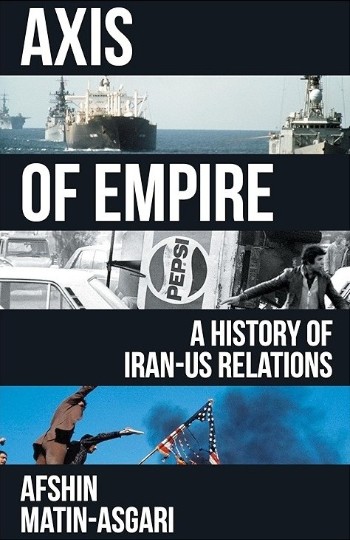
 Afshin Matin-Asgari, Axis of Empire: A History of Iran–US Relations (London: Verso 2026), 304pp.
This important history highlights how constant imperialist interventions in Iran since World War II have repeatedly damaged the country’s development, finds Zahid Rahman
Since the Iranian Revolution in 1979, Iran has been the ominous bogeyman in the Middle East for Western powers. In the years following the War on Terror, this caricature has hardened into an image of a timeless, irrational theocracy bent on the destruction of Western civilisation. Afshin Matin-Asgari’s new book, Axis of Empire, decisively challenges this narrative. As violence engulfs the Middle East following the latest US-Israeli attacks in late February, the book exposes a long history of American intervention and hubris that explains today’s crisis.
For much of the late nineteenth and early twentieth centuries, Iran’s relationship with the US had little political substance. It was shaped almost entirely through the activities of Protestant missionaries in Iran. Their contribution to Iranian society was carried out mainly through schools that educated students from notable and wealthy families. Since the French invasion of Egypt in 1798, Orientalist assumptions dominated European and American perceptions of the Middle East in general. The people of the region were viewed as ‘filthy, brutish, ignorant, unprogressive [and] superstitious’ by one American writer (p.11). Whilst the Russian Empire and Britain competed for influence over the country, for many Iranians, the US was a distant power, largely uninvolved in the upheavals that rocked the country in the first decades of the twentieth century.
This status quo changed in World War II. Iran was occupied by the Allied powers to establish a ‘Persian corridor’. Military aid was delivered to the Soviet Union via the Trans-Iranian Railway. The son of the Shah that was deposed in the invasion, Mohammed Reza, was installed as a constitutional monarch. During the war years, the socialist Tudeh (Masses Party) was beginning to gain momentum. It campaigned on a platform that supported land reform and oil nationalisation. However due to its close alignment with the Soviet Union, particularly its support for a Soviet oil concession (although it was committed to nationalisation) and Soviet interference in the country’s provinces of Azerbaijan and Kurdistan, the party began to lose support.
Mosaddegh and the 1953 coup
In 1949, the National Front was established under the leadership of Mohammad Mosaddegh. This was a loose coalition that ranged from right-wing Islamists to a left-wing splinter of the Tudeh Party. In April 1951, the Iranian parliament voted to nationalise the country’s oil industry and Mosaddegh became prime minister. In response, Britain and the United States intensified diplomatic pressure. Although aware of growing US hostility, Mosaddegh vacillated, as many leaders whose interests are tied to the middle classes often do. He failed to remove the Military Assistance Advisory Group (MAAG), a US-linked programme embedded within Iran’s armed forces. When an attempted military coup was launched, the Shah panicked and farcically fled the country on the first day, 16 August. This was after Mosaddegh had been forewarned of the plot by Tudeh networks within the military.
At this moment, Mosaddegh could have declared a republic, as many Iranians wished. Instead, he sent the Shah a telegram assuring him of his throne. On 18 August, following a meeting with the American ambassador, Mosaddegh banned anti-monarchist and anti-American demonstrations. This decision to suppress a supportive mass movement allowed the second military coup attempt to succeed. The Shah was brought back to power.
It is usually assumed that following the 1953 American-led coup, the Islamic Revolution in 1979 and clerical dictatorship that followed was inevitable. Asgari notes that there was no single imperative that necessitated that prospect, and Iranian history had several opportunities to take different turns.
After the coup, the United States set about building a ‘cold-war client state’. The Shah dramatically increased military spending, which grew more than tenfold by the time of his overthrow. Military aid accounted for 45% of the total US grants to Iran. The result of this militarism was Iran having the largest navy in the Gulf and the most powerful air force in West Asia. This militarisation served three purposes: to keep the Shah dependent on the United States, to sustain his rule domestically and to maintain Iran as a regional bulwark against the Soviet Union. The viciously repressive state security service, Savak, was trained by instructors from the United States, France, Britain, Israel and West Germany.
In the early 1960s, both countries recognised the imperative to modernise Iran. Though the Tudeh Party was officially banned, it retained much influence underground. Its lingering presence made the prospect of leftist mobilisation a considerable concern. The Kennedy Administration helped the Shah launch the White Revolution in 1963. The measures included land reform, literacy drives, women’s enfranchisement, and the nationalisation of forests. The reforms of the White Revolution were designed ‘to forestall a red one’ (p.127). Yet, while the reforms helped modernise Iran, they blighted one of the Shah’s key constituencies, the large landowners. Tudeh, as mentioned above, had close links to the Soviet Union. The Americans were operating through cold-war logic in helping to reform Iran to shore up the Shah.
Further on, Asghari narrates the events of 1979. The revolution managed to remove the Shah from power in January but the post-revolutionary state was unable to assert its authority across the country. Moreover the revolution fragmented into three different factions: a group of hardline clerics from the Islamic Republican Party; a disparate coalition of secular and Islamist leftists; and secular and religious nationalists. The first and second groups came into conflict whilst the third was largely marginalised. In urban centres, workers and soldiers began forming elected councils (shuras, often compared to the soviets of revolutionary Russia) to manage local affairs. Across the countryside peasants were seizing land and Tehran itself doubled in size. Leftist groups increasingly made economic demands and called for an end to military, intelligence and diplomatic cooperation with the US. Yet the clerical establishment actually tried maintaining the close links the Americans had to the country’s armed forces and allowed the Americans to keep spy stations on the Soviet border.
Khomeini’s regime
As 1979 progressed, the relationship with the US became a political football. In an attempt to bolster anti-imperialist credentials and outbid the leftists, Khomeini’s Islamic Republican Party decided to seize the American Embassy and take those inside hostage. This was the act that decisively severed the relationship with the US and set the stage for the decades of hostility that followed.
Khomeini succeeded in creating a force to protect his version of the revolution, the Revolutionary Guards. The Shuras that were formed during the revolution were replaced by Islamic Councils, closing off the possibility of a worker-led settlement of the revolution. Newspapers were suppressed and the left was driven off university campuses, their long-time strongholds. The Iran-Iraq War in 1980 simultaneously threatened the new regime but gave it the opportunity to escalate repression at home.
The Iran-Iraq War (1980-88) was another cruel reminder to Iranians about US imperialism. When Iraq began to lose the war, the United States along with European and Gulf countries helped Saddam financially and militarily so as to be able to continue. A CIA operative once suggested this was to let the countries ‘kick the shit out of each other’ (p.219). The US even directly intervened in the war by sinking several Iranian naval vessels in the Gulf. Furthermore Britain and Germany help supply Iraq with the resources needed to make chemical weapons. The war resulted in half a million Iranian casualties and helped to entrench anti-American sentiments in the Iranians of that generation.
Another key argument Asgari makes is that sanctions have strengthened the Iranian regime. He contends that the sanctions have not functioned as a means of constraining the regime, but rather helped to increase the regime’s control through its ‘resistance economy’. Major sectors of the Iranian economy like energy, armaments and electronics are dominated by the Islamic Revolutionary Guard Corps itself. Iran was forced to become more self-reliant.
The protracted economic war in which the US has tried to bring about regime change has instead caused the indefinite securitisation of the Iranian state. This allows them to crush internal dissent more effectively. This book was written before the uprising that began last December, but those demonstrations were a direct result of US sanctions that collapsed the Iranian currency’s exchange rate. Those protests show that even the ‘resistance economy’ had its limitations and sanctions were still very damaging in Iran.
This book is an excellent guide to understanding the complex history of US-Iranian relations. Whilst the US and Israel continue to seek regime change, Iran – backed into a corner – is trying to impose a significant cost on the Americans and the broader world, especially the Gulf States in the hope of the regime’s survival. The future of Iran and the wider region remain uncertain.
Before you go
The ongoing genocide in Gaza, Starmer’s austerity and the danger of a resurgent far right demonstrate the urgent need for socialist organisation and ideas. Counterfire has been central to the Palestine revolt and we are committed to building mass, united movements of resistance. Become a member today and join the fightback.
