
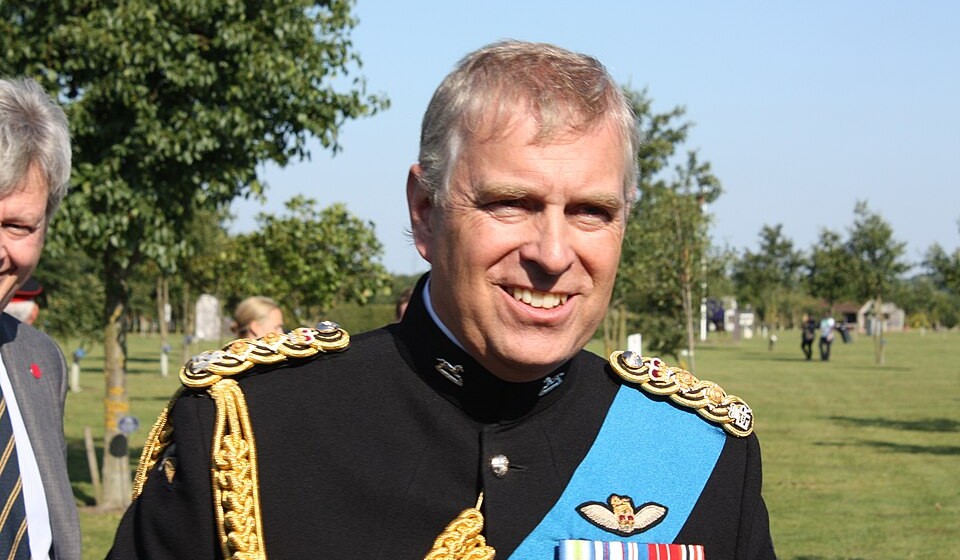
 Prince Andrew in 2011. Photo: Wikimedia Commons CC BY 3.0
The most serious crisis for the monarchy in modern times keeps delivering new blows to the institution and raises questions about its survival argues John Rees
Britain’s monarchy has been shaken to its foundations by the arrest of King Charles’s younger brother, Andrew Mountbatten‑Windsor, on suspicion of misconduct in public office. Blanket coverage in the press in this country and around the world reflects the depth of the crisis afflicting the monarchy.
In a statement on Thursday, the King completed the process of cutting the former Prince Andrew out of the Royal Family completely, saying that the law must take its course.
This is a crisis which is likely to be a long-running saga. Andrew Mountbatten-Windsor is being investigated for leaking confidential information to the convicted paedophile Jeffrey Epstein while he was a government appointed trade envoy. But the former prince has yet to be charged, or appear in court, let alone be convicted, or sentenced. Each stage of that process will be attended by more adverse publicity and more questioning of the institution of the monarchy.
Andrew has a long and disreputable record. His appointment as trade envoy was opposed, according to the Daily Telegraph, by his brother the then Prince Charles, but over ruled by his mother the Queen and Peter Mandelson. As the UK’s trade envoy, he used his position to facilitate connections between British arms manufacturers and foreign officials, including in Saudi Arabia, Yemen, and Kyrgyzstan. His trips frequently included visits to nations known for authoritarian rule, such as Yemen in 2009-10 and various meetings with Gulf state representatives.
Arms and weapons were Andrew’s speciality; wherever the then Prince went, arms deals would follow. In 2008, he was reported to have criticised the UK’s Serious Fraud Office (SFO) investigation into bribery allegations against British Aerospace (BAE) regarding a deal with Saudi Arabia, even describing the work of investigators as having ‘spoiled’ the deal. Due to his controversial connections and continued, politically embarrassing interactions, he was pressured to step down as the UK’s special trade representative in 2011.
All this has had its effect on public opinion. Some 91 percent of Britons now say they have a negative opinion of the ex-Prince, up from 87 percent in August and the highest ever recorded by YouGov. This shift is even more acute when looking at those who see the former Duke of York very negatively, which has increased from 69 percent to 81 percent. Only 4 percent of Britons see Andrew favourably, the joint-lowest on record.
A separate recent Yougov poll found the public are divided on the King’s handling of the matters surrounding Prince Andrew, with 40 percent saying he has managed the issue well but 32 percent saying he has done so badly.
But Andrew isn’t the only PR problem the royals have. Queen Camilla remains a divisive figure, with less than half of Britons, 45 percent, viewing her positively and over 40 percent seeing her negatively. Prince Harry and Meghan, Duchess of Sussex, are still seen negatively by most Britons, with the public seeing Harry negatively by 58 percent to 30 percent and Meghan by 66 percent to 21 percent. The wave of unpopularity has so far left the institution of the monarchy as a whole still with majority support, but even here more than a third of citizens have a negative attitude to the whole idea of the monarchy.
In a different, authoritative, study by the National Centre for Social Research conducted before the current crisis in autumn 2023, showed that just over half of people in Britain now believe that it is ‘very’ or ‘quite important’ for Britain to have a monarchy. This is the lowest proportion to be recorded by the survey since it first asked the question in 1983. Back then, as many as 86 percent said that it was important for Britain to have a monarchy. Support for the monarchy has been in decline over the last decade or so. As recently as 2012, around three-quarters still said having the monarchy was ‘very’ or ‘quite important’.
The British monarchy has been protected by a secretive aura, obsequious politicians who did nothing to challenge this, and a bogus sense of service and dedication in order to justify its great wealth and privilege. The late Queen’s longevity and her connection with the generation that lived through the Second World War enhanced many people’s view of the dysfunctional Windsor family. That has now changed. Four years after the death of Queen Elizabeth II the truth is that the monarchy is in deep trouble. Charles is not as popular as his mother, his Queen is actively disliked, so are other members of the royal family and now, unprecedently, he has had to expel his own brother from the tribe.
Indeed harking back to precedent takes many to the uncomfortable fact that the last monarch so detained in 1647 lost his head two years later, and England became one of the first republics. Demands for abolition of the monarchy and the House of Lords must surely increase in the wake of this scandal.
Reinventing the Royal Family has a long tradition in the English establishment. That task has never looked more difficult.
Before you go
The ongoing genocide in Gaza, Starmer’s austerity and the danger of a resurgent far right demonstrate the urgent need for socialist organisation and ideas. Counterfire has been central to the Palestine revolt and we are committed to building mass, united movements of resistance. Become a member today and join the fightback.

John Rees
John Rees is a writer, broadcaster and activist, and is one of the organisers of the People’s Assembly. His books include ‘The Algebra of Revolution’, ‘Imperialism and Resistance’, ‘Timelines, A Political History of the Modern World’, ‘The People Demand, A Short History of the Arab Revolutions’ (with Joseph Daher), ‘A People’s History of London’ (with Lindsey German) and The Leveller Revolution. He is co-founder of the Stop the War Coalition.