
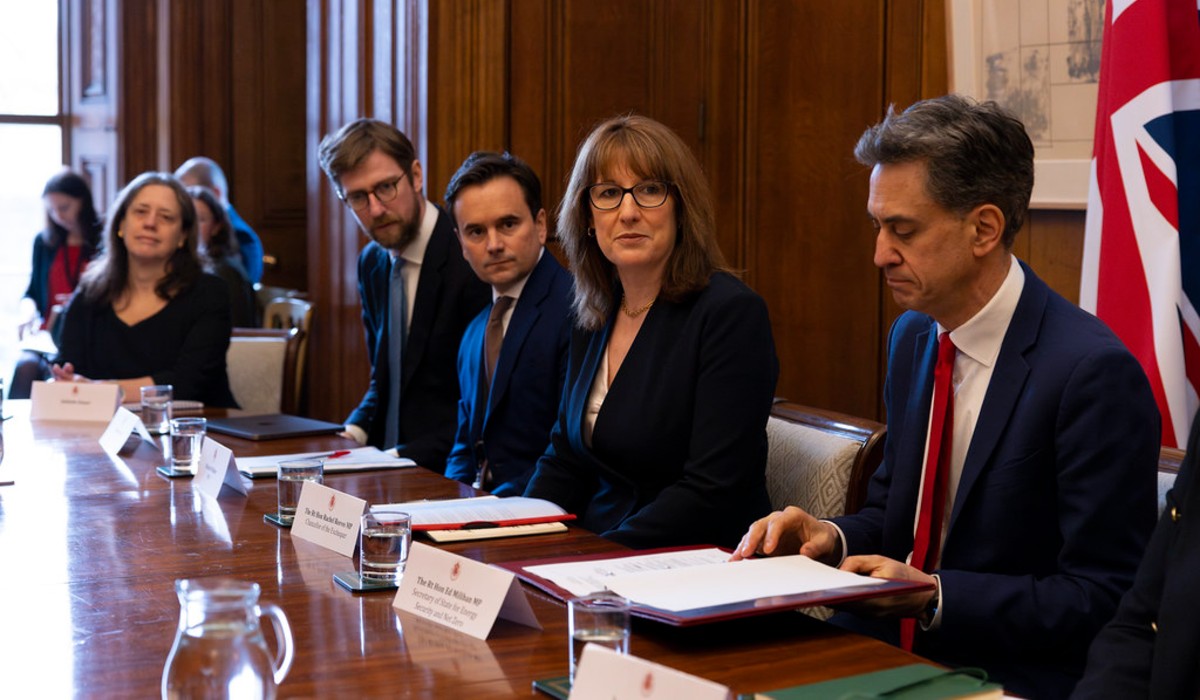
 Rachel Reeves and Ed Miliband host a roundtable for energy providers. Photo: HM Treasury / Flickr / CC BY-NC-ND 4.0
The government’s feeble response to the looming energy crisis reflects the bankruptcy of their economic ideas. It’s time to remove profit making from the sector, argues Kevin Crane
In 2022, when Russia invaded Ukraine, there was an inevitable, and indeed intentional, shock to world energy markets. Sanctions on Russian gas, followed by the blowing up of the Nord Stream pipeline by Ukrainian agents (presumably with American backing), caused global prices to skyrocket. Nowhere was unaffected, but Britain proved to be especially vulnerable.
Britain’s electricity generation and home heating and cooking are heavily dependent on gas, making it nothing short of surreal when we were told that in the decade running up to war, the government had actually been reducing the country’s gas storage capacity. The Tory government responsible was, by that point, locked in turmoil caused by Boris Johnson’s personal scandals and then a farcical leadership race which saw Liz Truss campaign to get the job of prime minister for roughly 2.5 times the number of days she managed to retain the office. The public could almost not have feared having less capable leadership to deal with such an emergency.
The anger about rocketing household bills was threatening to spill over into mass resistance. A non-payment campaign called ‘Don’t Pay UK’ gained a large amount of popular traction, and while we do not know if mass non-payment would actually have occurred, it was clear that the energy companies were genuinely afraid that it might. Against this backdrop, and despite the ultra-free-market politics that Truss championed (to the destruction of her career), the Tories found themselves pushed into a solution to which they were ideologically opposed. They intervened directly into the market to control prices: it was the least-worst option, from their perspective, which just about let them scrape through the turmoil of the end of that year and set Rishi Sunak up for his own hapless stint in Number Ten.
Price controls on energy didn’t last, of course, and Sunak’s government got right back to allowing the energy companies to profiteer as before so soon as the market stabilised. He didn’t really have much else to say about the situation, other than that he was going to authorise new drilling licenses for North Sea oil and gas. This drew applause from much of the climate-change denialist political right but ultimately came to nothing. Partially, this was because there was considerable scepticism that any fossil-fuel reserves that remain within British waters can be cost-effectively extracted, if they can even be located. Mostly though, it was a response to the fact that the globalised nature of gas distribution and refining meant that even if the raw fossil fuel could be found, it would not actually provide a source of cheap gas to the British domestic economy. Labour would ultimately scrap new North Sea licenses when they came into office, but if any of us had been hoping that they’d be more pro-active on other fronts, we were going to be disappointed.
A really bad case of déjà vu
Four years on, we have a global energy crisis caused by a major power illegally invading another country and a British government in the grip of a leadership crisis under a prime minister beset by personal scandals. We also have a vulnerability to shocks to a world energy crisis that is exactly the same as last time, too. Nothing was learned by state or government, and the energy companies were incentivised to just quietly let everything revert to how it was because they had been making huge profits from the whole thing.
Keir Starmer’s administration has obviously struggled to position itself over the Iran war, but even their sheepish fence sitting on whether or not Britain is part of the invasion looks like the height of dynamism next to their near-silence on what we’re going to do with the Strait of Hormuz firmly shut and no apparent end to the violence in sight.
Energy minister Ed Miliband and Chancellor Rachel Reeves have given vague, mostly meaningless statements to the press, promising variously to ‘intervene’, ‘stand by people’ and ‘provide support’ to people struggling to pay their bills, but without actually divulging any plan or proposal. Starmer has made similar indistinct noises about petrol-station prices but been essentially silent about electricity bills: it is tempting, and I think also reasonable, to suggest that this is because his grasp of economics really is so poor he finds that bit too difficult to talk about.
Ordinary people, already largely contemptuous of politicians, will not be surprised, but still very angry about the absolute lack of initiative coming from the government. All signs point to serious price shocks affecting working-class people including soaring bills, high inflation and increases to interest rates. What on Earth could be more important to these idiots than acting on these things?
The answer, of course, is appeasing ‘the markets’ as we euphemistically call centres of capitalist power. Labour, like the Tories before them, are ideologically wedded to trying to find some sort of market-based solution to the energy crisis. If they can’t find one now, then their preferred option is to keep dithering in the hope that one will turn up, or that someone else will solve the issue for them. At the moment, their main plan seems to be to wait for other countries that actually have gas reserves to release them, thus getting Britain out of the hole it dug for itself.
Providing cover for Labour in parliament is the poor quality of the opposition: Reform and the Tories, when they too aren’t flip-flopping over whether or not they support Donald Trump’s designer Armageddon, stick resolutely to the line that the way out of our energy problems is simply to drill. As discussed above, this would not work even it weren’t an obvious ecological disaster. The addiction of the right-wing parties to these arguments reflects a deep-rooted influence of fossil-fuel lobby cash, as well as a sort of magical thinking.
While some of the other parties, notably the Lib Dems and Greens, are now making much more critical statements about the war, which is, of course, a step in the right direction, it would be fair for people to point out that even if America and Israel could be made to stop bombing Iran tomorrow, we would still be facing massive economic pain from the energy shock. The working class has a right to demand solutions more immediate than just waiting for the market to ease back into being less dysfunctional.
Ultimately, there is a fundamental contradiction between fossil-fuel gas being a private commodity from which corporations can profit and any actual strategy that would reduce our society’s dependence on such a fragile and ecologically harmful resource. Trying to ‘work with’ these corporations to get a long-term solution has exactly as much chance of succeeding as trying to collaborate with tobacco companies to stop people smoking. In the end, we just have to put an end to the for-profit use of fossil fuels. That will not be an easy battle, but it is one that the left has to take on.
Before you go
The ongoing genocide in Gaza, Starmer’s austerity and the danger of a resurgent far right demonstrate the urgent need for socialist organisation and ideas. Counterfire has been central to the Palestine revolt and we are committed to building mass, united movements of resistance. Become a member today and join the fightback.
