
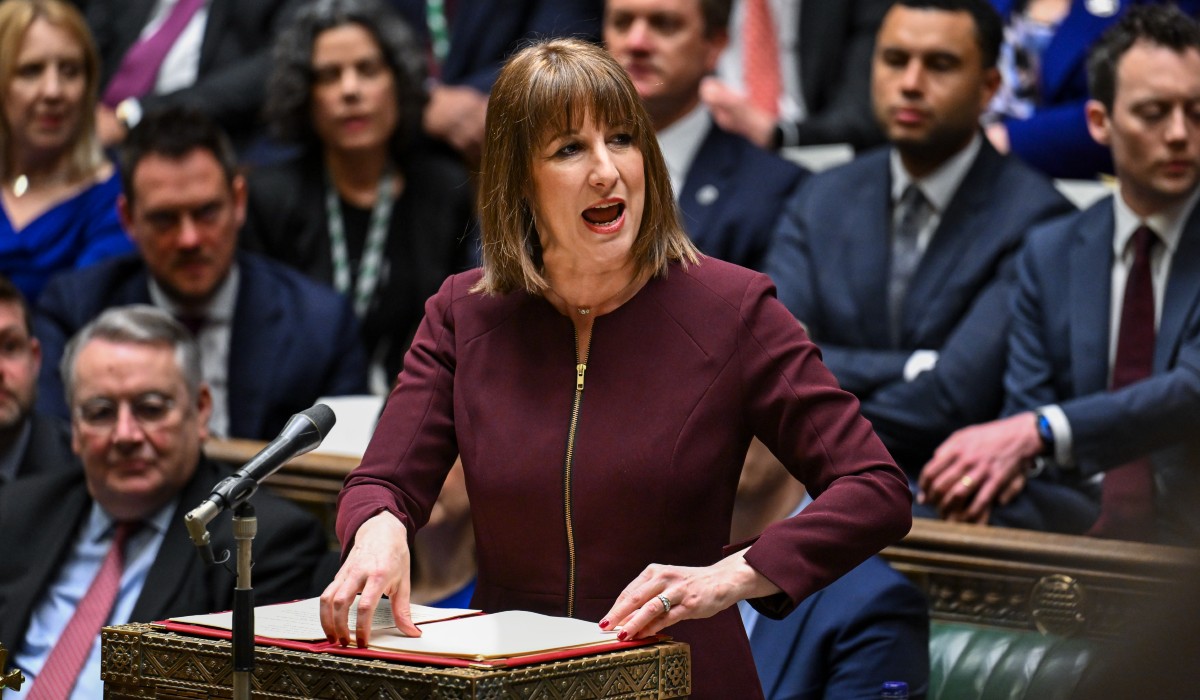
 Rachel Reeves. Photo: House of Commons / CC BY-NC-ND 2.0
Terina Hine takes on the myth of out-of-control welfare
The warnings are stark. The economy isn’t working and neither, apparently, are millions of us. These were the noises coming out of Number 11 ahead of the November budget.
‘I can’t leave welfare untouched,’ said Chancellor Rachel Reeves in a Channel 4 interview, ‘If more and more of our money … is spent on welfare, you’ve got less for the NHS, you’ve got less on schools and you have to put more on people’s taxes.’
Welfare benefits are out of control according to Reeves, a position almost never challenged by journalists happy to rewrite government statements as news.
Are we a nation of shirkers? Are welfare costs spiralling? Not according to the Office for Budget Responsibility who record welfare spending as being stable as a proportion of GDP, and lower than it was in 2015-16.
Yet this is not the government line. In a press release dated June 2025, the Labour government made its position clear. Welfare costs are ‘spiralling’, some benefits have ‘doubled’ since the pandemic, disability and incapacity-benefit costs are expected to reach ‘a staggering’ £70 billion a year by the end of this parliament. All of which, we are encouraged to believe, is completely unsustainable.
The government is desperate to paint welfare spending as placing excessive strain on our overburdened economy. A view unsurprisingly shared by the traditional nasty party.
Kemi Badenoch closed her party conference in October expressing outrage at the 6.5 million working-age adults claiming benefits: ‘You heard me right, six and a half million. That is the entire population of Cardiff, Belfast, Glasgow, and Manchester. Combined. Being paid to sit at home all day.’ In reality, today’s projected total welfare payments, which includes pension payments, are around 11% of national income a year. This is lower than when David Cameron was prime minister, even though we now have more pensioners.
Working-age benefits, including all out-of-work and health-related benefits, are well below the levels recorded in the 2010s. The FT’s economics commentator, Chris Giles, reported in October that ‘total non-pensioner benefits have hovered between 4 and 5 per cent of GDP for over 40 years,’ and are currently at the lower end of the scale.
What about the ‘shocking’ number of people ‘being paid to sit at home all day’? According to the Department for Work and Pensions there’s been a rise of 80% in out-of-work benefits since 2018.
Yes, there are 6.5 million adults claiming out-of-work benefits. And yes there has been a rise in the number of claimants since 2018, but this is a long way shy of the 80% being reported. According to Professor Ben Geiger of King’s College London, this claim, which has been amplified by politicians and journalists, is ‘wildly misleading’.
It’s not the number of claimants that has resulted in this rise, but how we count them. For example, sometimes a couple was counted as one claimant but is now always counted as two. Universal Credit has led to recipients being classed as out-of-work when in the past they weren’t: people just claiming Child Tax Credits and/or Housing Benefit were not counted as ‘out-of-work’ under the old system even when they were not working. And of course, the state pension age has risen, so we now have a lot more people of working age.
Increasing the pension age has added to the number of sickness and out-of-work benefit claimants, but it has saved considerable sums.
It’s cheaper to pay 0.5m people benefits than to pay them the state pension yet, ironically, the result is presented as welfare running out of control.
If counted consistently over time, out-of-work rates today are similar to 2014-15 levels, and noticeably lower than 2013. The proportion of 16-64 year olds not working is lower than achieved under Thatcher, Major or Blair, and is close to record lows even with the 22% rise since 2018.
The misleading and inaccurate reporting of welfare statistics is being used to scapegoat the poor and disabled to cover for the failure of successive governments’ economic policies. Welfare spending is not out of control.
Before you go
The ongoing genocide in Gaza, Starmer’s austerity and the danger of a resurgent far right demonstrate the urgent need for socialist organisation and ideas. Counterfire has been central to the Palestine revolt and we are committed to building mass, united movements of resistance. Become a member today and join the fightback.
