
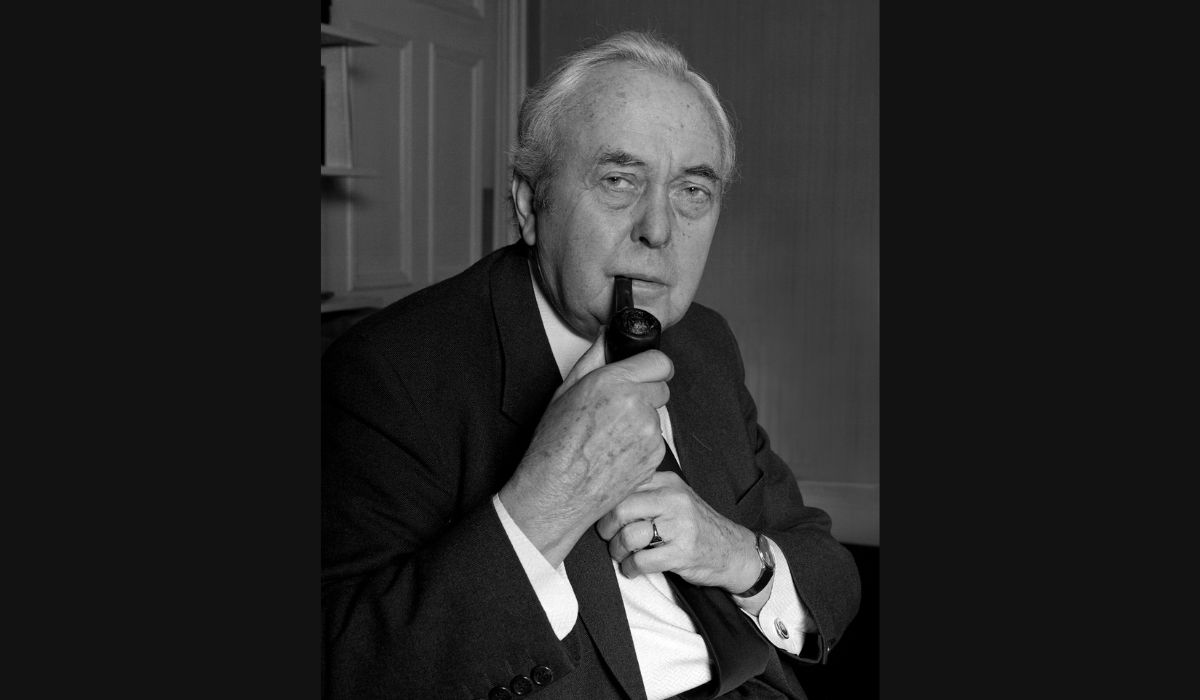
 Harold Wilson, aken in his apartment in Westminster London. Source: Allan Warren - Wikicommon / cropped from original / CC BY-SA 3.0
Harold Wilson’s tenure as Prime Minister ended fifty years ago. Jonathan Maunders reflects on his departure and the factors influencing his resignation
This April marked fifty years since Harold Wilson’s departure as Prime Minister. Following his shock resignation, Wilson was formally replaced by James Callaghan on 5th April 1976. While the move stunned many, it represented more than just a change at the top. It was a sign that the entire post-war political settlement was cracking.
Wilson is still often remembered as a shrewd moderniser: a Labour winner who kept the Tories out and held the centre together. But his real legacy is less flattering.
His government promised change and delivered management, retreating before the demands of British capitalism. By 1976, with inflation soaring, class conflict sharpening, and Britain’s post-war consensus crumbling, the limits of that strategy were impossible to ignore.
The wider culture registered that breakdown too. This was the year punk burst into view: the Sex Pistols’ “Anarchy in the U.K” would soon help turn punk into the soundtrack of a country running on disillusion and anger.
Powerful forces
Wilson’s story, though, has another side. He believed that powerful forces inside the British state were working against him: elements of the security services, the military, the press and the wider establishment.
For years, that was treated as evidence of paranoia. The respectable view was that Wilson, in the early stages of cognitive decline, was imagining enemies in the shadows.
That verdict now looks shakier.
This is not to say that all of Wilson’s allegations bare truth, or that there was a single, fully coherent coup plot waiting to be uncovered. British ruling-class power rarely works in such dramatic fashion. It does not always need tanks in the streets. Market pressure, media hysteria, smear campaigns, intelligence gossip, and military posturing can neuter democracy just as effectively.
However, there is enough evidence to show that Wilson’s paranoia was grounded in some reality. There was the Cecil King episode, when the press baron openly discussed launching a coup, proposing Lord Mountbatten lead the resulting military junta.
Meanwhile, multiple whistleblowers have shed light on an era of dirty tricks and black propaganda. This was a climate in which parts of the establishment, egged on by Washington, saw even moderate Labour governments as threats to be contained.
Wilson was not a revolutionary brought down by reaction. He was a moderate Labour politician committed to managing capitalism, not confronting it. He worked within the state, not against it. Yet even that did not protect him.
That is one of the central lessons of the Wilson years. Labourism did not make itself safe by being cautious. It did not win the loyalty of the state by being compliant. It simply trapped itself inside a crisis it could neither solve nor escape.
Recent history should make us wary of dismissing Wilson’s fears too quickly. The continuing Undercover Policing Inquiry has kept exposing the British state’s willingness to operate covertly against the left and against movements from below.
The spy cops scandal clearly does not prove a neat anti-Wilson conspiracy. But it does reveal a deeper continuity: a state that has repeatedly treated dissent as something to be monitored, penetrated and undermined.
Seen in that light, Wilson’s suspicions look less like fantasy and more like a distorted recognition of something real. He may have overstated the coherence of what he faced, but he was not wrong to sense that anti-democratic forces existed within the state.
Failure
None of this excuses Wilsonism. His governments ultimately failed not because they faced hostility from above, but because they refused to break with the system producing the crisis.
Wilson’s final weeks offered one last emblem of that reality. His resignation honours list, the so-called ‘Lavender List’, seemed to confirm how far Labour had drifted into the murky overlap of patronage, celebrity and big business. Far from rescuing Wilson’s reputation, it torpedoed it.
That is why 1976 still matters. Wilson’s resignation marked not just the end of a premiership, but the breakdown of any pretence of Labour radicalism. What followed under Callaghan would deepen that retreat, helping lay the foundations for Thatcherism.
It still speaks to the present. 50 years later, we have another feeble Labour government defined by the same instinctive limits: managerial caution dressed up as seriousness, austerity sold as responsibility, and a leadership more comfortable disciplining the left than confronting entrenched power.
Wilson’s failure was not that he thought enemies were moving in the shadows, it was that he had no strategy for confronting the system they served.
Before you go
The ongoing genocide in Gaza, Starmer’s austerity and the danger of a resurgent far right demonstrate the urgent need for socialist organisation and ideas. Counterfire has been central to the Palestine revolt and we are committed to building mass, united movements of resistance. Become a member today and join the fightback.
