
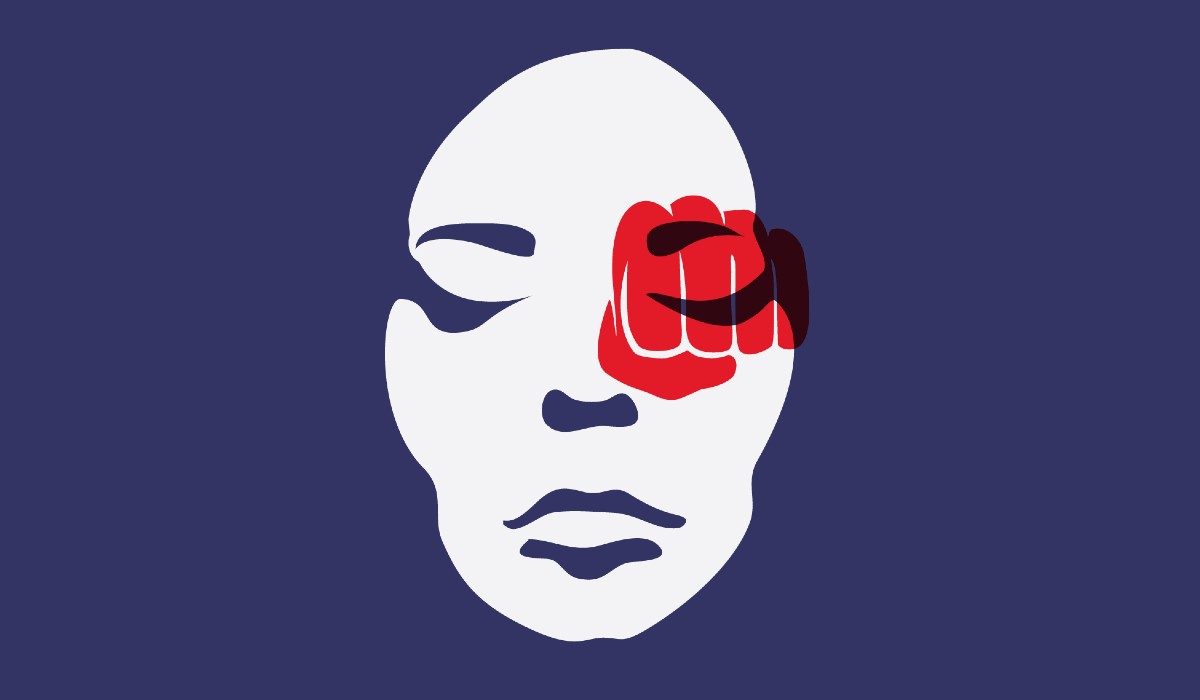
 ‘Open your eyes - to women being abused’. Poster by Denitza Tchacarova, Bulgaria, 2013
Urgent action is required to stem the growing tide of misogynistic abuse and sexual violence against women, writes Terina Hine
The mass rape of Gisèle Pelicot in France shocked the world. For a decade, Pelicot’s husband had drugged his wife and invited more than fifty men to rape her. It was a case so abhorrent, many of us found it hard to believe, it really was the stuff of nightmares.
And now we are told this was not an aberration. Rather, according to the UK National Crime Association, there is a ‘truly international network’ of organised, drug-facilitated sexual assault. Members of this ring of abuse have been identified in ‘dozens of countries spanning every continent’.
In just a few days, hundreds of women survivors from 22 countries joined a support network set up by two British victims, Zoe Watts and Amanda Stanhope. Like Pelicot, both women had been repeatedly raped by their partners while unconscious. It is clear this behaviour is not isolated, but is organised and growing.
The World Cup, a fun sporting event for the majority, is a time when abuse of women is likely to increase. Domestic abuse rises by around 11% following national team matches and when England loses by 38%, according to research by the National Centre for Domestic Abuse. This is not a result of football itself, but the circumstances surrounding the games – alcohol, late nights, emotional highs and lows and many players are hardly role models.
In this year’s tournament, two players accused of rape were able to play without sanction. Thomas Partey, a former Arsenal player, is scheduled to go on trial next year at Southwark Crown Court after being charged with seven counts of rape and one of sexual assault, (Partey has denied all the charges). Japan’s Kaishu Sano, who has denied gang-raping a woman in a Tokyo hotel made a settlement with the victim. Japan’s Football Association characterised the incident as a ‘personal mistake’.
There is much speculation that the rise of the manosphere, accompanied by a societal shift that diminishes women’s rights, is making abuse worse and more prevalent.
In the US, a Gallup poll in April found that the proportion of Americans who believe it’s acceptable to have a baby outside marriage has fallen to 58%, the lowest in twelve years, and the number who believe birth control is acceptable has also fallen by 7% in just a year, to its lowest level since polling began in 2012.
At the same time, a third of young American men claim to admire the misogynist influencer Andrew Tate. Generally, social attitudes in the UK are more liberal, but the influence of the manosphere is prevalent, and in 2022, 71% of young British men said that the man in a family should be the main breadwinner.
British teens spend more than three and a half hours per day on their phones. The boorish, offensive ‘older brother’ has been commercialised and monetised. Louis Theroux’s documentary on the manosphere revealed it to be a monetised scam, preying on the vulnerabilities of young men. Algorithms push the content. Women become the scapegoat. And in a time when jobs are scarce and the future looks bleak, an easy scapegoat is appealing.
On TV, depictions of violence against women rose 120% between 2004 and 2010, while depictions of violence against teenage girls rose by 400%. Naked, battered female corpses have remained commonplace on our screens since. A third of children report seeing content encouraging sexual violence towards women. While most do not go on to commit violent offences, negative impacts on attitudes, behaviour and relationships are common. Normalising misogyny and sexual violence are dangerous with real-world impacts.
Misogynistic abuse of female teachers in schools is on the rise. Boys have been found making AI images of female staff, joking about raping girls, and laughing it off if challenged. Reports of female teachers being belittled and patronised, referred to as ‘love’ and told ‘it must be that time of the month’ are not uncommon.
Girls are expected to wear increasingly sexualised clothing, mocked whether they do or don’t, padded bras are sold to pre-pubescent children. Sexualised advertising and images saturate the media. Children and young people are exposed to an unprecedented range of content, there is no watershed on the internet, and with this proliferation comes normalisation. Advertising has always relied on sex to sell, but increased exposure and the constant drip-drip of images to young audiences has a pervasive effect.
One in three women and girls experience physical or sexual violence during their lifetime. Last year, there was an estimated 2.3 million cases of domestic abuse, disproportionally affecting women. Reported incidents of rape rose by more than 500% over the last two decades. How much of this rise is due to increased reporting and the fact that it only became a criminal office to rape within marriage in 1991, we can only speculate. However, we do know that many women and girls fail to report sexual abuse because of the reception they receive by the justice system. With the increasing use of sedative drugs, many victims do not know what happened to them.
Although the government has rightly named violence against women and girls a national emergency, action is still lagging and limited. This must change, and urgently.
From this month’s Counterfire freesheet
Before you go
The ongoing genocide in Gaza, Starmer’s austerity and the danger of a resurgent far right demonstrate the urgent need for socialist organisation and ideas. Counterfire has been central to the Palestine revolt and we are committed to building mass, united movements of resistance. Become a member today and join the fightback.
