
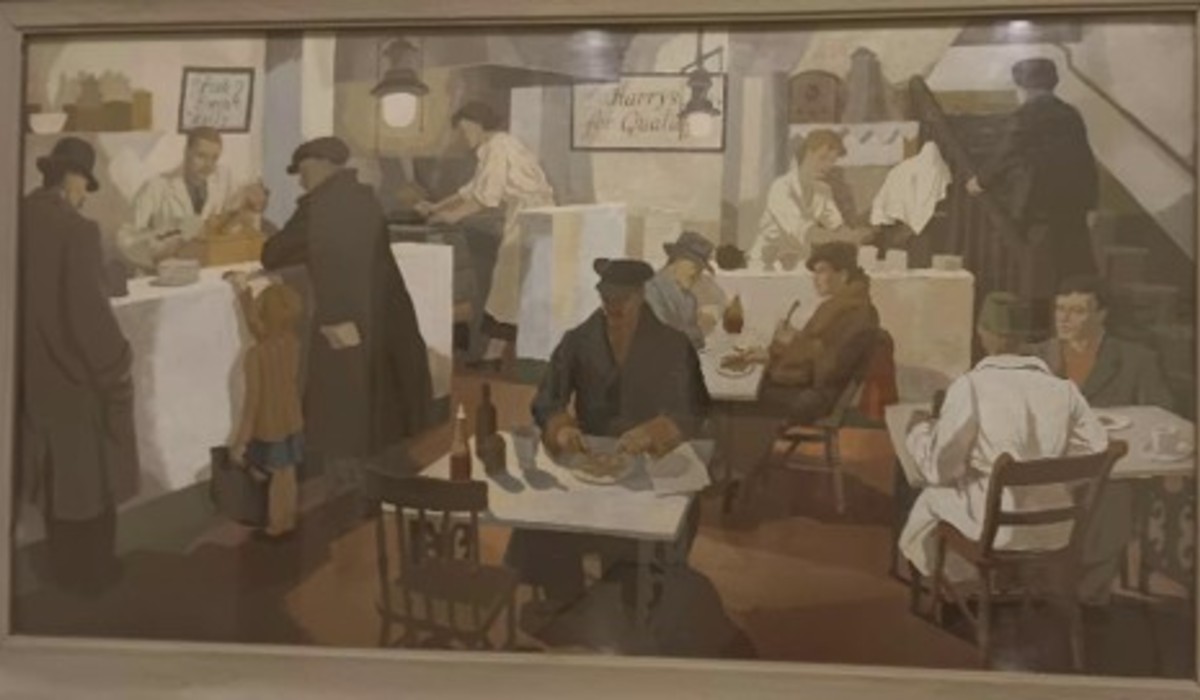
 The Fried Fish Shop, 1936, by Cliff Rowe. Photo: Leah Levane / Comrades in Art exhibition
There is much that has been lost and much that we can learn from the Artists International Association, finds Leah Levane in her review of ‘Comrades in Art: Artists Against Fascism’
There is a brilliant and well curated exhibition in Eastbourne; Comrades in Art: Artists Against Fascism . I spent two hours there and could easily have been there for longer.
The exhibition is about the work of the Artists International Association (AIA) of which, to my chagrin, I had never heard. It was formed to unify artists against fascism and war, later rallying comrades across Europe during the Spanish Civil War and efforts to overcome the rise of fascist General Franco.
It was fascinating to learn about the artists, some of whom had emerged from the horrors of World War One, often initially as pacifists. Later, many put pacifism behind them in recognition of the need to take up arms in the context of the rise of fascism.
Earlier this year there was an exhibition about the AIA at the Tate in London, which covered only the first ten years of the AIA. This exhibition takes us up to the 1960s and includes the importance of art in postwar construction, involving many Association members (there were around 900 at its peak). AIA members also contributed to the 1951 Festival of Britain.
The movement was founded in 1933 by left-wing artists, many of whom were experiencing unemployment and acutely aware of the political crises at home and abroad. Mussolini was already in power in Italy, the crisis in Germany was giving rise to support for the Nazis, and political tensions in Spain. An early exhibition was Artists Against Fascism in London, supported by established artists such as Augustus John, Paul Nash and Henry Moore.
‘Comrades in Art’ is fascinating from the historical and artistic perspectives. For example, some pieces that were 90 years old looked astonishingly modern. The AIA was committed to increasing access for working class people to art. For the AIA this included producing affordable lithographic prints and mural commissions, and later their involvement in art for schools.
The exhibition shows some of the life of ordinary people, such as a bookshop in Wentworth Street, Whitechapel, shipbuilding and screen printing workers, and portraits of the artists and their surroundings. There was also at least one example showing disillusion with developments in the USSR.
This picture was painted in early 1936 before the outbreak of the Spanish Civil War and the Moscow Show Trials. It shows the artist – Rowe’s – deep scepticism about political developments in the USSR. The information provided tells is that the café is “Harry’s café” and the Harry in question is Harry Pollitt who was secretary of the British Communist Party for (far too) many years. “He is seen serving an unemployed man, watched over by a bowler hatted man reminiscent of the not so secret policeman from a photograph “Sedition”. At the centre of the picture, is Stalin, dining in shadow at the centre of a well- lit restaurant. The work also shows other artists involved in the Artists International Association including Clara Zetkin who was critical of Stalin’s view of art’s subservience to power.
In 1943, with the war still raging, the AIA organised an exhibition “For Liberty” at the John Lewis bombsite in Oxford Street, involving artists from different aesthetic perspectives and calling for “an imaginative peace.”
As well as paintings and photographs there are stunning sculptures, some of which are maquettes for larger pieces.
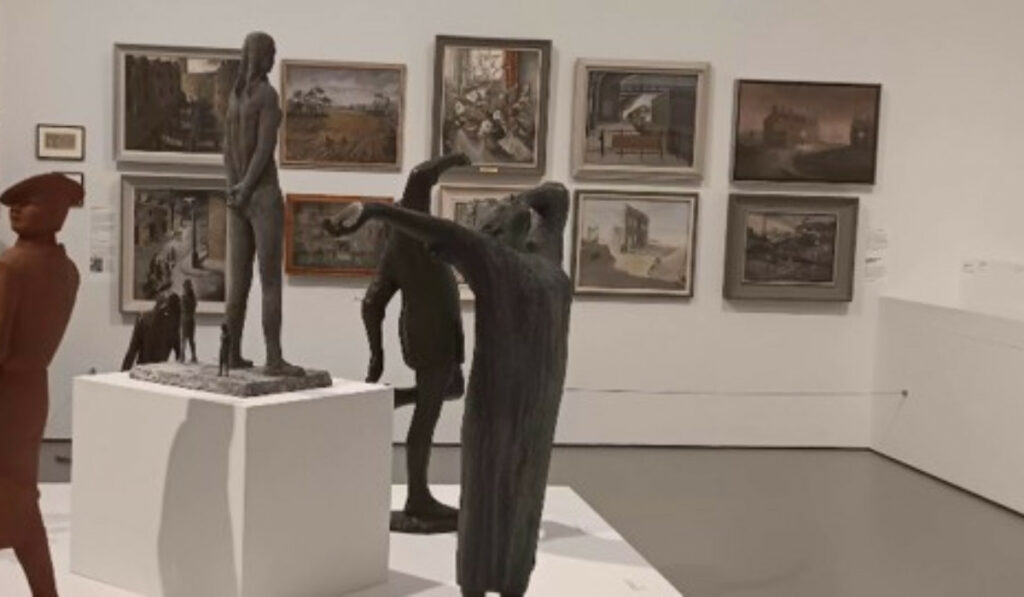
AIA members were also involved in supporting art in schools, at a very different time from now. For about 20 years, hundreds of schools and colleges acquired thousands of works by leading artists from annual ‘Pictures for Schools’ exhibitions. Local authorities built up collections of art to loan to schools as a resource for teaching art to children. As the information by this poster notes: “In the 21st century a combination of public sector austerity and financial opportunism has undone the work of previous decades. Collections have been dispersed as local education authorities have been disempowered as an act of policy.” (Most of the works bought then since been sold)
There is much that has been lost and much that we can learn and campaign for, if we consider the work of the Artists International Association.
Before you go
The ongoing genocide in Gaza, Starmer’s austerity and the danger of a resurgent far right demonstrate the urgent need for socialist organisation and ideas. Counterfire has been central to the Palestine revolt and we are committed to building mass, united movements of resistance. Become a member today and join the fightback.
