
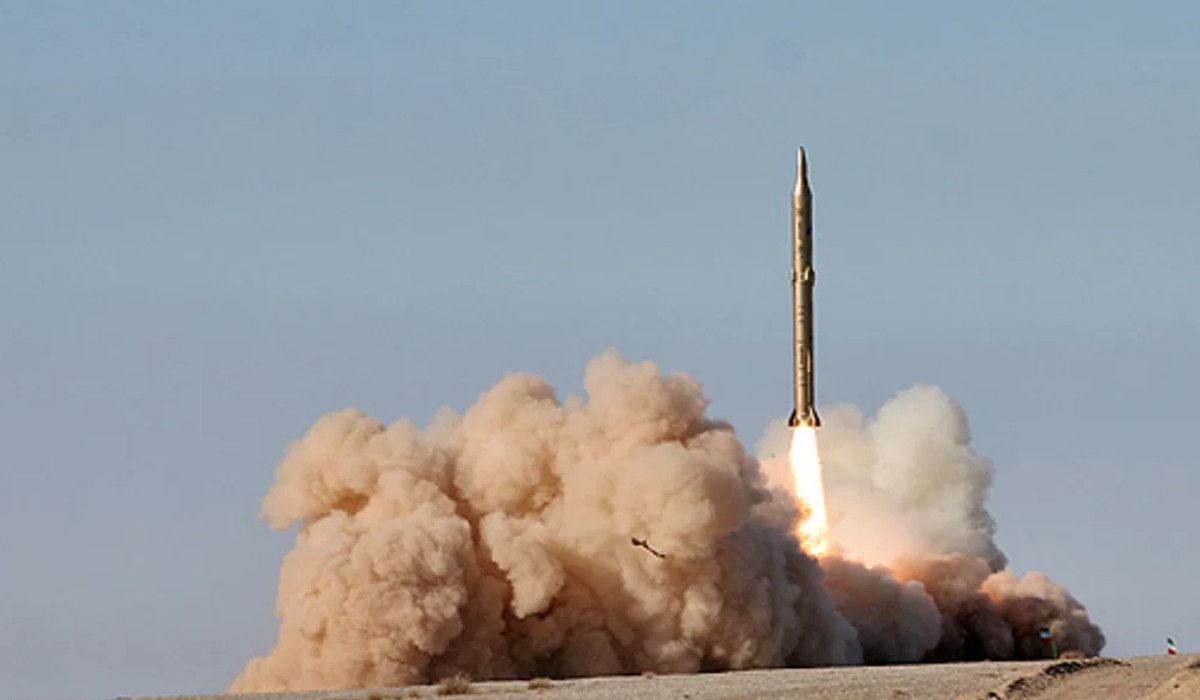
 Iranian ballistic missile launch. Photo: Fars News Agency / Vahid Reza Alaei CC BY 4.0
Iran and the US are once again exchanging strikes, Chris Bambery explains this recent escalation and its flash point, the Strait of Hormuz
For the third time since the two states signed a Memorandum of Understanding (MOU) on 17 June 2026, Iran and the US are exchanging strikes. This is the most extensive exchange so far, with Trump declaring the end of the ceasefire. Washington also revoked the lifting of sanctions which allowed Iran to sell oil on the world market.
The flash point is over the Strait of Hormuz. In the full-scale war between the US and Israel on the one side and Iran on the other, Iran discovered that its control of the Strait was a more effective weapon than developing a nuclear weapon because it threatened to destabilise the global economy.
Iran says it has closed the Strait of Hormuz, Washington says it is open.
Point 5 of the Memorandum of Understanding states in regard to the Strait of Hormuz:
“Upon the signing of this MOU, the Islamic Republic of Iran will make arrangements using its best efforts for the safe passage of commercial vessels with no charge for 60 days, only from the Persian Gulf to the Sea of Oman and vice versa. The traffic of commercial vessels will immediately start, and considering the need for removing the tactical and military obstacles and de-mining by the Islamic Republic of Iran will be instated within 30 days. The Islamic Republic of Iran will conduct dialog with the Sultanate of Oman to define the future administration and maritime services in the Strait of Hormuz, in discussion with other Persian Gulf littoral states in line with the applicable international law and the sovereign rights of coastal states of the Strait of Hormuz.”
These are my italics. Most readers would understand this as giving Iran effective say in how the Strait operate.
Iran’s parliament speaker and chief negotiator, Mohammad Bagher Ghalibaf, has stated that the Strait ‘will never return to its pre-war conditions and will be administered’ by Iran.
Negar Mortazavi, a senior fellow at the Center for International Policy, explains:
“The MoU committed both sides to keeping the Strait open through coordinated arrangements for safe commercial navigation, not unilateral action… From Tehran’s perspective, that means any passage or maritime security arrangements should be coordinated with Iran.”
But the US and Oman then unilaterally opened up the southern corridor which hugs the Omani coast, without consulting Tehran. Iranian Revolutionary Guards responded by targeting vessels crossing this corridor.
At the moment we are witnessing tit for tat attacks by both states. The US is striking Iranian targets with aircraft and Cruise missiles, and Iran is targeting US assets in Jordan, Kuwait, Bahrain, Qatar and Oman.
In this contest the US seems to be holding a far weaker set of cards than Iran. After all, it carried airstrikes for weeks after the initial 28 February attacks. Here, the Israelis murdered the Supreme Leader, Ali Khamenei, but failed to remove the regime (the initial aim), to destroy or seize Iranian stocks of enriched uranium, or to significantly degrade Iran’s extensive arsenal of nuclear missiles and attack drones.
As Trita Parsi points out:
“In Iran… the United States didn’t even win the military phase — despite facing a far weaker conventional force. Iran leveraged geography and asymmetric tactics to blunt American power and inflict a strategic setback. Even more striking, early claims that U.S. airstrikes had significantly degraded Iran’s drone and missile capabilities now appear overstated. The lesson is clear: control of the skies does not guarantee control of outcomes. Without the will to deploy ground forces—and without the ability to translate airpower into decisive results — American primacy begins to look increasingly hollow.”
Washington then attempted to impose its own blockade of the Strait of Hormuz, to stop Iran selling oil. Because of Iranian missiles and drones, US warships had to stay well away from the Iranian coast, making the blockade very difficult to maintain.
If the air war and the blockade failed, what has changed now? Nothing. Even Trump knows a land war with a country the size of Iran is a non-starter. That only leaves the use of nuclear, or tactical nuclear weapons. This would be a very dangerous escalation involving an ally of China and Russia. It would also likely mean regional powers like Saudi Arabia and Turkey developing their own nuclear weapons.
On the other hand, Iran reckons it can take the economic pain – it’s used to it – and the US cannot. It has plenty of targets in the Gulf, including US military bases and other assets. If it wanted to go further up the escalatory ladder it’s shown it can hit Israel, or, with the aid of the Houthis, it could shut down the Red Sea with devastating consequences for the world economy.
The US remains militarily strong, with overwhelming military capability. But, it has found there are serious limits on its ability to project this power when it comes to Iran. For political and economic reasons the US wanted the war ended and now it does not want to be involved in a long war in the region. Instead, it wants to focus on China.
Washington is still deeply involved in the Ukraine war as well as with Iran. Even the US cannot concentrate its military power on three fronts.
Regarding the Strait of Hormuz, Iranian missile attacks on ships using the Omani corridor will send the insurance of vessels operating in the Gulf skywards. Many shipping companies will not think the costs worthwhile. In other words, Iran does not have to fully shut the Strait, the very threat of attack may be sufficient.
Despite saying that the ceasefire is over, and despite Trump’s violent rhetoric, Washington says it still open to talks. So, I think it likely the Pakistanis and the Qataris will get both sides back to the negotiating table, but there is a fly in the ointment the West is ignoring.
During the recent, extended funeral ceremonies for Ali Khamenei, the Speaker of the Iranian Parliament, Mohammad Bagher Ghalibaf, and the Iranian Foreign Minister, Abbas Araghchi, were both badly heckled by opponents of the deal they had negotiated with America.
Many believed they were winning the Spring war and saw little reason to stop it. The killing of Khamenei and other leaders has meant that the Iranian Revolutionary Guards have assumed greater political, as well as military, control.
Even if negotiations resume, the Iranians do not trust the Americans, for good reason. There are so many difficult issues to resolve before they will even discuss their nuclear programme. There is also the refusal of Israel to withdraw from Lebanon – the very first point agreed in the MOU.
My guess is that a situation of no peace, no war might exist in which various states began to accept Iranian control of the Strait of Hormuz, and that paying a toll for safe passage through it is a price worth paying.
Before you go
The ongoing genocide in Gaza, Starmer’s austerity and the danger of a resurgent far right demonstrate the urgent need for socialist organisation and ideas. Counterfire has been central to the Palestine revolt and we are committed to building mass, united movements of resistance. Become a member today and join the fightback.

Chris Bambery
Chris Bambery is an author, political activist and commentator, and a supporter of Rise, the radical left wing coalition in Scotland. His books include A People's History of Scotland and The Second World War: A Marxist Analysis.