
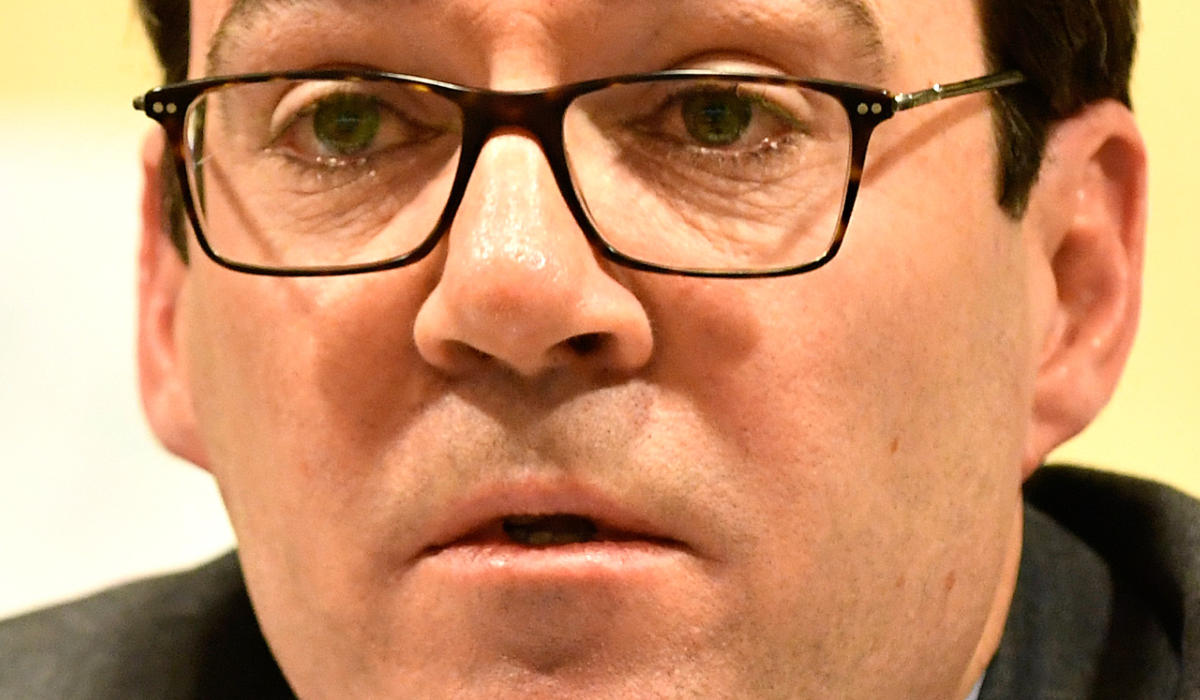
 Andy Burnham conferring with the EU at Brussels, March 2018. Photo: Flickr/European Committee of the Regions
Lindsey German on Labour’s latest attempt at renewal
Andy Burnham’s partial apology for the government’s record on Gaza (and it was very partial) is a sign of the times. It demonstrates the strength of the Palestine movement in Britain but also the damage Starmer’s line on Gaza has done to Labour’s vote.
The fact that Burnham has felt the need to distance himself from Starmer’s extremely damaging support for Israel cutting off water and electricity in Gaza reflects how deeply feelings and solidarity for the people of Gaza run.
This is something you wouldn’t have heard much from the mainstream media. The various analyses of Starmer’s demise rarely mention Israel, Gaza, genocide or any combination of an issue which has cost Labour many votes, has seen it lose a number of previously safe seats and turned others into very tight marginals, and has been a major factor turning Labour voters towards the Greens.
That’s because there is little real understanding of why Starmer, establishment poster boy and ideal prime minister in theory, has been such a catastrophic disaster that only two years into a government with a huge majority he is being forced out in an unprecedented coup which relied on the Manchester mayor being parachuted in through a by-election. It says a great deal for the feebleness of the leading cabinet ministers that none of them have strong – or indeed any – popularity ratings.
While some of this can be put down to their own lack of ability, what it really demonstrates is the mismatch between expectations of a Labour government and the failure to deliver any real change that would materially benefit working-class people. Starmer’s policies played a big part in this – Gaza, the axing of the winter fuel allowance, attacks on benefits, sleaze over accepting gifts, mimicking of Reform’s racism, his warmongering – but it is also the absence of change which is being felt so acutely by millions.
Burnham will become prime minister in a week’s time. He will be anointed as the saviour of Labour. Already the cringeworthy behaviour of Labour MPs includes sending him their CVs and appearing in a selfie with Burnham on his return to Westminster as they vie for possible ministerial jobs and other favours from the new leader. He is being greeted as the saviour for Labour by its loyalists. Forgotten are Burnham’s previous (failed) attempts to become Labour leader, including his decisive defeat to Jeremy Corbyn in 2015.
The truth is, however, that any enthusiasm for him among the electorate will rapidly evaporate unless he adopts policies which make a difference. Here there is quite a lot of rhetoric but not a great deal of substance. Having a Number 10 of the north is likely to have as little meaning as mainstream broadcasting news sending their presenters to Leeds or Salford to read the same news that they would in London. Burnham’s planned tour of Britain through the summer will raise his profile but he needs to put forward real change, not a cosmetic one. For a mainstream soft left Labour politician this is extremely difficult. When we hear the news that the disgraced right-wing Labour Together Josh Simons, who resigned his Makerfield seat for Burnham, is to be head of policy in Downing Street, then it is clear that any fundamental change to benefit working-class people is not on the cards.
Burnham has some idea of what needs to be done, but to do it properly will challenge everything we know about his politics to now. There is talk that he will change local councils’ borrowing rules to allow them to build more council housing. That should have been done two years ago, instead of Starmer and Reeves ripping up planning regulations to allow more private housing developments which are still unaffordable for many. Will he tax the rich? Not in any serious way. Public ownership of utilities will fall far short of seizing control away from the greedy and incompetent companies that own them now. Despite fine talk of workers’ rights, these have been watered down and limited. Money for wages and public services are already being deprioritised in favour of the biggest arms spending bonanza for decades.
So, not being Starmer will carry him some way, maybe even through a snap general election some are predicting, but not that far. That’s because, like his predecessor, he is unable to deal with the fundamental problem for working-class people of worsening living conditions, the breakdown of society in many areas, and the lack of decent jobs.
It is shameful but not surprising that a number of the union leaders are joining in with this uncritical support for Burnham. With a few notable exceptions, the unions have done little to fight Labour’s attacks on some of the poorest, and they need to start doing so now.
Meanwhile, Nigel Farage’s attempt to get round the scandals over his finances looks like it is backfiring. Even if, as expected, he wins his Clacton seat again in the by-election he has called, he may face a second one following scrutiny of his financial affairs. And the political focus this summer will not be on him – when his main opponent is a bin – but on Burnham. Farage is in some trouble, as is Reform, which is under-performing in real polls as opposed to opinion ones, and which is now considered by many voters as sleaze-ridden. The bleats that attacks on Farage are from ‘the establishment’ would be funny if the people making them weren’t so dangerous. Farage, Tice, and their crew are variously stockbrokers, property developers and members of the aristocracy.
Any revival of Labour will contribute to Reform’s problems, but not for long unless there is serious change. And the hard-core Reform supporters are already gravitating towards Restore Britain. The far-right vote is not going to decline without a serious campaign against its politics and an upsurge of organisation and struggle on the left.
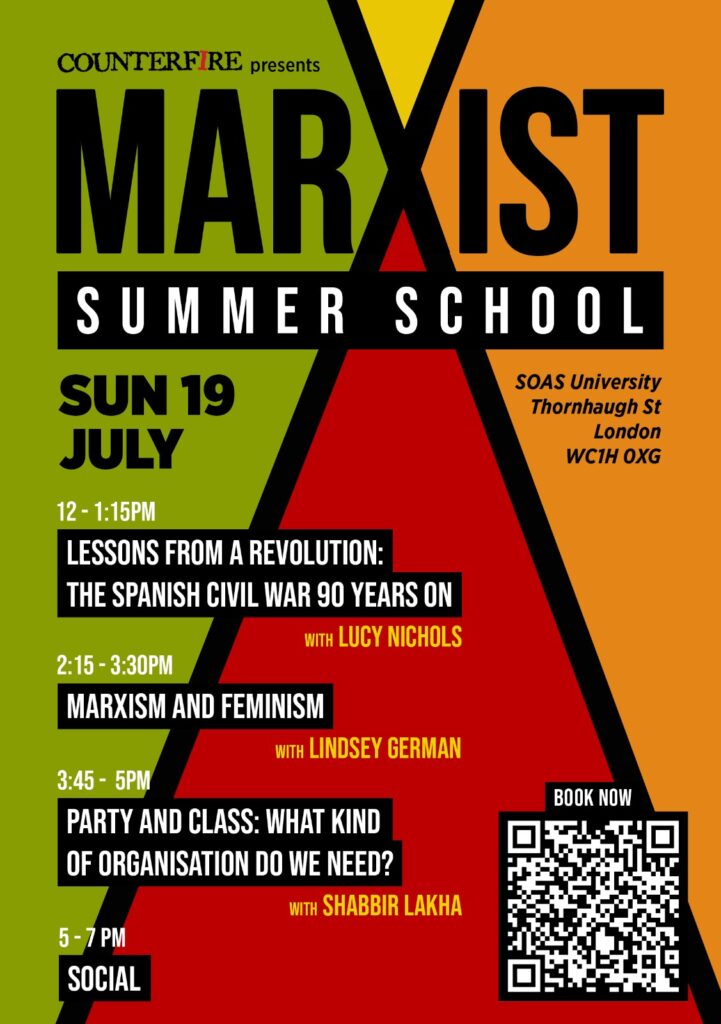
This week: I will be helping organise next Saturday’s Palestine demo in London, to tell Burnham why he needs to end support for genocide and militarism. On Tuesday there is an activists and groups meeting from Stop the War to discuss follow up to the international conference last month. On Wednesday an online meeting in Southampton. And on Sunday I will be speaking on Marxism and Feminism at the Counterfire Marxist Summer School. Do join me.
Before you go
The ongoing genocide in Gaza, Starmer’s austerity and the danger of a resurgent far right demonstrate the urgent need for socialist organisation and ideas. Counterfire has been central to the Palestine revolt and we are committed to building mass, united movements of resistance. Become a member today and join the fightback.

Lindsey German
As national convenor of the Stop the War Coalition, Lindsey was a key organiser of the largest demonstration, and one of the largest mass movements, in British history.
Her books include ‘Material Girls: Women, Men and Work’, ‘Sex, Class and Socialism’, ‘A People’s History of London’ (with John Rees) and ‘How a Century of War Changed the Lives of Women’.