
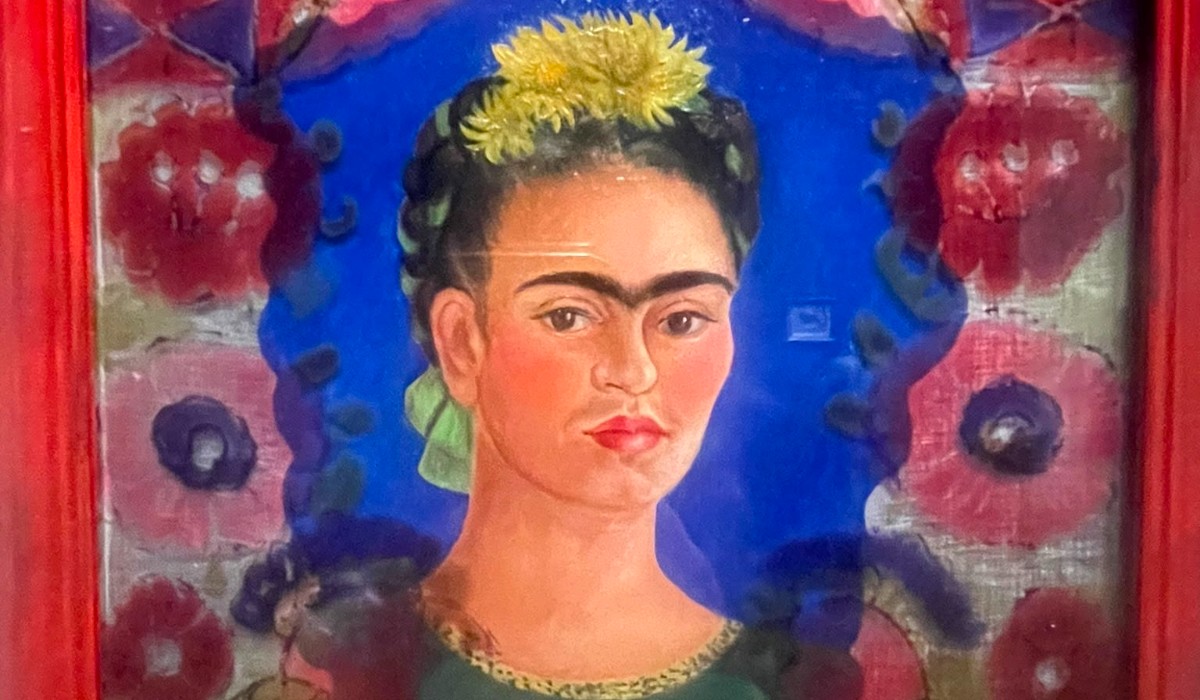
 Painting of Frida Kahlo from the exhibition / Photo: Cici Washburn
Cici Washburn reviews a new exhibition about the Mexican revolutionary artist Frida Kahlo and argues that its reliance on multiple identities hides the substance of her politics
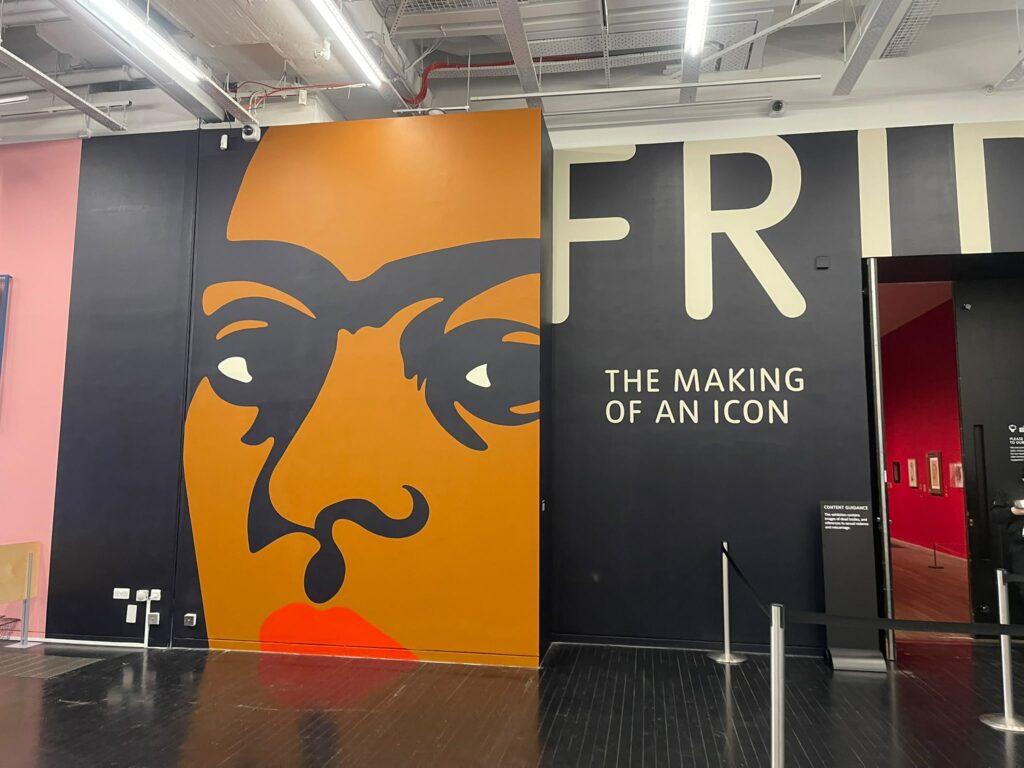
All over London you will see big adverts for Tate Modern’s ‘Frida: The making of an icon’, with the strap line ‘Revolutionary artist and global icon.’ The word revolutionary gave me some slight, yet misguided hope for this exhibition.
When you enter the exhibition you immediately learn that only 33 of Frida Kahlo’s artworks are included in the exhibition and this is not a retrospective, it’s purely about her legacy and popularity and has a feeling of being more of a shrine and collection of memorabilia than about the artist herself.
Frida Kahlo was a revolutionary, a socialist and politically active, the exhibition vaguely hints at this but in a misleading way. She was a member of the Communist Party, although both she and her long-term partner and sometimes husband Diego Rivera were influenced by Trotsky for a period. Kahlo was intensely political independently and in her relationships, Diego Rivera is referred to and her portraits of him are included but their politics are totally excluded and the exhibition doesn’t even mention Trotsky with whom she had an affair.
Her original diary covering the years 1944-54 which is published and I recommend, is in the exhibition with a couple of pages from it on the wall, I don’t think the curators have read it, it is in part an autobiography, a means for her to explore ideas for paintings and parts of it describe her struggle between health difficulties and political activism; ‘I have to fight with all my strength to contribute the few positive things my health allows me to the revolution. The only true reason to live for’. You would not know from this exhibition what Kahlo lived for.
This is an exhibition that views Frida Kahlo through her multiple ‘identities’ as though she wore one like an outfit and changed outfits. The introduction to the exhibition says ‘The first section explores how Kahlo constructed her identity through her art and personal style’- as though she displayed and invented her disabilities, politics, gender and sexuality rather than those things being part of her, her life, her struggles and lived experience. It’s as though the Tate sees Frida Kahlo as a brand that she invented. The exhibition talks about how she presented her identities in different ways and how she ‘presented herself as a disabled person’.
The exhibition shows artwork, medical instruments, powerful photos, and plaster casts that display the fact that Frida had an accident but it presents this as her identity and completely neglects the fact that she faced illness her whole life as she had polio as a child and the impact her operations and illness had on her and how they informed her artwork and outlook. In the room that links her to the Surrealist movement the Tate even says that Kahlo insisted that she did not paint dreams but her own reality, yet you get a feeling that the Tate is intent on ignoring Frida’s realities as they are far more concerned with her identities.
The exhibition concludes from the very beginning that Frida’s multiple identities are why she is a cultural icon, and constantly refers to ‘Fridamania’ and the vast commercialisation of her and her face and gives the impression it is exploring how ‘Fridamania’ came to be and what is behind it. But it completely fails to do so as it is all through the lens of identities and its obsession with Frida’s belongings, jewellery, clothes, and photographs with no depth and very little context means the exhibition just becomes part of the rather empty vacuum of adoration for Frida with no depth or context and no feeling for her life.
In relation to why Frida has become a ‘world legend’ John Berger wrote ‘in part due to the fact that in the dark age which we are living under the new world order, the sharing of pain is one of the essential preconditions for a re-finding of dignity and hope’. He goes on to suggest that some forms of sharing of pain can lead to resistance. There is nothing in this exhibition that makes any attempt to explore this idea or any other ideas.
Despite all this, if you were planning to visit the exhibition, I would still very much recommend you do, because she is an incredible artist and intensely political.
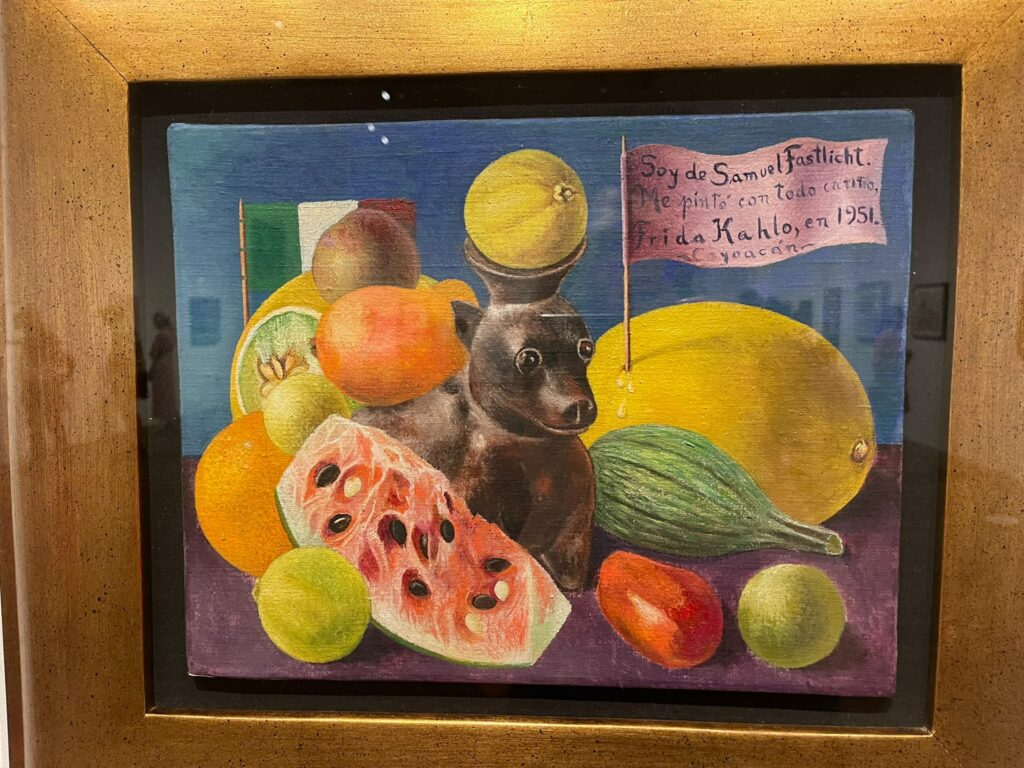
The fault in this exhibition is the way it is presented and the lack of her artwork. It is also fascinating to see this stark example of how the prism of identity politics can rob us of meaning, life, context and struggle. The 33 Frida artworks are an unusual selection with some paintings I hadn’t seen before and many of her very interesting still lifes. Some of the works by her friends, contemporaries and those inspired by her are very interesting and were new to me (some not so much) and make for an exhibition with a variety of interpretations and mediums. In a very narrow way there is a section on how her artwork was inspiration to feminist artists in the US in the 70s, and a section on her ‘pro activist legacy’ all still worth seeing.
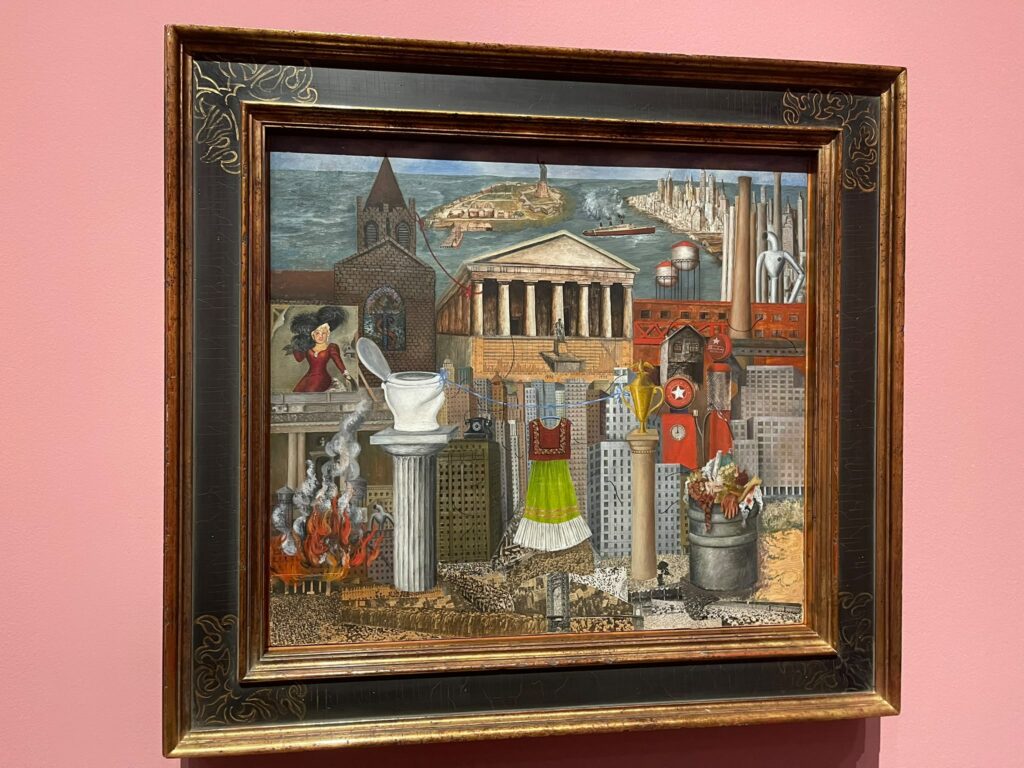
The artwork I most enjoyed seeing is Frida’s painting and collage ‘My dress hangs there’ 1933, a painting about her views of the US with flames, factories, a toilet and photos of mass protests. This felt so refreshing as it gave a rare glimpse in this exhibition as to how the artist viewed and related to capitalism, the US and politics more generally.
The last room is called ‘Fridamania’ and displays hundreds of objects created commercially honouring and displaying Frida Khalo, you then enter the gift shop full of objects of Frida that you can purchase, giving you the feeling that the Tate is cashing in on the commercialisation and legacy it is claiming to explore yet fails to do so and hence becomes a part of it.
What makes this exhibition disappointing is that the remarkable, revolutionary life and work of this artist that is loved by millions globally is presented through an extreme perspective of identity that is unique to the times we are in now and totally obscures the meaning, rawness of her pain, her rage, her depth, her struggles, the world she lived in, and her politics which is what makes Frida Kahlo extraordinary.
Before you go
The ongoing genocide in Gaza, Starmer’s austerity and the danger of a resurgent far right demonstrate the urgent need for socialist organisation and ideas. Counterfire has been central to the Palestine revolt and we are committed to building mass, united movements of resistance. Become a member today and join the fightback.
