
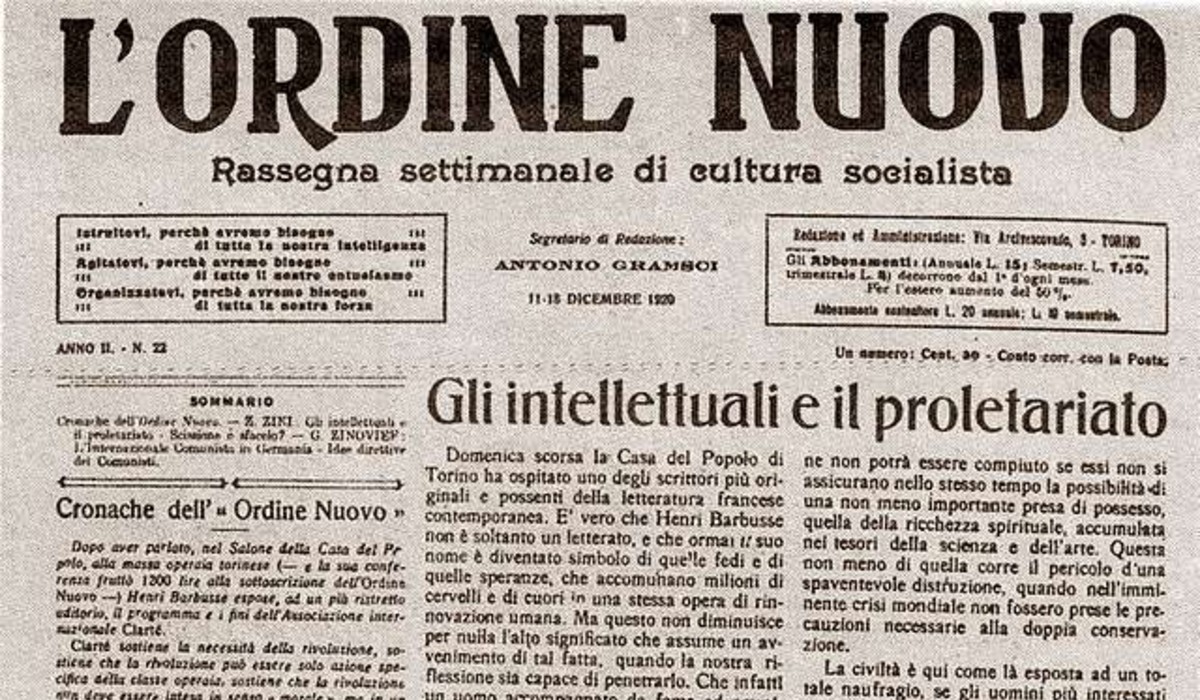
 L'Ordine Nuovo, 11 December 1920. Photo: Public domain
In this final instalment in his series on Gramsci’s Marxism, Chris Bambery examines Gramsci writings on common sense, and explores how ideas change
In 1920, Lenin dropped a bombshell at the Second Congress of the Communist International;
“We must simply tell the Italian comrades that it is the line of L’Ordine Nuovo members that corresponds to the line of the Communist International, and not that of the present majority of the Socialist Party’s leaders and their parliamentary group.” [i]
The Italian Socialist Party (PSI) had opposed World War I and was now affiliated to the Communist International, but was refusing to expel the reformist wing dominated its parliamentary grouping.
Italy had been in the grip of a revolutionary crisis, centred on Turin where Gramsci was based. It would culminate in the occupation of the factories led by democratically elected factory councils. But the PSI dismissed these because it still saw itself as leading the revolution.
In contrast, Gramsci’s newspaper, L’Ordine Nuovo (New Order) argued that the factory councils corresponded to the soviets in Russia and could be the basis of a new proletarian state.
In the Prison Notebooks, Gramsci returned to the insult thrown at him and the L’Ordine Nuovo group in 1920, that they were spontaneists:
“It must be stressed that ‘pure’ spontaneity does not exist in history: it would come to the same thing as ‘pure’ mechanicity. In the ‘most spontaneous’ movement it is simply the case that the elements of ‘conscious leadership’ cannot be checked, have left no reliable document. It may be said that spontaneity is therefore characteristic of the ‘history of the subaltern classes’, and indeed of their most marginal and peripheral elements … Hence in such movements there exist multiple elements of ‘conscious leadership’ but no one of them is predominant or transcends the level of a given social stratum’s ‘popular science’ – its ‘common sense’ or traditional conception of the world.” [ii]
On the one hand, Gramsci was against counterposing spontaneity favorably to Marxism. On the other he also rejects those who simply dismiss spontaneous rebellion:
“Neglecting, or worse still, despising, so-called ‘spontaneous’ movements, i.e. failing to give them a conscious leadership or to raise them to a higher plane by inserting them into politics, may often have extremely serious consequences. It is almost always the case that a ‘spontaneous’ movement of the subaltern classes is accompanied by a reactionary movement of the right-wing of the dominant class, for concomitant reasons. An economic crisis, for instance, engenders on the one hand discontent among the subaltern classes and spontaneous mass movements, and on the other conspiracies among the reactionary groups, who take advantage of the objective weakening of the government in order to attempt coups d’etat. Among the effective causes of the coups must be included the failure of the responsible groups to give any conscious leadership to the spontaneous revolts or to make them into a positive political factor.”[iii]
He continued:
“Neglecting, or worse still despising, so-called “spontaneous” movements, i.e. failing to give them a conscious leadership or to raise them to a higher plane by inserting them into politics, may often have extremely serious consequences. It is almost always the case that a “spontaneous” movement of the subaltern classes is accompanied by a reactionary movement of the right-wing of the dominant class, for concomitant reasons. An economic crisis, for instance, engenders on the one hand discontent among the subaltern classes and spontaneous mass movements, and on the other conspiracies among the reactionary groups, who take advantage of the objective weakening of the government in order to attempt coups d’état. Among the effective causes of the coups must be included the failure of the responsible groups [communists] to give any conscious leadership to the spontaneous revolts or to make them into a positive political factor…. The “spontaneous” movements of the broader popular strata make possible the coming to power of the most progressive subaltern class as a result of the objective weakening of the State. This is still a “progressive” example; but, in the modern world, the regressive examples are more frequent.”[iv]
For Gramsci, the relationship between spontaneity and conscious leadership is in large part the relationship between party and class. In 1920 the Italian social democrats and trade union bureaucrats had sufficient organisation and support to subvert the revolution.
Looking back, he reflected on the experience of L’Ordine Nuovo in 1919-20:
“The Turin movement was accused simultaneously of being ‘spontaneist’ and ‘voluntarist’ or Bergsonian. This contradictory accusation, if one analyses it, only testifies to the fact that the leadership given to the movement was both creative and correct. This leadership was not ‘abstract’; it neither consisted in mechanically repeating scientific or theoretical formulae, nor did it confuse politics, real action, with theoretical disquisition. It applied itself to real men, formed in specific historical relations, with specific feelings, outlooks, fragmentary conceptions of the world, etc. which were the result of ‘spontaneous’ combinations of a given situation of material production with the ‘fortuitous’ agglomeration within it of disparate social elements. The element of ‘spontaneity’ was not neglected and even less despised. It was educated, directed, purged of extraneous contaminations; the aim was to bring it in line with modern theory. The leaders themselves spoke of the ‘spontaneity’ of the movement and rightly so. This assertion was a stimulus, a tonic, an element of unification in depth; above all it denied that the movement was arbitrary, a cooked-up venture, and stressed its historical necessity. It gave the masses a ‘theoretical’ consciousness of being creators of historical and institutional values, of being founders of a State. This unity between ‘spontaneity’ and ‘conscious leadership’ or ‘discipline’ is precisely the real political action of the subaltern classes, insofar as this is mass politics and not merely an adventure by groups claiming to represent the masses.” [v]
Gramsci poses the question:
“Can modern theory [Marxism] be in opposition to the ‘spontaneous’ feelings of the masses? ‘Spontaneists’ in the sense that they are not the result of any systematic educational activity on the part of an already conscious leading group, but have been formed through everyday experience illuminated by ‘common sense’ i.e. by the traditional popular conception of the world).” [vi]
He answered his own question thus:
“It cannot be in opposition to them. Between the two there is a ‘quantitative’ difference of degree not one of quality. A reciprocal ‘reduction’ so to speak, a passage from one to the other and vice versa, must be possible.” [vii]
In 1923, Gramsci came up with his own definition of the relationship between party and class:
“We have not thought of the party as the result of a dialectical process in which the spontaneous movement of the revolutionary masses and the organisational and directive will of the centre converge, but only as something floating in the air, which develops in and for itself, and which the masses will reach when their situation is favourable and the revolutionary wave has reached its height.”[viii]
How ideas change
Philosophy is usually presented as something beyond the ken of everyday folk. It is seen as timeless truths handed down by great men. For Antonio Gramsci, philosophy was a response to contemporary problems, using contemporary modes of thought which have to be judged from an historical and social point of view.
We are, for Gramsci, all philosophers. The language we use together with our culture, religion, folklore and the common sense of everyday life all involve particular conceptions of the world. The ideas which dominate our lives filter down to us in a fragmented way, often finding expression in a way different to how those philosophers and intellectuals first expressed.
Gramsci argues that everyday common sense ‘facts’ contains within them some embryonic ‘good sense’ – what he calls ‘the healthy nucleus that exists in “common sense.”’[ix]
Good sense represents a more accurate and penetrating world view hidden in amongst the fragments of everyday common sense. The good sense in amongst common sense might, for example, identify an injustice in the world or the belief that the parliamentary system is rigged, or that the there is a class divide and the ruling elite are only out for their own interests.
For Gramsci this has implications for political practice. In order to achieve a new, more coherent, world view, you have to start with common sense, while uncovering the truths and discarding the contradictions found there. So, common sense in the site of political battle.
The good sense contained within common sense needs to be ‘made more unitary and coherent’… In this way can a ‘new common sense and with it a new culture’ emerge.[x]Antonio Gramsci,
Creating widespread good sense on a range of issues is crucial for achieving hegemony. Popular consciousness contains all sorts of modern and progressive ideas together with some terrible throwbacks. For Gramsci, a worker could be a “walking anachronism, a fossil” expressing all sorts of racist and sexist ideas but at the same time a loyal trade unionist who would never cross a picket line.
Popular consciousness “contains Stone Age elements and principles of a more advanced science, prejudices from all the past phases of history at the local level and intuitions of a future philosophy which will be that of a human race united the world over”.[xi]
Gramsci was drawing on his immersion in the Turin working class during the revolutionary years of 1919 and 1920. The mix of contradictory consciousness explains why the working class is not, under capitalism, an autonomous force acting in pursuit of its own interests.
The advance from popular to revolutionary consciousness is not a straight, unbroken line.
Workers could act in ways which contradict what they said. This contrast between thought and action was the central contradiction within popular consciousness. Workers spontaneously fight back despite, the dominant ideology they might espouse. Gramsci wrote, “One might almost say he [the worker] has two theoretical consciousness (or one contradictory consciousness). One which is implicit in his activity and which in reality unites him with his fellow workers in the practical transformation of the real world, and one superficially explicit or verbal, which he has inherited from the past and uncritically absorbed.”[xii]
The most important clash is between a worker’s perceived view of the world and the reality they experience through struggle. That gives rise to awareness of class, and that workers stand in opposition to the power of the ruling class. This is “good sense”, a mighty step forward from “common sense”. This can develop to a second higher stage, to a common class identity which transcends sectional interests.
Then, “A third moment is that in which one becomes aware that one’s own corporate interests transcend the corporate limits of the purely economic class, and can and must become the interests of other subordinate groups too.
“This is the most purely political phase. It is the phase in which previously germinated ideologies become ‘party’, come into confrontation and conflict, until only one of them tends to prevail. This brings about not only a unison of economic and political aims, but also intellectual and moral unity, posing all the questions around which the struggle rages on a ‘universal’ plane, thus creating the hegemony of a fundamental social group over a series of subordinate groups.”[xiii]
As early as 1916, Gramsci explained:
“Every revolution has been preceded by a long process of intense critical activity, of new cultural insight and the spread of ideas through groups of men initially resistant to them.”[xiv]
Gramsci stressed the importance of the revolutionary party:
“One certainly cannot ask every worker from the masses to be completely aware of the whole complex function which his class is destined to perform in the process of development of humanity. But this must be asked of members of the party. The party can and must, as a whole, represent this higher consciousness. Otherwise it will not lead them but be dragged along by them. Hence, the party must assimilate Marxism. The party and its ideas cannot be separated from daily reality. Modern theory [Marxism] cannot be in opposition to the ‘spontaneous’ feelings of the masses. A passage from one to the other and vice versa, must be possible.” [xv]
In conclusion, the Prison Notebooks are not an easy read. Unlike his articles in L’Ordine Nuovo or for the young Italian Communist Party, they were not written for a working class audience but for himself, as notebooks to which he hoped to return but unfortunately could not.
The Prison Notebooks, are, however, a very worthwhile read and crucial to any strategic discussion of how to make a revolution in late capitalism.
[i] Lenin, Collected Works (Moscow, Progress Publishers 1982), volume 31, p.251
[ii] Antonio Gramsci, Selections from the Prison Notebooks, (London, Lawrence and Wishart 1971), pp.196-197
[iii] ibid, (p.199)
[iv] Ibid, (pp.199-120)
[v] Ibid, (p.198)
[vi] Ibid, (pp.198-199)
[vii] Ibid, (p.199)
[viii] Ibid, (p.198)
[ix] Ibid, (p.328)
[x] Ibid, (p.328) and (p.424)
[xi] Ibid, (p.126)
[xii] Ibid, (p.333)
[xiii] Ibid, (p.181)
[xiv] Ibid, (p.12)
[xv] Ibid, (p.288)
Before you go
The ongoing genocide in Gaza, Starmer’s austerity and the danger of a resurgent far right demonstrate the urgent need for socialist organisation and ideas. Counterfire has been central to the Palestine revolt and we are committed to building mass, united movements of resistance. Become a member today and join the fightback.

Chris Bambery
Chris Bambery is an author, political activist and commentator, and a supporter of Rise, the radical left wing coalition in Scotland. His books include A People's History of Scotland and The Second World War: A Marxist Analysis.