
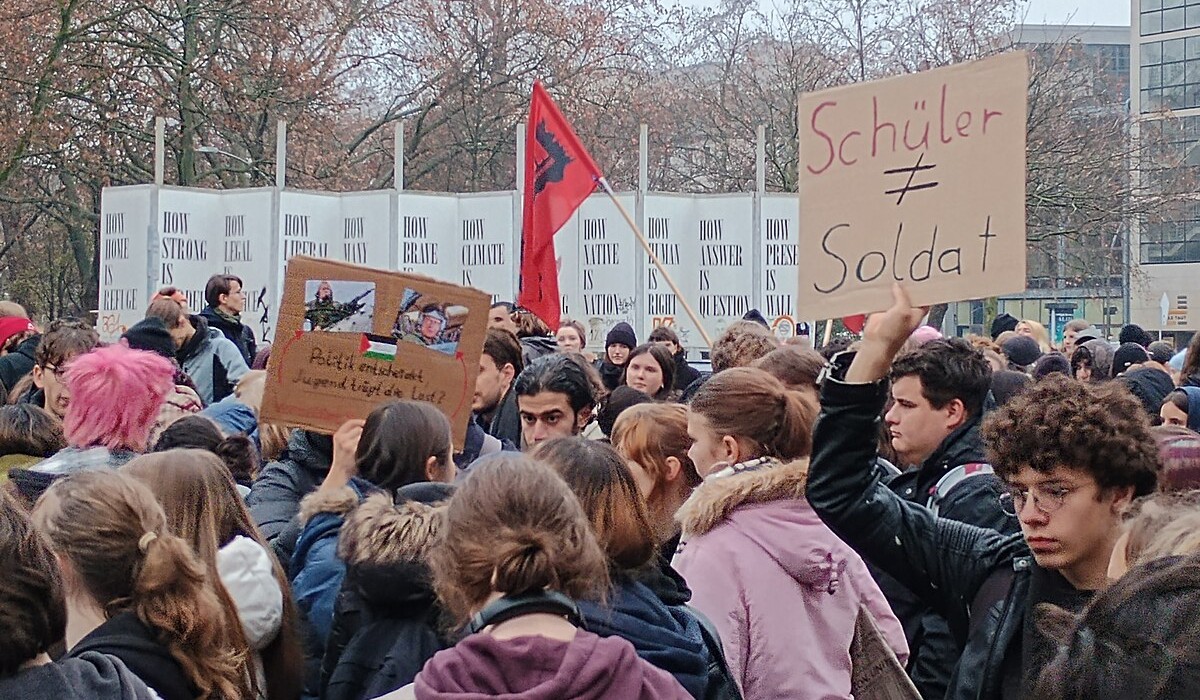
 School strikes against conscription in Germany. Photo: Roy Zuo / CC BY-SA 4.0
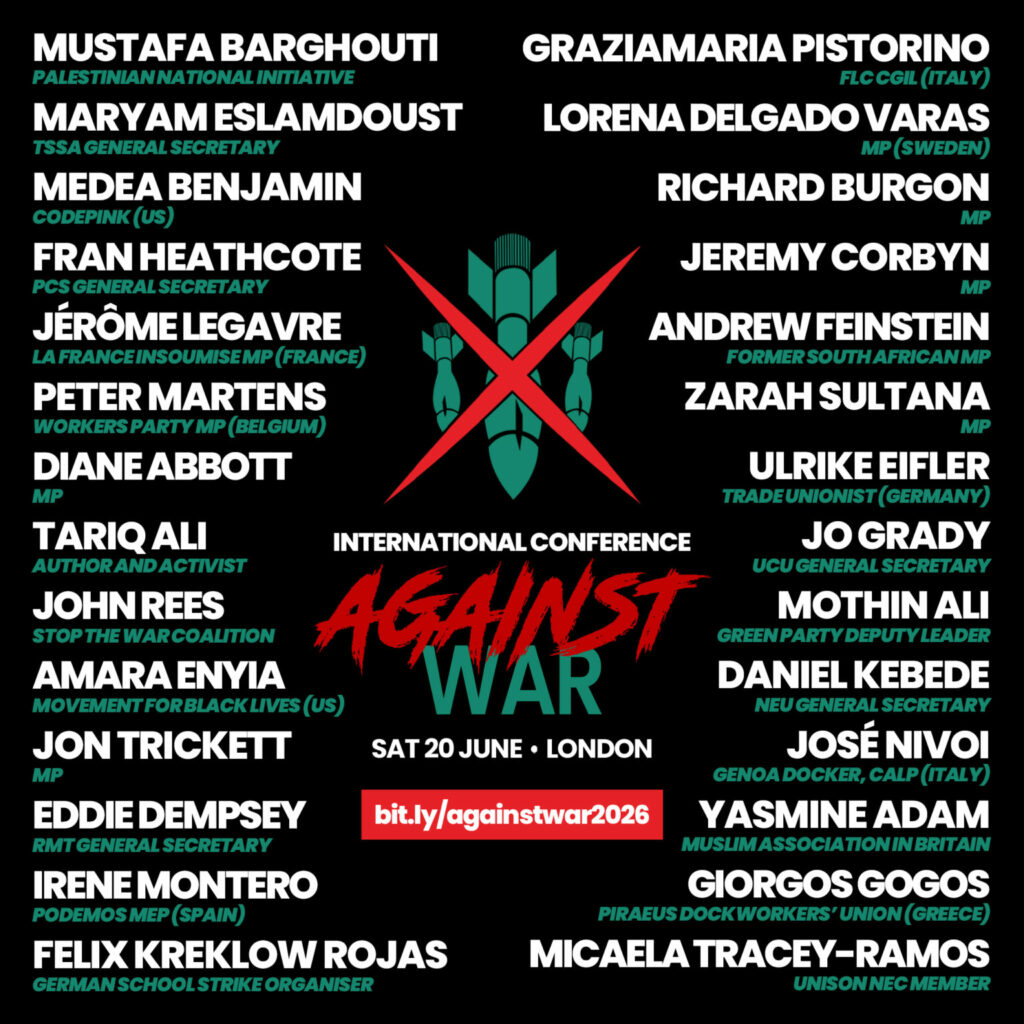
Jamal Elaheebocus spoke to Ulrike Eifler, a trade unionist and member of Die Linke in Germany, about why she is attending the International Anti-War Conference
Can you tell us who you are and why you’re attending the peace conference?
I come from Würzburg, an industrial region in northern Bavaria home to many mechanical engineering firms and automotive suppliers, where I serve as the Second Authorized Representative of the IG Metall trade union.
I am traveling to London because, as a trade unionist, there is no better place for me to be on June 20th than at this historic Anti-War Conference. We are currently witnessing the militarization of society, that extends deep into the world of work. Nurses are having to learn how to evacuate the dead and wounded. Teachers are required to invite soldiers into their classrooms for recruitment purposes. Employment agency staff are being trained to steer unemployed people toward military.
All of this demonstrates that militarization and war preparation are shaping the attacks on working class people. There are plans to extend working hours. Emergency laws restrict the right to strike. And there are already preparations to force us to remain at our workplaces in case of war. I want to talk about all of this at the conference and exchange views with others so that we can succeed in halting our governments’ war preparations.
What does the increasing militarism look like in Germany and what has the response been?
We are seeing a total militaristic permeation of the entire society in Germany now. Northern Germany, in particular, is being prepared to serve as a logistical hub. Our government anticipates that, in the event of a crisis on the Eastern Front, the rail, road, and transport networks would be tied up for months as thousands of troop units are routed across northern Germany to Eastern Europe.
Military exercises are taking place in Hamburg where the military, public authorities, and private companies practice working together for a wartime scenario. Cooperation among hospitals in Berlin and the surrounding area is also being practiced, simulating how the 1,000 wounded soldiers the government anticipates daily could be distributed among the hospitals.
Overall, resistance to this remains too muted. Yet, an impressive youth movement opposing conscription is growing in schools and universities. The repression directed at this movement is immense. That is also why the DGB (German Trade Union Confederation) – along with all eight of its affiliated unions – has sided with the youth and opposes conscription.
Why do you think having an international anti-war movement is important?
A few months ago in Greece, dockworkers in Piraeus refused to load a ship. The background to this was that activists from the BDS movement had informed them the vessel was carrying military equipment destined for Israel via a transshipment in Piraeus. When the union called for a refusal to unload the ship—arguing that workers should not become complicit in genocide—it was diverted to Italy for unloading.
This example demonstrates that effective anti-war work requires both the knowledge possessed by political groups and the organisational strength of the trade union movement. When the two combine, they can throw a wrench in the gears of the war machine. However, the example also shows that we must build international networks to effectively disrupt our governments’ war plans.
What are you hoping the conference will do for the anti-war movement?
The prominent German trade unionist and concentration camp survivor Willi Bleicher once said, “Millions are stronger than millionaires.” With this conference, we must lay the groundwork to unite the many diverse anti-war protests: we are witnessing protests against the genocide in Gaza in every country; we are seeing strikes against arms shipments in Greece, France, and Italy; and in Germany, we are experiencing a growing school-strike movement against conscription. In Belgium, trade unions are calling for general strikes against social spending cuts month after month. Meanwhile, in Russia and Ukraine, young men are resisting military service or deserting the front lines.
All of this reflects a growing anti-war sentiment. Our task is to bring these movements together to forge a shared perspective for resistance. At the same time, we must realize that the international peace movement will not form spontaneously, by chance, or on its own. An international organization is urgently needed—one capable of building this movement and serving as its backbone.
Before you go
The ongoing genocide in Gaza, Starmer’s austerity and the danger of a resurgent far right demonstrate the urgent need for socialist organisation and ideas. Counterfire has been central to the Palestine revolt and we are committed to building mass, united movements of resistance. Become a member today and join the fightback.
