
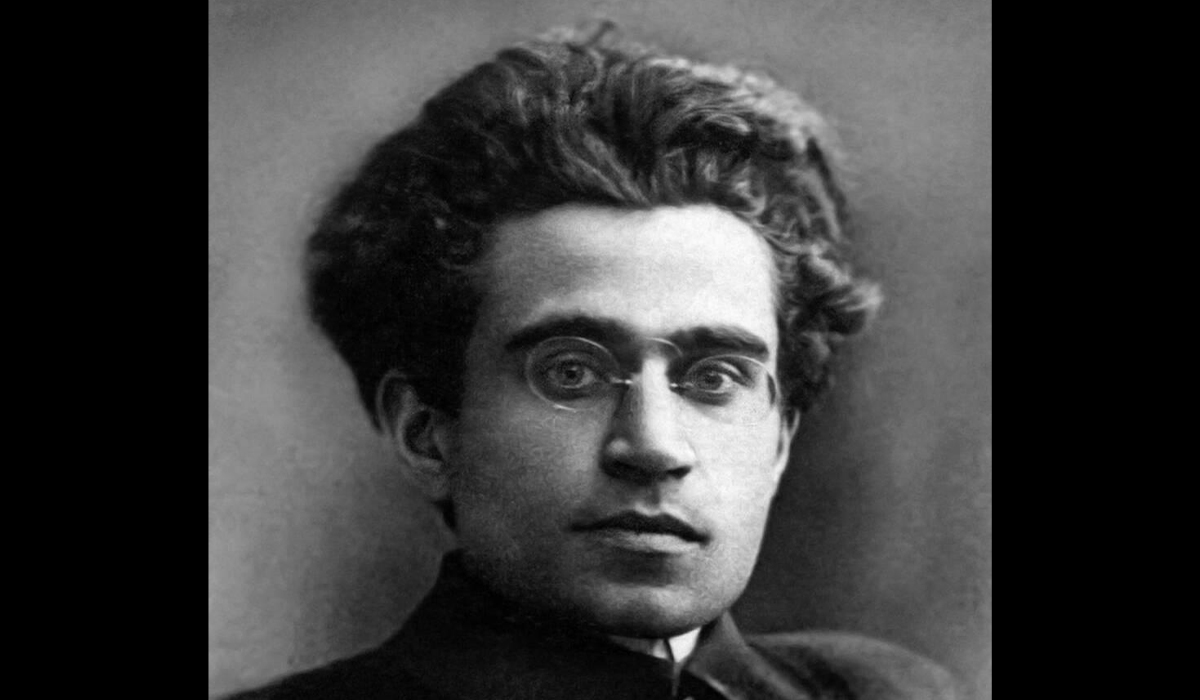
In the first in his series on Antonio Gramsci, Chris Bambery outlines how Gramsci came to write his famous Prison Notebooks and argues that, contrary to some opinion, Gramsci was a committed Marxist whose ideas were born from the revolutionary socialist tradition
Of all the great Marxist figures, Antonio Gramsci is one of the most often cited and least understood.
Gramsci, an Italian Marxist, was imprisoned by Mussolini’s fascist regime. From here he wrote his famous Prison Notebooks. The Prison Notebooks are literally just notes, written without the aid of a great number of reference books and in terrible the prison conditions, which undermined Gramsci’s already precarious health. It was in the Prison Notebooks that Gramsci laid out his theory of hegemony, explained in further detail later in this series.
Gramsci wrote under prison censorship and with the fear that his jailers would remove access to books and writing materials. So, he uses code in which Marxism is the “philosophy of Praxis” and Lenin become “Ilyich.”
Gramsci entered prison in 1926 as general secretary of the Italian Communist Party (PCI). He had attended the Fourth World Congress of the Communist International and had lived in Moscow for 18 months in 1922-1923, where he enjoyed discussions and debates with Lenin, Trotsky and other Bolshevik leaders.
What did Gramsci take from his time in Moscow?
The first was that he was won to the strategy of the united front, which would be particularly relevant in Italy where fascism had come to power in October 1922. The revolutionary wave of 1919-1920, which drew Italy into a revolutionary crisis, had ebbed. The then young Communist Parties had waged a war of the offensive, or ‘position’. Now they had to wage a war of manouvre in order to win the majority of the working class. The difference between these two kinds of wars is sketched out in Trotsky’s military writing.
The second was the difference between revolution in the east and in the west. At the Fourth Congress, there was an awareness among the Russians that their experience of revolution would not match that of Western Europe.
Trotsky addressed this:
“In countries that are older in the capitalist sense, and with a higher culture, the situation will, without doubt, differ profoundly. In these countries the popular masses will enter the revolution far more fully formed in political respects.”
He continued:
“What does this mean? This means it will hardly be possible to catch the European bourgeoisie by surprise as we caught the Russian bourgeoisie. The European bourgeoisie is more intelligent, and more farsighted: it is not wasting time. Everything that can be set on foot against us is being mobilized by it right now. The revolutionary proletariat will thus encounter on its road to power not only the combat vanguards of the counter-revolution but also its heaviest reserves. Only by smashing, breaking up and demoralizing these enemy forces will the proletariat be able to seize state power. But by way of compensation, after the proletarian overturn the vanquished bourgeoisie will no longer dispose of powerful reserves from which it could draw forces for prolonging the civil war. In other words, after the conquest of power, the European proletariat will in all likelihood have far more elbow room for its creative work in economy and culture than we had in Russia on the day after the overturn. The more difficult and gruelling the struggle for state power, all the less possible will it be to challenge the proletariat’s power after the victory.”
Gramsci had been centrally involved in Italy’s two ‘red years’, bienno rosso, of 1919-1920, in which he was centrally involved, had been contained and defeated. He was haunted by this failure and concerned with the reasons why it had come to be defeated.
Martin Clark points out that “Gramsci in prison thought constantly about the “revolution that failed” in 1919–20’ and that the ‘analysis of why revolutions fail is a major theme of the Prison Notebooks,’ providing ‘the stimulus’ for his views on hegemony, political organisations and parties, and intellectuals”. [i] In other words, this is how Gramsci came to formulate his theory of hegemony.
This theory had been used by the Bolsheviks pre-October 1917 and after, in relation to the alliance between the Russian working class and the peasantry. Gramsci would have read Gregori Zinoviev’s article[ii], ‘The Bolsheviki and the Hegemony of the Proletariat’, published in April 1923.
In the Prison Notebooks Gramsci looks back at these debates and advances them much further. But, he does so as a Marxist committed to socialist revolution.
He writes in the Prison Notebooks:
“The greatest modern theoretician of the philosophy of practice [i.e. Lenin] has in opposition to the various tendencies of ‘economism’ … constructed the doctrine of hegemony as a complement to the theory of the state-as-force.”[iii]
To state this is to state a minority position of so-called Gramsci scholars. All too often, Gramsci is counter posed to Lenin, and these scholars reduce the war of position to some reformist long trek through the institutions of parliamentary democracy.
Joseph A. Buttigieg offers this explanation of Gramsci’s motives in writing the Prison Notebooks:
“To be sure Gramsci’s total political commitment to the Communist cause made it imperative that he persist in his scholarly labours. He had to produce a thorough description of the many faces of power and its manifold loci in order to devise an effective strategy for the overthrow of the existing hegemonic order and for the establishment of a counter-hegemony-the very notion of the war of position and its successful outcome depend entirely on such a description.”[iv]
Frank Rosengarten rejects attempts to separate Gramsci from Lenin, Trotsky and other key figures in the Comintern is misconceived:
“Let it not be forgotten that it was Trotsky who taught Gramsci something of what he knew about revolutionary tactics and about the general conditions governing political struggle in the West as opposed to the East.” [v]
Continuing in that vein, Alan Sandro points to:
“… two distinct, though related, aspects of the struggle for hegemony: first, the problem of seizing the strategic initiative, including considerations such as aligning oneself in relation to allies, enemies and (potentially) revolutionary or counter-revolutionary forces and identifying (and establishing hegemony over) the key issues and institutions around which the struggle for power will be fought out and alliances formed or broken; second, what might be termed the problem of education, of cultivating among the popular masses the kind of organisational ability and capacity for critical reflection necessary for their emergence as independent actors in the revolutionary process.”[vi]
For Gramsci, after the victory of fascism communists were involved in a war of maneuver, in order to win hegemony over not just the working class but all oppressed groups. But at some point that would transcend into a war of position, culminating insurrection. AS he would wrire in the Notebooks:
There is for Gramsci an end – revolution:
“The decisive element in every situation is the permanently organised and long-prepared force which can be put into the field when it is judged that a situation is favourable (and it can be favourable only in so far as such a force exists, and is full of fighting spirit). Therefore the essential task is that of systematically and patiently ensuring that this force is formed, developed, and rendered ever more homogeneous, compact, and self-aware.”[vii]
Having set the scene, in the rest of this series I will examine key concepts to be found in the Prison Notebooks.
[i] Martin Clark, Antonio Gramsci and the Revolution that Failed, (New Haven, CT, Yale University Press, 1978) P225
[ii] https://www.marxists.org/archive/zinoviev/works/1923/04/hegemony.htm
[iii] Antonio Gramsci, Further Selections from the Prison Notebooks, (London, Lawrence and Wishart, 1995), P507
[iv] Joseph A. Buttigieg, The Legacy of Antonio Gramsci, boundary 2, Vol. 14, No. 3, The Legacy of Antonio Gramsci (Spring, 1986), P8
[v] Frank Rosengarten, The Revolutionary Marxism of Antonio Gramsci, Haymarket, Chicago, 2015, P41
[vi] Alan Sandro, Lenin and the Logic of Hegemony: Political Practice and Theory in the Class Struggle, (Leiden, Brill,2014), P8
[vii] Antonio Gramsci, Selections from the Prison Notebooks, (London, Lawrence and Wishart, 1971), P185
Before you go
The ongoing genocide in Gaza, Starmer’s austerity and the danger of a resurgent far right demonstrate the urgent need for socialist organisation and ideas. Counterfire has been central to the Palestine revolt and we are committed to building mass, united movements of resistance. Become a member today and join the fightback.

Chris Bambery
Chris Bambery is an author, political activist and commentator, and a supporter of Rise, the radical left wing coalition in Scotland. His books include A People's History of Scotland and The Second World War: A Marxist Analysis.