
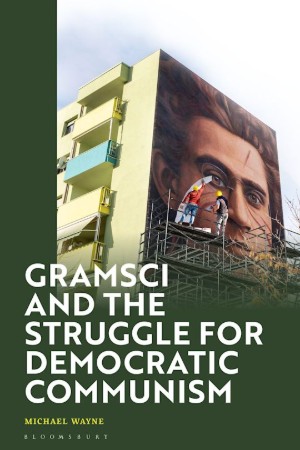
 Michael Wayne, Gramsci and the Struggle for Democratic Communism (London: Bloomsbury 2026), 328pp.
Michael Wayne’s analysis of Gramsci has its strengths, particularly on contemporary Britain, but is wrong to attack the October Revolution, argues Chris Bambery
There is much that is good in this book, but there is also much with which I have to disagree. That’s particularly the case Chapter 1, ‘Gramsci and communism’s democratic deficit’ and Chapter 3, Lenin and Gramsci on Economism and Hegemony’. Wayne contrasts Gramsci to Lenin and attacks the latter and the 1917 October Revolution.
Whenever there is a discussion of Antonio Gramsci, and especially his Prison Notebooks, it is crucial to remind ourselves that at all points post-1917, he regarded himself as a revolutionary and a Leninist. For Gramsci, the historic task of the working class is the capture of state power, and the creation of a ‘state of a special type’, similar to the Paris Commune and Soviet Russia in its early, revolutionary years. I think this is missing from Wayne’s analysis and it is important, because if that is left out, it opens the way to all sorts of reformist ways of utilising Gramsci, as the Italian Communist Party (PCI) did after 1945.
In his 1976 article, ‘The Antinomies of Antonio Gramsci’, Perry Anderson showed that it is impossible to understand Gramsci’s prison writings outside the context of the debates in the early Comintern: ‘The theory and practice of the Third International … had been saturated with emphasis on the historical necessity of violence in the destruction and construction of states. The dictatorship of the proletariat, after the armed overthrow of the bourgeois state apparatus, was the touchstone … Gramsci never questioned these principles. On the contrary, when he started his theoretical explanations in prison, he seems to have taken them so much for granted that they scarcely ever figure.’i
The second point about Gramsci was that from the Fourth Congress of the Communist International in late 1922 until his death in April 1937, Gramsci championed the united front; Lenin’s most important strategic gift to Western communists.
As the post World War I revolutionary upsurge of 1919-1920 ebbed away without a breakthrough, Lenin, ably assisted by Trotsky, recognised that the young Communist Parties organised a minority of the working class. The task now facing them was to win a majority; to win those who still looked to the old social-democratic and labour parties.
That was to be achieved by organising common struggle for partial demands, against unemployment and fascism for instance. This was met by fierce resistance inside the leadership and parties of the Communist International, the organisation linking together the Communist Parties of the world. That was the case in Italy.
Gramsci and the united front
Gramsci attended the Fourth World Congress of the Comintern in late 1922, only weeks after Benito Mussolini came to power. There, both Lenin and Trotsky made a special effort to win Gramsci to the united-front strategy and succeeded. From exile in Vienna and then from Rome following his election as an MP in 1924 (which gave him parliamentary immunity), Gramsci would fight to win the PCI to this strategy.
When he gained the leadership of the PCI, he produced one of his most important writings, the Lyons Theses; the key document of the 1926 congress of the PCI. It lays down a united-front strategy for opposing Mussolini’s fascist dictatorship: ‘The principle that the party leads the working class must not be interpreted in a mechanical manner … The capacity to lead the class is related, not to the fact that the party “proclaims” itself its revolutionary organ, but to the fact that it “really” succeeds, as a part of the working class, in linking itself with all the sections of that class and impressing upon the masses a movement in the desired direction and favoured by objective conditions. Only as a result of its activity among the masses will the party get the latter to recognise it as “their” party (winning a majority); and only when this condition has been realised, can it … draw the working class behind it.’
Leadership required the party taking up immediate or partial struggles: ‘The Communist Party links every immediate demand to a revolutionary objective; makes use of every partial struggle to teach the masses the need for general action and for insurrection against the reactionary rule of capital … In every case, the party utilises the experience of the movement in question, and of the outcome of its own proposals, to increase its influence—demonstrating through facts that its action programme is the only one which corresponds to the interests of the masses and to the objective situation—and to transport a backward section of the working class on to a more advanced position.’
The stress on the united front did not stop Gramsci from continuing to define the ultimate tasks of the Communist Party as: ‘(a) to organise and unify the industrial and rural proletariat for the revolution; (b) to organise and mobilise around the proletariat all the forces necessary for the victory of the revolution and the foundation of the workers’ state; (c) to place before the proletariat and its allies the problem of insurrection against the bourgeois state and of the struggle for proletarian dictatorship, and to guide them politically and materially towards their solution, through a series of partial struggles.’
The vote at the Lyon congress reflected Gramsci’s rearming and rebuilding of the party – he secured 90.08% of the vote. The Lyons Theses and Gramsci’s leadership of the PCI, prior to his imprisonment, is never discussed by Wayne. Neither does he reference the debates Gramsci participated in at the Fourth Congress of the Communist International, some of the richest and most imprtant in the history of Marxism.
I would argue you cannot read the Prison Notebooks without understanding Gramsci was defending this united-front approach against the Stalinist madness of the Third Period which declared revolution was imminent, social democracy was not an opponent of fascism but its twin and world Communist parties had to go on the offensive.
In contrast, Gramsci challenged the idea that the mass of Italian workers was breaking with reformism, and that the country was approaching a revolutionary situation that would sweep fascism away and install the dictatorship of the proletariat. Instead, he pressed for united action with the Socialists and other anti-fascists, and for the raising of a demand for a constituent assembly. He believed that if fascism fell, as a result of the global recession that followed the 1929 Wall Street Crash, for instance, the strongest likelihood was this would be followed by a period of parliamentary rule.
Interestingly, at exactly the same time, Trotsky was also arguing that if fascism fell, it might well be superseded by a period of democratic rule, rather than socialist revolution, and argued that revolutionaries could raise democratic demands and ‘invest them with the most audacious and resolute character possible.’ He too called for the creation of a constituent assembly. For his efforts, Gramsci was ostracised in prison by other PCI members.
In defence of October
I start with all this because it is missing from Wayne’s book and it is crucial to an understanding of much of the Prison Notebooks. Because they are personal notebooks and they were written under prison censorship, they are written almost in code which means they are open to interpretation from those hostile to the revolutionary Marxism Gramsci espoused.
Wayne’s view of the October Revolution is that it was the product of Lenin’s ‘own moment of ultra-leftism in 1917 when he proclaimed that the soviet state was ready to replace the more familiar institutions of a representative type.’ For Wayne, this attempt was doomed to end in tragedy (p.246). He further argues that the soviets were not capable of being new popular organs of representative rule and the new state the Bolsheviks created was a repressive one. Before going on to counter that argument, it’s worth pointing out that in 1917 there were few if any ‘familiar institutions of a representative type’ of any great substance in Russia.
Lenin’s views on the state, on the bourgeois nature of the Russian Revolution, on the peasant question, on imperialism, and on the party and much else, shifted and changed significantly, influenced by developments in international capitalism – the war above all – and the debates in the Second International and outside after its collapse in August 1914. The positions he outlined in State and Revolution, above all the commune state, had only been recently arrived at and were still developing.
Wayne argues that ‘at the level of democratic political institutions (as opposed to policies) there was a historic falling short, and a sustained failure to really think about what democratic political institutions could realise the democratic ethos of communism in the longterm’ (pp.7-8). He goes on to argue: ‘Even after Russia’s involvement in the First World War was ended in 1918 and after the civil war was won in 1920, the democratic deficit was hardly considered a mortal danger to the revolution by its leading figures. They were indifferent to the question of democratic political institutions or hubristically confident that they could invent new, more democratic organs in the forbiddingly difficult situation of post-revolutionary Russia. Many revolutionary leftists have hardly moved the dial of their thinking on this over one hundred years later and still invoke workers councils as an advance on representative organs with little or no discussion of the specificity of the political forms of rule that would mediate those councils’ (pp.19-20).
What’s missing here is the virtual destruction of the Russian working class in the civil war and consequently the soviets, plus all civil-society institutions. The Bolsheviks made the revolution believing Russia was the weak link in the chain and this would lead to revolution in Western Europe, in Germany principally. When that happened, Soviet Russia would take the backstage and develop utilising German industry and skill.
None of them thought a new Germany would mirror Russia and Lenin stressed the contrast between the east, where it was easier to make a revolution but harder to build socialism and the west, where matters were vice versa. Lenin and the Bolsheviks cannot be blamed for the failure of the European revolution, the civil war, imperialist intervention and blockade, or the destruction of industry and famine.
Tucked away in a footnote is an interesting argument: ‘In the absence of that [a successful Western European revolution], a restoration of capitalism in some form was inevitable. Better, in my view – for the Soviet people, for the reputation of communism and indeed for future revolutions that were often compromised by the Soviet Union, that the restoration was back to a form of democratic capitalism than totalitarian rule (accumulation by the state/party)’ (p.251).
However, a restoration back to democratic capitalism was not on the agenda. If the Whites had won the Civil War, counter-revolution would have won and taken the form of something like fascism. The Bolsheviks were holding on for the international revolution but Trotsky, while looking to Germany in 1923, Britain in 1926 and China in 1925-7, stressed the need to rebuild party democracy and for gradual industrial development to revive working-class democracy.
The Left and United Oppositions were, unfortunately defeated, and Stalin triumphed but even that was not inevitable. Victor Serge pointed to the enthusiasm within Russia for the Chinese Revolution and the hopes it engendered, and the apathy which followed defeat.
Wayne rightly points to the Bolsheviks’ positive record on women’s liberation, but he could also have pointed to Lenin’s demand that the right to self-determination had to apply in the Soviet Republics. In other words, a majority of the leadership in Ukraine and Georgia had to be Ukrainians and Georgians. This became the subject of Lenin’s last fight, that against Stalin’s removal of the Georgian leadership. This stress on the right to self-determination was not abstract but decreed that these regions had the right to run their own affairs using the majority language, to create schools, courts of justice and other institutions on the same basis.
Sharia was recognised as part of the new Soviet legal system. An early Soviet appeal promised Muslim workers and peasants that: ‘Henceforth your beliefs and customs, your national and cultural institutions are declared free and inviolable … build your national life freely and without hindrance.’ This often involved sharp arguments with the local Bolsheviks, often Russian settlers, who dominated the original soviets. The new government in Moscow championed the rights of the indigenous people against them, including the right to take back land granted by the Tsarist authorities to colonists.
State, the revolution and dual power
Lenin was open to other possibilities of political rule in Soviet Russia. Thus he wrote ‘On Cooperatives’ in 1923, urging support for co-operatives inside revolutionary Russia. In it, he argued: ‘There is a lot of fantasy in the dreams of the old cooperators. Often they are ridiculously fantastic. But why are they fantastic? Because people do not understand the fundamental, the rock-bottom significance of the working-class political struggle for the overthrow of the rule of the exploiters. We have overthrown the rule of the exploiters, and much that was fantastic, even romantic, even banal in the dreams of the old cooperators is now becoming unvarnished reality.
‘Indeed, since political power is in the hands of the working-class, since this political power owns all the means of production, the only task, indeed, that remains for us is to organize the population in cooperative societies.’
There is a richer history of dual power, not just during Russia’s revolution in 1917, but elsewhere too, but Wayne does not factor in those other experiences. The socialisation of land in Aragon in 1936 during the Spanish Civil War was done on the basis of voluntary co-operatives. The right of individual peasant families to cultivate their own land was recognised, as long as it was not more than was necessary for their needs. For example, in Catalonia in 1936 and 1937, the takeover of workplaces following the military coup was largely spontaneous but then became controlled by the trade unions. Far more interesting as organs of dual power were the neighbourhood committees who organised the street fighting in July 1936 and the 1937 May Days. They arranged food and other services, and maintained order.
Nevertheless, Wayne attacks, ‘all that frankly childish talk of “smashing the state” which suggests starting from scratch, in complete contradiction with the Marxist notion that socialism inherits its preconditions from capitalism’ (p.100). But it was not just Lenin in his ‘ultra-left’ moment of October 1917 who argued this; it was the conclusion Marx came to from the 1871 Paris Commune.
The Bolsheviks and the working class of St Petersburg had to respond to the September 1917 coup by General Kornilov which was out to destroy the soviets and the revolution. The defeat of that coup saw the Kerensky regime fall apart. In the aftermath, the Bolsheviks faced a choice; making the revolution or being ‘smashed’ by reaction.
They also had to respond to something else. The mass of the Russian population, not just the working class, wanted an end to the war. Only the Bolsheviks promised that. Arrayed against them were not just every other political formation but also what remained of the state. The bulk of the army wanted the war to end. To end the war required making the revolution.
Wayne refers to some of the arguments I make, mockingly writing that power was ‘snatched away from the working class’ because the European revolution did not happen or ‘because, as luck would have it, some murderous tyrant just happened to come along’ (p.223).
Of the latter, it’s mocking because it ignores the materialist explanation of how Stalin truimphed, rooted in the isolation of the Russian revolution. Take that away and Wayne’s arguments seem to echo the Cold War consensus that Lenin led to Stalin; something I and others in the revolutionary tradition reject utterly.
Gramsci has great strengths, but unlike Lenin, he never addressed imperialism and the rise of national-liberation movements. Lenin’s strategy combined working-class struggle in the developed world and national liberation struggles in the colonial world, even if led by non-communists. This broke new ground and his stress on anti-imperialism remains crucial today.
So, what’s good in Wayne’s book? Chapter 7, ‘Gramsci and the British Cultures of Neoliberalism, is outstanding. Chapter 4, ‘Trotsky and Gramsci on Politics and the Culture of Everyday Life’, is very good, although marred by Michael’s opposition to October.
I broadly agree with his Chapter 8, ‘Gramsci and the Venezuelan Revolution’. My own experience of Caracas in 2005, when the Bolivarian revolution was at its peak, was that there were elements of dual power, the missions in the barrios and the neighbourhood committees, but they were largely uncoordinated and too dependent on the state, the army above all.
Since then, those elements of dual power have weakened, and the Bolivarian administration is corrupt and self-seeking. The proof of that came at the start of this year following Trump’s kidnapping of President Maduro and his wife. The government responded by simply caving into Trump’s demands, particularly giving US oil giants control of the country’s oil.
The concluding chapter, ‘Gramsci and the Contradictions of the Coming Revolution’, centres on the need to map out forms of popular rule which are representative and both vertical and horizontal. On that I broadly agree. I agree too that the soviet model of 1917 has great strengths but cannot be simply replicated.
In James Hinton’s, The First Shop Stewards Movement, he produces a map of Glasgow’s engineering plants which sent shop stewards to the Clyde Workers Committee in 1915, a proto soviet. The point is that such revolutionary democratic organs no longer exist and we cannot conjure them back. On the site of Parkhead Forge, there is now a shopping centre with a major supermarket. The latter is unionised but it’s a sweetheart deal. It can be organised but how requires strategic thinking.
Wayne is right to bring Gramsci to that strategic table and to open a debate on building new, popular and representative organisations of the working class, by which I mean in its widest sense and not just the industrial proletariat. Wayne provides some useful insights but does not map out such a strategy. For that I don’t blame him because it will require much wider discussion involving wider forces, individuals and views. On that I am sure Wayne would agree.
i Perry Anderson, ‘The Antinomies of Antonio Gramsci’, New Left Review I/100, (1976), p.46.
Before you go
The ongoing genocide in Gaza, Starmer’s austerity and the danger of a resurgent far right demonstrate the urgent need for socialist organisation and ideas. Counterfire has been central to the Palestine revolt and we are committed to building mass, united movements of resistance. Become a member today and join the fightback.

Chris Bambery
Chris Bambery is an author, political activist and commentator, and a supporter of Rise, the radical left wing coalition in Scotland. His books include A People's History of Scotland and The Second World War: A Marxist Analysis.