
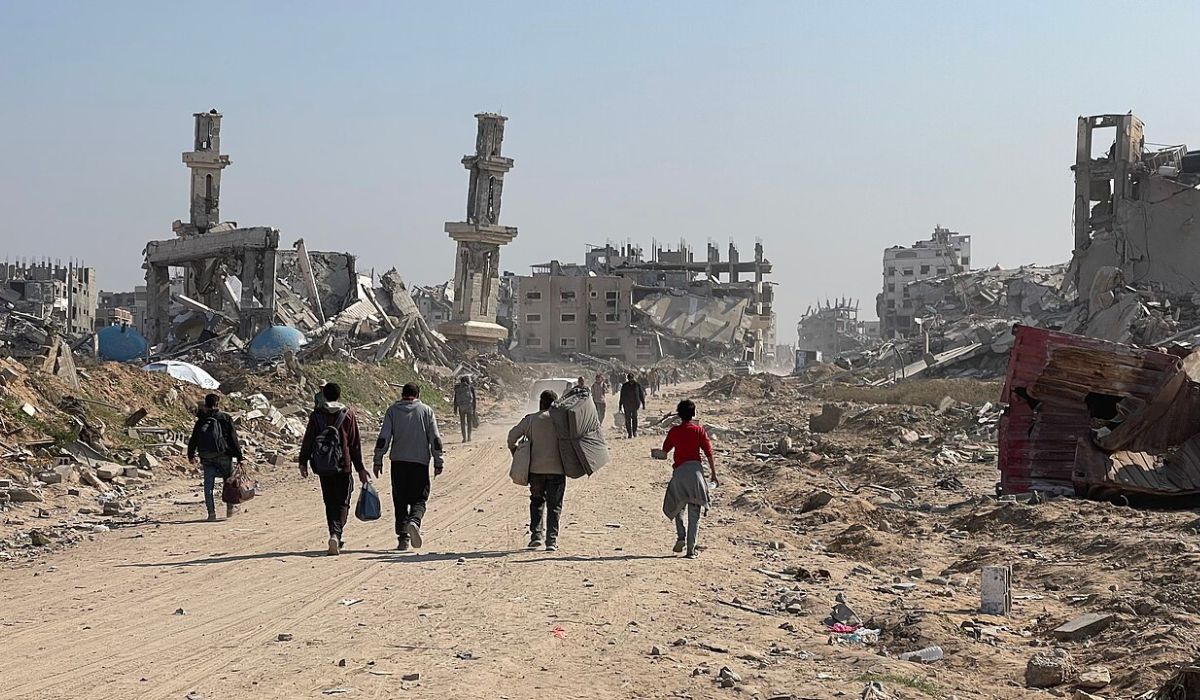
 Displacement of Gaza Strip Residents During the Gaza-Israel War 23-25. Source: Jaber Jehad Badwan - Wikicommon / cropped from original / CC BY-SA 4.0
Israel has shown itself committed to forever wars, but is failing in its aims to destroy Hamas, defeat Iran, and now Hezbollah in Lebanon. Chris Bambery analyses
Over 3000 Lebanese civilians have now been killed in Israel’s war on Lebanon. The war has displaced over 1.05 million people. Four hundred have been killed since Israel supposedly declared a ceasefire last month. Israeli warplanes are targeting the capital, Beirut, and villages in the south of the country and the Bekaa Valley.
This dreadful war has obvious parallels with Israel’s genocidal war on Gaza:
“Israel has repeated the Gaza playbook in its war on Lebanon: intense aerial bombardment and illegal mass evacuation orders that lead to the large-scale displacement of civilians; the destruction of civilian infrastructure and border towns to make way for so-called “buffer zones” occupied by Israeli troops; the targeting of hospitals and healthcare workers; and the killing of journalists. And, as it did with Gaza, the West largely looks on with indifference.”
But despite inflicting heavy civilian casualties, Israel is far from defeating Hezbollah with its fighters operating in the so-called “security zone” the IDF has created north of the Israeli-Lebanese border.
Israeli Prime Minister, Benjamin Netanyahu has admitted publicly that Israel is far from defeating Hezbollah. Earlier this month he told the Israeli Defence (IDF) Force high command:
“I do not delude myself that this will come easily, nor do I think, and I say this honestly – the job is not done.”
Israel believed that in the June 2025 war, they had degraded Hezbollah, particularly its stock of drones and missiles, but Northern Israel is coming under daily attack, with much of the population having been evacuated.
Hezbollah used the past months to re-arm, aided by the Iranian Revolutionary Guards (IRGC) and utilising their “mosaic defence, “the decentralisation of military command. Weaponry has been smuggled through Syria, despite the collapse of the Assad regime.
The Financial Times quoted an Israeli military official saying:
“Hezbollah returned to what it used to be – a guerrilla force that tries to strike when it can, using hit-and-run tactics. It’s trying to get back to its old capabilities.”
The group has also utilised first-person view (FPV) drones, first used in the Ukraine war. In recent weeks, these have been increasingly used against UDF soldiers in the so-called “security zone,” running north of Israel’s border with Lebanon.
Hezbollah has posted numerous videos of assault drone attacks on stationary Israeli vehicles, particularly on numerous Israeli Merkava tanks using guided anti-tank missiles and pre-planted explosive devices.
Israel began by pledging to destroy Hezbollah but has had to backtrack and now says its goal is securing its security zone.”
“… on April 3, the IDF reframed its objectives more narrowly, saying militarily disarming Hezbollah was unrealistic because such an endeavour would require occupying all of Lebanon, which surpasses Israel’s means.”
Both goals cannot be achieved simply through an air war, it requires infantry operations.
Both Tel Aviv and Washington are demanding the Lebanese government disarm Hezbollah, but is simply beyond the means of a state seriously divided along religious lines. Neither can they do anything to stop the Israeli attacks.
In this situation, Hezbollah has come to be seen as the one force defending Lebanese sovereignty:
“Israeli military pressure has also contributed to the partial depopulation and economic paralysis in southern Lebanon. It has created a contested buffer zone where state authority is minimal. In this environment, Hezbollah has assumed the de facto responsibility for deterrence and response, reinforcing a dual security structure in which the Lebanese state plays a secondary role.”
The overwhelming majority of displaced refugees within Lebanon are Shi’ite. They face hostility from other groups in Lebanon. If they look east, they see what they perceive as a Salafi regime in Syria, which seeks revenge for Hezbollah’s support of Bashar al-Assad’s regime. To the south is Israel, which has promised to destroy Hezbollah. In that situation, they are not going to support the group being disarmed.
There is also the question of what Israel is seeking as a permanent settlement:
“The proposal to create an economic zone in the border area could well set up a governing authority that has a say on who can enter such an area. This means that, given its participation in such an authority, Israel could be granted veto power over which Lebanese citizens can access sovereign Lebanese territory. The Israelis may also demand the freedom to deploy forces inside Lebanon and continue overflights to guard against potential threats, and might even demand oversight over Lebanon’s borders with Syria.”
This is a land grab, effectively extending Israel’s borders. A step towards creating the greater Israel championed by Netanyahu and the far right, including National Security Minister Itamar Ben-Gvir and Finance Minister Bezalel Smotrich.
As Israel nears a general election, which promises to be very close, the far right is upping the ante.
The far-right National Security Minister, Itamar Ben-Gvir, posted a video of himself taunting handcuffed hostages, forced to kneel on the ground, who had been seized from the convoy heading to Gaza while in international waters. This has prompted protests from the Spanish, French, Canadian and Italian governments.
Ben-Gvir is also shown waving a large Israeli flag next to dozens of activists kneeling on the ground with their hands tied behind their backs. He tells them in Hebrew, “Welcome to Israel. We are the masters.”
Far-right Israeli Finance Minister Bezalel Smotrich claims he has been told the prosecutor of the International Criminal Court (ICC) has requested a “secret” arrest warrant for him.
He described this as “a declaration of war” and blamed the Palestinian Authority, the powerless body supposedly in charge of the West Bank.
The ICC has recently denied that warrants had been issued for five unnamed Israeli officials.
Smotrich – who is in charge of Israeli policies in the occupied West Bank – responded by ordering the demolition of Khan al-Ahmar, a prominent Palestinian Bedouin village.
A Palestinian Authority official denounced the order as “a dangerous escalation”.
In 2018, Israel’s Supreme Court upheld an eviction order for Khan al-Ahmar, but it has not been enforced after warnings from the United Nations, the ICC and others that this would violate international law.
Whoever wins, the upcoming election in Israel is a country committed to forever wars. Its weapons industry is also increasingly important, and those wars showcase what’s on offer.
But having failed to destroy Hamas in Gaza, having failed to dismember Iran, it is now failing to destroy Hezbollah. Zionism has always relied on its supposed invincibility to deter any state from attacking it. Now it does not look so invincible.
If – and this is a big if – the US and Iran reach a settlement, it will have to include an end to the war in Lebanon, which Tehran will demand. Then, Trump either has to tell Netanyahu to stop or ignore that peace deal. What Trump would do then is anyone’s guess.
Before you go
The ongoing genocide in Gaza, Starmer’s austerity and the danger of a resurgent far right demonstrate the urgent need for socialist organisation and ideas. Counterfire has been central to the Palestine revolt and we are committed to building mass, united movements of resistance. Become a member today and join the fightback.

Chris Bambery
Chris Bambery is an author, political activist and commentator, and a supporter of Rise, the radical left wing coalition in Scotland. His books include A People's History of Scotland and The Second World War: A Marxist Analysis.