
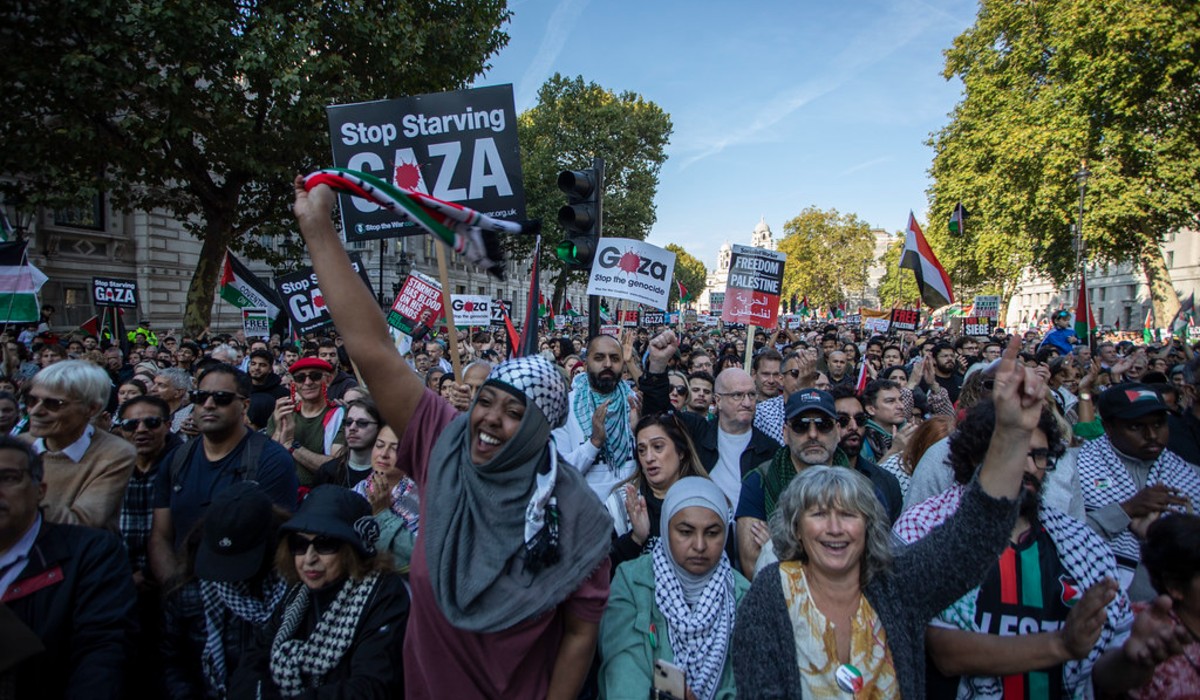
 Palestine demonstration in London. Photo: Steve Eason / Flickr / CC BY-NC 4.0
Paul Heron, solicitor, represents the Stop the War Coalition and the Campaign for Nuclear Disarmament at the Undercover Policing Inquiry (UCPI). Here he expresses his concern about calls by the Police Commissioner and the Prime Minister to ban future marches for Palestine.
Recent statements by senior political figures and policing authorities proposing restriction, or even an outright ban, on Palestine solidarity marches mark a deeply troubling escalation in attempts to curtail democratic freedoms in the UK. These calls, echoed by the Independent Reviewer of Terrorism Legislation, Jonathan Hall KC, come in the wake of appalling anti-semitic attacks which must be unequivocally condemned. However, the effort to link such acts of violence to mass protests for Palestine is both unfounded and dangerous.
As organisations with long-standing commitments to peace, anti-racism and international solidarity, the Stop the War Coalition and the Campaign for Nuclear Disarmament have rejected entirely any attempt to conflate anti-semitism with opposition to the actions of the Israeli government. Anti-semitism is a form of racism that must be confronted wherever it appears. No individual should face violence or discrimination because of their religion or ethnicity. But to suggest that protests opposing the devastation in Gaza are responsible or influence such attacks is a serious distortion of reality.
For over two years, hundreds of thousands of people have taken to the streets in the UK to express solidarity with Palestinians. These demonstrations have brought together a broad coalition of trade unionists, faith groups, anti-racist campaigners, and crucially, many Jewish organisations who reject the claim that these are “hate marches.” On the contrary, they are a visible expression of opposition to war, occupation, and the catastrophic humanitarian consequences of ongoing military actions. They represent the best of us.
The scale of destruction in Gaza, including the loss of tens of thousands of lives, the targeting of civilian infrastructure such as hospitals, and the displacement of entire communities, has rightly provoked widespread public outrage. These marches are not only acts of solidarity but also protests against the role of the British government in supporting or enabling these policies. To criminalise such expressions of dissent is to undermine the very principles of democratic accountability.
There is little doubt that existing legal powers are more than sufficient to address any unlawful conduct during protests. The police already possess very extensive authority to impose conditions and act against individuals suspected of criminal offences. Any additional restrictions on the right to protest must meet the strict legal tests of necessity and proportionality. A blanket ban would fail these tests and set a dangerous precedent. It maybe the Palestine demonstrations today, but it could be trade union protests tomorrow!
Equally concerning is the broader political and mainstream media offensive that appears to be developing. Their portrayal of Palestine solidarity marches as inherently suspect risks allowing sweeping restrictions not just on these demonstrations, but on wider civil liberties. There is a clear danger that these developments form part of a wider agenda to suppress protest more generally. The right to peaceful assembly and freedom of expression are cornerstones of any democratic society. Once eroded in one context, they become vulnerable in all others. All of us need to take note.
As legal representatives of movements with deep histories of campaigning against war and injustice, we stand firmly against any attempt to ban or unduly restrict Palestine solidarity marches. We also stand in solidarity with all communities facing racism and violence, including the Jewish community, and affirm that the fight against anti-semitism must go hand in hand with the fight against islamophobia and the need to defend democratic rights.
Efforts to scapegoat protest movements for acts of hatred they do not endorse or incite must be rejected. The path forward lies not in repression, but in solidarity, accountability, and the fight for fundamental freedoms.
Reposted from Public Interest Law Centre.
Before you go
The ongoing genocide in Gaza, Starmer’s austerity and the danger of a resurgent far right demonstrate the urgent need for socialist organisation and ideas. Counterfire has been central to the Palestine revolt and we are committed to building mass, united movements of resistance. Become a member today and join the fightback.
