
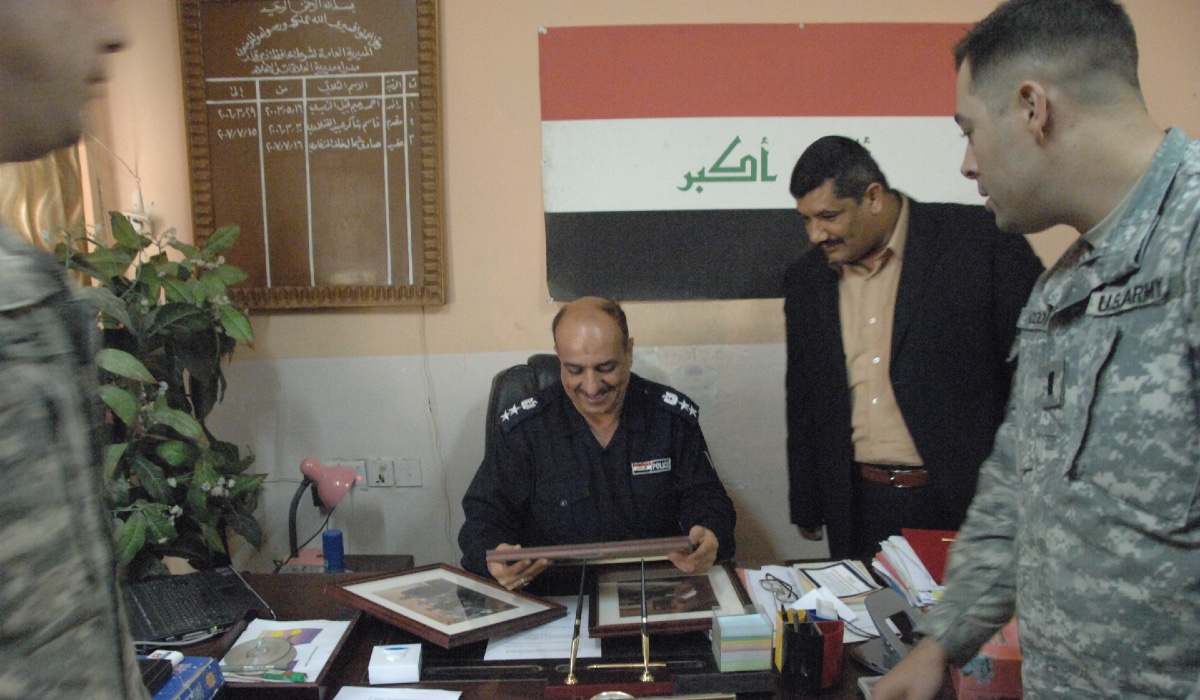
 US soldiers with Iraqi officials in 2010, during Operation 'Iraqi Freedom'/ Spc. Ernest Sivia III, Public domain, via Wikimedia Commons
The 2003 invasion of Iraq didn’t end, it continued through the wholesale neoliberalism of its economy and state, which is the meaning of its corruption, argues Mehiyar Kathem
Many people assume that the West, particularly the United States and Europe, is opposed to corruption in Iraq. In Iraq, we know that this is not true.
After the United States destroyed Iraqi institutions and dismantled the Iraqi state in 2003, it began supporting a small cadre of politicians. Through them, it sought to steer Iraq in a direction of its choosing. The theft of Iraqi resources was normalised. But this theft should not be understood simply as ‘lost money’. It was money used to create a new political and social class tied to the post-2003 order.
State resources were illegally extracted and increasingly invested in the private sector. In this way, corruption became one of the mechanisms through which a new political economy was built. It transferred public wealth into private hands, while producing politicians, investors, contractors, businesses, NGOs, media platforms, private universities, and social groups whose interests became tied to the weakening of the state.
The United States has also used Iraq’s oil money, particularly through the mechanisms of the US Federal Reserve and the flow of Iraqi oil revenues, as an instrument to shape Iraq’s elite politics. Control over these financial flows has allowed the United States to exert pressure over Iraqi policy, influence who is allowed to enter government, and determine who is excluded from power. In this sense, Iraq’s oil wealth has not functioned simply as national revenue. It has become part of a broader system of external control over Iraq’s political class and state direction.
The broader Western goal has been the total privatisation of Iraq. This has been unfolding since 2003 and is accelerating today. On Iraq’s current trajectory, everything is being pushed towards privatisation: hospitals, schools, universities, communications, cultural heritage, public services, and many other sectors.
This is neoliberalism: a system in which the market and the private sector become equal to, or stronger than, the state itself. In Iraq, neoliberalism has not simply been an economic policy. It has been instrumentalised as a political weapon to weaken, hollow out, and dismantle the Iraqi state.
This was clear in Prime Minister al-Zaidi’s statement that ‘the old economy is dying, and the new economy is waiting to be born.’ The phrase echoes Antonio Gramsci, although it is used inaccurately. Gramsci was referring primarily to political crisis, not to the privatisation of the economy. Yet the phrase reveals something important about the direction Iraq is being pushed towards: the death of the public economy and the birth of a privatised order.
Al-Zaidi’s policy is not simply to encourage private investment. It is to privatise what remains of the Iraqi state, or what has not already been privatised, and to transfer the power, capacity, and functions of the state to the private sector. This means that the state is not being rebuilt. It is being hollowed out further. Its responsibilities are being handed over to private actors whose interests are not necessarily national, public, or accountable.
The United States continues to exert influence over Iraq. A new class of investors, politicians, contractors, and sections of society now work to ensure the continuation of the post-2003 neoliberal order. What Iraq has today is worse than a normal market economy. It is a weak state with little regulation of the private sector, limited capacity to build national development programmes, and an economy increasingly captured by private interests.
Neoliberalism and the attack on the Iraqi state did not end after 2003. They continue today. What we are witnessing now is not a new economic vision, but the continuation of the same policies that began with the destruction of the Iraqi state after the invasion. The language has changed. The actors have multiplied. The private sector has grown stronger. But the direction remains the same: the weakening of the public state and the empowerment of private interests.
So when we speak about ‘corruption’ in Iraq, we should not reduce it to bribery or stolen money. Corruption is also the transfer of state resources to non-state actors. It is the privatisation of public wealth. It is the reproduction of neoliberalism. And above all, it is the continued weakening of the Iraqi state in favour of the private sector.
Before you go
The ongoing genocide in Gaza, Starmer’s austerity and the danger of a resurgent far right demonstrate the urgent need for socialist organisation and ideas. Counterfire has been central to the Palestine revolt and we are committed to building mass, united movements of resistance. Become a member today and join the fightback.
