
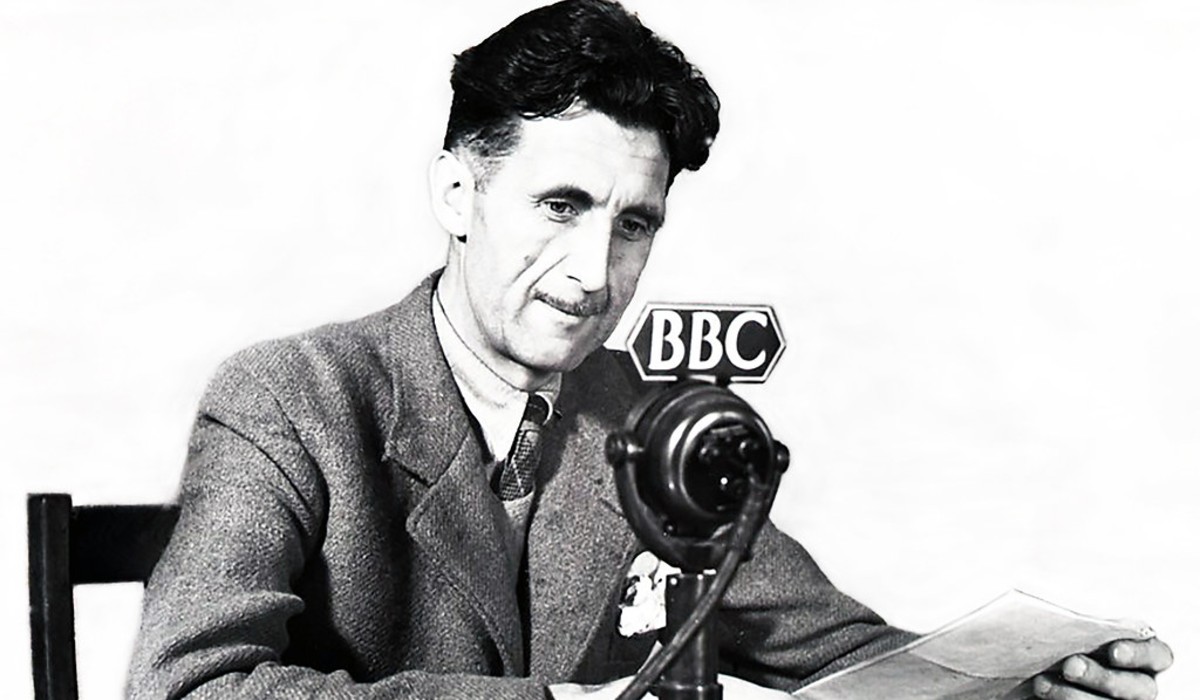
 George Orwell. Photo: Levan Ramishvili / Flickr / Public domain
This film on Orwell’s political observations seeks to draw parallels with authoritarian regimes in his times and now. Elaine Graham-Leigh explores this narrative
It’s well known that George Orwell had no time for the idea that literature could be unpolitical. He wrote in his essay ‘Politics and the English Language’ that ‘there is no such thing as keeping out of politics’; works which purport to do so are simply supporting the political status quo. This documentary obediently includes this quotation, but ultimately does not grasp its meaning.
Director Raoul Peck’s aim, according to the film’s publicity, was to set out new ways of seeing Orwell and his works, making the case that Orwell, particularly in his last book, 1984, was ‘remarkably prophetic’ about twenty-first-century world politics. Peck does this through juxtaposing quotations from 1984, other novels, Orwell’s non-fiction writing and letters, with clips of modern-day events. These are presented without comment – the only voiceover is Damian Lewis reading Orwell’s words – as we see for ourselves the connections the film is presenting.
Some of this is interesting, particularly sections on Orwell’s childhood, his time at Eton and as a military policeman in Burma, although not exactly revelatory if you know anything about Orwell’s life. Some of it feels like padding, taking about an hour’s worth of material to a more cinematic one hour 59 minutes. It all adds up though to an argument which, deliberately or not, ends up in a more liberal place than you might expect.
The film is carefully even-handed in its selection of modern dictatorial regimes and their atrocities, giving the impression that it is trying to rise above the details; to be, in fact, apolitical about a political argument. There is a lot of Trump and a lot of Putin, but there is also footage from, among others, Burma, Honduras, El Salvador, Sudan and China. The lack of any documentary script means that none of the conflicts we’re shown is explained, so any political context has to come from the audience’s prior knowledge.
The effect is to imply that all of the events shown proceed from the same causes and can be understood in the same way. This elides significant differences between the examples: in what sense, for example, is ongoing conflict in Haiti the same thing as the social-credit system in China? It also moves the argument from one about how Orwell in 1984 predicted some developments of modern society to something which appears to be saying that there is no significant difference between the political context of the 1930s and 1940s and that of the 2020s.
Orwell was dying of TB when he wrote 1984, a fact to which the film returns with the sound of laboured breathing over images of TB bacilli. The treatment of the various modern political events shown takes Orwell’s TB from a background to the film to a central metaphor. By removing the context, the film ends up reifying totalitarianism. Rather than a political development that can arise and be resisted in various ways, it becomes a disease with which societies can be infected, with no more reason or political explanation than that.
This is not a framing which is particularly useful for challenging the system. There is in fact little here in the roster of bad guys that would challenge Western left-liberal opinion. While Gaza and Lebanon are mentioned, there is comparatively little about Israel, which, considering the centrality of questions like how states lie to promote their interests, seems like a pointed omission. Russia’s invasion of Ukraine is more prominent, but shorn of any Nato-related context. The selection at the end of the film of a number of protests from around the world, illustrating the message that there is hope if people will refuse to be fooled, continues this lack of challenge. It correctly includes Black Lives Matter protests, but leaves out the worldwide protests over Gaza since 2023, including instead an Israeli protest for the return of the hostages.
Orwell was an important writer, and his fiction and non-fiction remain well-worth reading. This film is a demonstration of the correctness of his argument that any apolitical art is the art of the political establishment. That is a useful lesson of which to be reminded, but having had that reminder, there are better ways of spending two hours.
Before you go
The ongoing genocide in Gaza, Starmer’s austerity and the danger of a resurgent far right demonstrate the urgent need for socialist organisation and ideas. Counterfire has been central to the Palestine revolt and we are committed to building mass, united movements of resistance. Become a member today and join the fightback.

Elaine Graham-Leigh
Elaine Graham-Leigh is an activist and writer of history, politics and fiction. She is the author of The Southern French Nobility and the Albigensian Crusade, (Woodbridge: The Boydell Press, 2005), A Diet of Austerity: Class, Food and Climate Change, (London: Zero Books, 2015), Marx and the Climate Crisis, (London: Counterfire, 2020), The Caduca, (Canterbury: The Conrad Press, 2021) and Revolution in Carcassonne: The Story of a Fourteenth-Century Rebellion, (London: Whalebone Press, 2025). She is a founding member of Counterfire.