
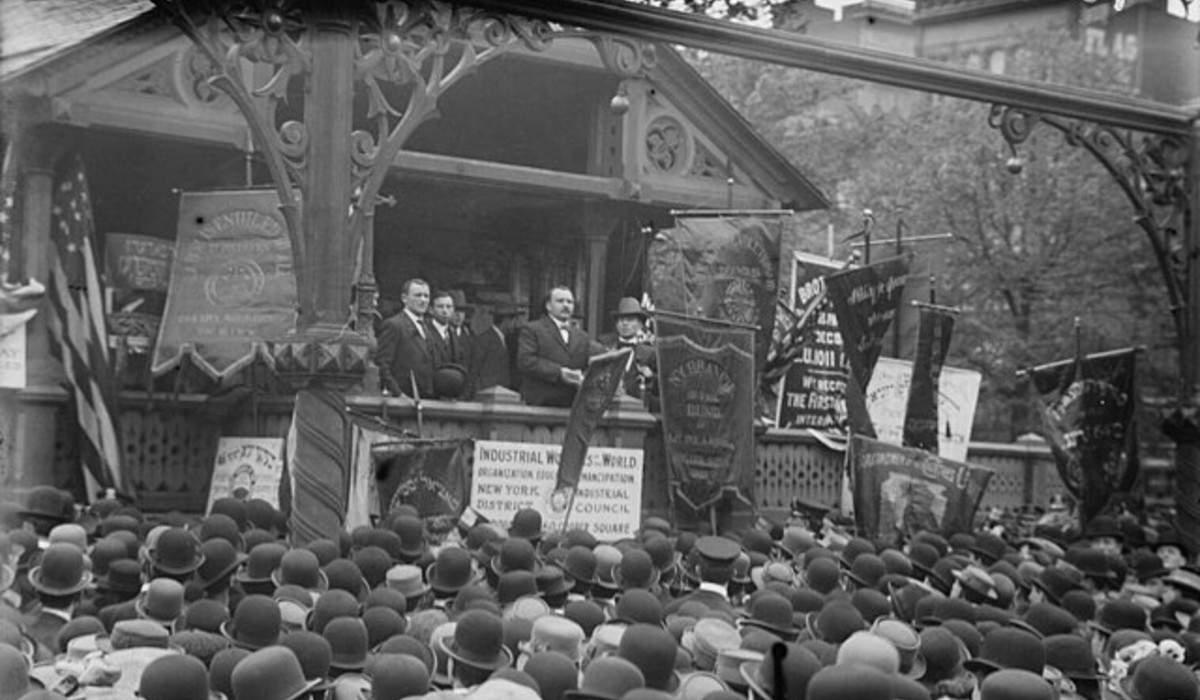
 James Connolly addresses a crowd in New York City on May Day, 1908. Photo: Public Domain
Lewis Akers examines the ideas of James Connolly, one of the leaders of the 1916 Easter Rising
The Edinburgh-born socialist and trade unionist James Connolly was a man who, throughout his life, was committed to the fundamental transformation of society from below. He had little faith in bureaucrats or politicians to change the world, believing instead that socialism had to emerge from below. It was not something that could be imposed upon workers from above, but had to come from them. A hundred years on from his execution by the British for the key role he played during the Easter Rising, there are key ideas espoused by Connolly which should be taken up by the left as touchstones for navigating many of the challenges we face today—challenges that are strikingly similar to those faced by the movement in Connolly’s time.
Socialism From Below
Connolly was committed throughout his life to the fundamental transformation of society from below. He had little faith in bureaucrats or politicians to change the world, believing instead that socialism had to emerge organically from working people themselves.
Much of this distrust was vindicated during the 1913 Dublin Lockout, when Connolly requested both material and practical support from British trade unions. They failed to back his calls for sympathetic strikes at a time when the Irish Transport and General Workers Union (ITGWU) and its members were under severe financial pressure.
A key lesson of the dispute was that workers can only rely on themselves and the wider working class to win their battles. While official institutions may offer support, they cannot be depended upon entirely. These lessons remain crucial for the modern left. Due to the weakness of the left and independent organisation rank and file organisation, many look to politicians and union leaders for direction. However, real leadership must be built from below: the rank and file must organise and, where necessary, push leaders into action. Change is not something that can be implemented from the top down; it must come from workers themselves as the driving force of transformation.
These principles are essential when considering how to revitalise the trade union movement. They also point to the need for independent, bottom-up revolutionary organisation capable of advancing serious politics. This is particularly relevant in the context of the squabbling and disunity seen in initiatives such as Your Party, which have squandered momentum that might otherwise have offered a meaningful alternative to the racism of Reform and the timidity of the Greens.
Democracy, Sovereignty and Self-Determination
As an Irish republican and a key figure in the 1916 Rising, Connolly recognised the need to combine his belief in socialism from below with a clear-sighted commitment to self-determination, sovereignty, and socialist politics. He saw these as interconnected rather than separate. He famously said:
‘If you remove the English Army tomorrow and hoist the green flag over Dublin Castle, unless you set about the organisation of the Socialist Republic your efforts will be in vain. England will still rule you. She would rule you through her capitalists, through her landlords, through her financiers, through the whole array of commercial and individualist institutions she has planted in this country and watered with the tears of our mothers and the blood of our martyrs.’
This captures a key principle that guided Connolly throughout his life. The liberation of Ireland from the British Empire was not about symbolism or national exceptionalism, but about transferring power to working-class people and paving the way for socialist transformation.
This perspective remains relevant today. Debates around sovereignty and political alignment—such as positions on Nato or the European Union—highlight ongoing tensions about where power resides and how it is exercised. For Connolly, political independence without economic and social transformation would be insufficient.
His focus on dismantling the British state as a means of advancing socialism provided socialists in Scotland with a tradition to relate too, particularly with regards to the SNP’s commitment post independence to retain key elements of the British state such as foreign policy alignment, monetary policy and constitutional arrangements.
If the left is to rebuild within working-class communities – especially among those who feel excluded and disempowered – it is essential to draw on Connolly’s insight that bringing power closer to the people is central to achieving meaningful social change. This approach may also counter the ability of right-wing movements to present themselves as defenders of democracy and sovereignty, and instead help to construct a credible left alternative capable of challenging reactionary politics. This is particularly important at a time when the Greens are on the rise but due to their support for Nato and the EU, will be unable to connect with large sections of the working class who want to see power closer to home and distrust transnational organisations to act in their best interests.
Opposing War at Home and Abroad
In a time when war is raging across the world, from Ukraine to Gaza, perhaps Connolly’s most important guiding principle was his uncompromising opposition to war. Unlike many of his contemporaries, Connolly joined socialists such as Lenin, Luxemburg and Trotsky in opposing the First World War on the basis that it was a capitalist conflict that would achieve little for working people.
He was clear that the duty of socialists during wartime was, first and foremost, to oppose the war efforts of their own governments in order to prevent working-class people from different nations slaughtering one another on the battlefield. In writing in the aftermath of the declaration of war, he argued that if workers wanted to achieve peace, fighting workers from other countries was not the solution. Instead, it was crucial to oppose the politicians, financiers, and media figures who beat the drums of war while remaining insulated from its brutal consequences.
In the current period, many trade unionists and socialists would do well to revisit Connolly’s response to the drive to war. His principled opposition and insistence on resisting militarism at home were tragically vindicated by the senseless slaughter of ordinary men in battles such as the Somme, which left countless families devastated.
However, this lesson appears to have been forgotten by some on the left who advocate for increased arms spending or have focused heavily on military solutions in conflicts such as Ukraine, rather than prioritising pathways to peace. Connolly’s principles of anti-imperialism and opposition to war are in clear need of rediscovery. There is good reason to believe they would resonate widely, as polling in recent years has repeatedly suggested that majorities are sceptical of war and of British involvement in conflicts, whether in Iran, Gaza, or Ukraine.
Connolly’s Politics 100 Years on
It is clear that Connolly’s politics are as relevant today as ever. In a world once again marked by extreme inequality and the drive to war – much as it was in Connolly’s time – his ideas and principles provide the left with a foundation on which to organise a fightback. They offer a clear antidote and alternative to reactionary politics and militarism. Connolly’s lessons from the past remain there to be grasped. If they are taken up, the left has a chance to build socialism from below and to push for a fundamental transformation of society—from one based on profit to one centred on people.
Before you go
More war, escalating authoritarianism, a deepening cost of living crisis – the left faces big challenges.
But resistance is also growing.
Counterfire has been at the heart of the mass movements against war, in solidarity with Palestine, and against austerity. Given the scale of the crisis, we urgently need to ramp up our operations. We need your help to raise £30,000 to make that happen.
