
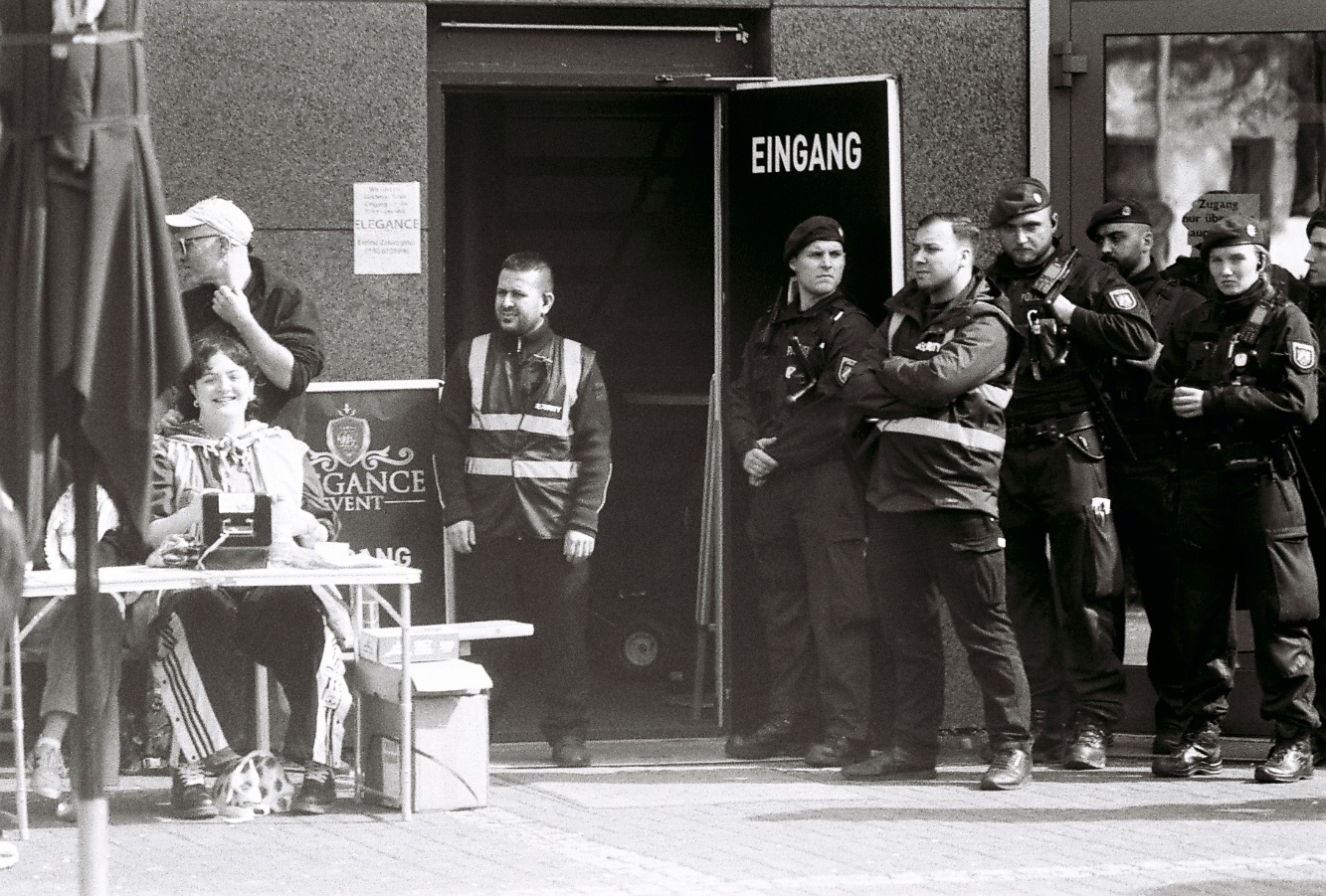
 Palestine Solidarity Conference before it was broken up by the police, Berlin, April 2024. Wieland Hoban was one of the organisers.
Photo: Robert Dale / Wieland Hoban, Germany’s Jewish Problem: Genocides Past and Present (New York: O/R Books 2026), 282pp.
Palestine Solidarity Conference before it was broken up by the police, Berlin, April 2024. Wieland Hoban was one of the organisers.
Photo: Robert Dale / Wieland Hoban, Germany’s Jewish Problem: Genocides Past and Present (New York: O/R Books 2026), 282pp.
Germany’s Jewish Problem is a gripping account of Jewish involvement in the Palestine movement in Germany under particularly difficult conditions, finds Robert Dale
Germany’s Jewish Problem reads rather like a slow-burn thriller. The first two hundred pages track the author’s thoughts as a Jewish anti-Zionist activist in Germany between October 2020 and July 2023. The reader knows there’s a time bomb ticking, set to go off on 7 October 2023. But the protagonist, the author Wieland Hoban, doesn’t yet. That already makes it a fascinating read.
Hoban is one of the leading lights of the German-based Jewish Voice for a Just Peace in the Middle East (Jüdische Stimme für gerechten Frieden in Nahost). This small organisation has played an outsized role in Germany’s Palestine solidarity movement. I first came across the group in autumn 2023, when they were key to asserting any kind of public protest at all.
During the first weeks after 7 October, all public displays of solidarity were verboten. The first to break the ban was Jewish Voice member Iris Hefets (who contributed the introduction to the book). On 14 October, she stood alone on a public square in Berlin with a placard saying, ‘As an Israeli and a Jew, stop the genocide in Gaza’. And was harassed by the police for her pains. If I remember rightly, it was also Jewish Voice who organised the first public assembly in Berlin that was not banned, a candlelit vigil at the Brandenburg Gate. In case it’s not obvious, their Jewish identity made it harder for the German police simply to trash their gathering.
Most of the book, whose full title is Germany’s Jewish Problem: Genocides Past and Present, deals with the period before 7 October. It comprises a series of articles and interviews originally published in The Battleground. Hoban lays out the difficulties and debates faced by a Jewish activist working in Germany, clearly and in detail: the shrill accusations that opposing Israel is ‘antisemitism’, the BDS controversies, the contested definitions of antisemitism (the IHRA document), the pressure applied to public figures who speak out and the internal politics of the Jewish communities.
While the book frames these as German problems, I couldn’t help thinking that they are essentially the same questions that activists have been dealing with in other countries. Sure, the pressure was greater here, the repression harsher and the push-back slower and weaker.
As Hoban lays out in the last quarter or so of the book, the German authorities’ initial clampdown was ferocious. Most public demonstrations were prohibited, with severe police violence against those that did occur. Many speech bans were imposed, including ‘from the river to the sea’, any mention of ‘genocide’, comparison of any kind with ‘the Holocaust’ and any mention of the names of armed resistance groups, just for starters.
There were potentially severe repercussions for speaking up, too. People lost their jobs, cultural organisations were stripped of public funding and closed down, artists and authors (not a few of them Jewish, ironically) had exhibitions cancelled and prizes rescinded. So what followed was also a fight for free speech and the right to demonstrate.
International comparisons
As that struggle played out, initially at least, non-German activists played an outsized role: Jewish, Palestinian and European/American. The Irish contingent was very visible. These people were keyed into discussions outside Germany, and somewhat shielded from the social pressures. I know, for example, that the non-German contingent at the external broadcaster Deutsche Welle were up in arms over the rules on news coverage. During this phase, mass participation by Germany’s Muslim communities did not transpire in the way it did elsewhere.
I often heard rather superior tut-tutting from the Anglo/European crowd about the dismal attitude of ‘the Germans’. Unfair and unproductive, I felt. Other societies also have issues that are ‘unmentionable’. The fate of northern Ireland’s Catholics in Britain until the 1990s for example. Palestinian solidarity during the campaign against Corbyn in 2017–2019. The lack of any meaningful pushback against Britain’s expensive, deadly, war-prolonging meddling in Ukraine. If you think of the public atmosphere on those issues at their respective times, you get some idea of what it was like here.
I have found the question of why it has been like this rather puzzling. In the end, I think that it is probably just the normal state of affairs. When it comes to war and imperialism, our rulers will always choose to clamp down. How much we can push back depends on many factors, and in Germany the constellation was unfavourable.
When they choose to wield the ideological bludgeon of the Holocaust, it is bigger and heavier here, although passive ‘public opinion’ has not been particularly pro-Israel. In the Muslim and immigrant communities, veiled threats of loss of citizenship and deportation for forbidden speech acts certainly will not have encouraged participation. I also wonder about the influence of developments that are largely forgotten, yet somehow embedded into the political substrate. In Britain, the struggle in Palestine resonates with earlier liberation struggles against British colonialism and with the anti-apartheid movement. You could probably even make a case that there is a whiff of British shame at having created the whole mess in the first place. Those are stories that largely passed Germany by.
You can read Germany’s Jewish Problem for the differences in Germany, such as the harshness of the repression or the bizarre institution of the ‘antisemitism czar’. But you can also read it for the issues that are essentially similar, where Hoban’s dissection under such a strong spotlight is particularly clarifying.
It’s probably worth mentioning that there are a number of ‘Jewish problems’ in Germany that this book does not set out to address: The fundamental question of where antisemitism comes from. The question of why the Nazis singled out the Jews (as we see in Ukraine, where Jewish billionaire Ihor Kolomoyskyi funded the neo-Nazi Azov, a philosemitic fascism is possible). Questions around the Holocaust: was it a singular act of particularly German madness or a particularly horrific example of the barbaric tendencies inherent to capitalism?
To close, the movement here did break through in the end, with two very large and successful demonstrations in summer 2025 (for details see Counterfire reports in June and September). Interestingly, they were both organised by individuals outside the activist circles who had embodied the movement until that point. Hoban’s book ends in September 2024, after which he apparently stopped writing for The Battleground. I guess he has probably just been too busy. I do hope he writes a sequel.
Wieland Hoban, Germany’s Jewish Problem: Genocides Past and Present is available from O/R Books.
Robert Dale lives in the Berlin region, where he has been active in socialist politics since the 1980s.
Before you go
The ongoing genocide in Gaza, Starmer’s austerity and the danger of a resurgent far right demonstrate the urgent need for socialist organisation and ideas. Counterfire has been central to the Palestine revolt and we are committed to building mass, united movements of resistance. Become a member today and join the fightback.
