
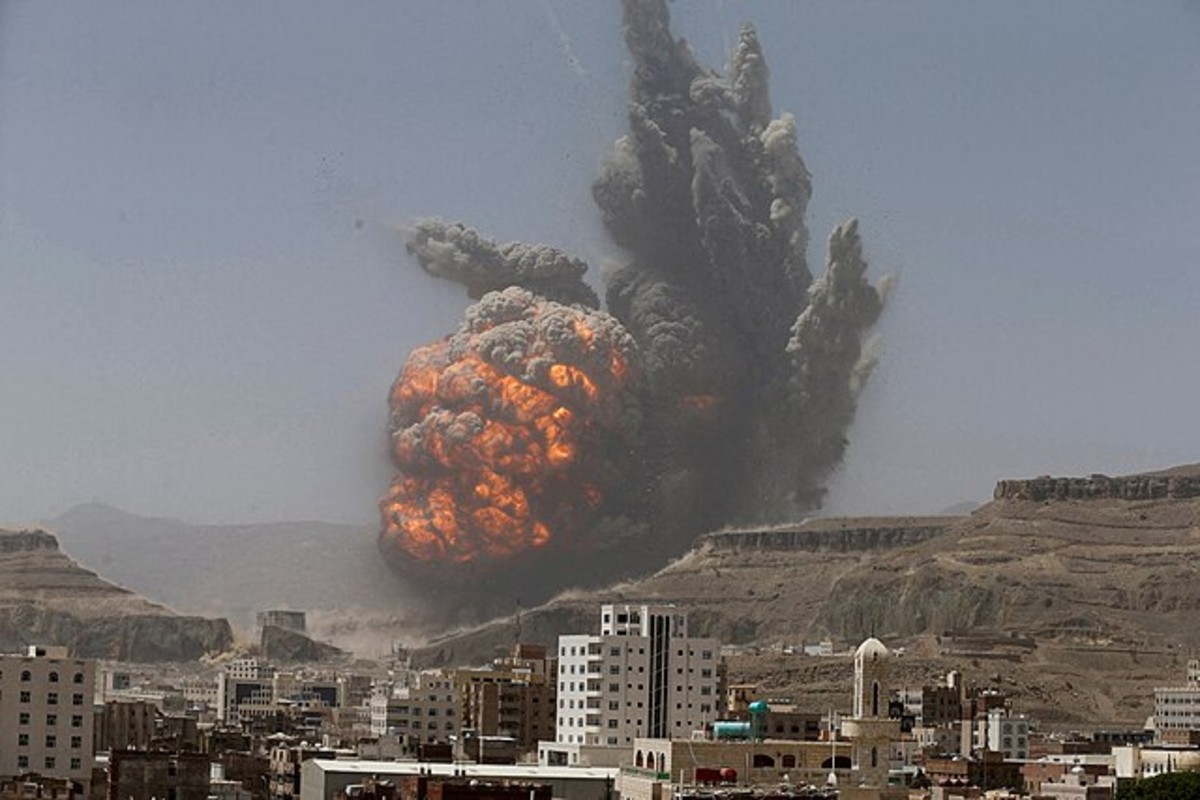
 Bombing of army weapons depot in Yemen's capital Sanaa during Saudi-led coalition bombing campaign 2015. Photo: CC0 1.0 Universal
Not only is a possible ground invasion of Iranian territory fraught with uncertainty, but the role of Saudi and other Gulf states also opens further dangerous implications, argues Chris Bambery
The Washington Post has reported that the US is about to launch a land operation against Iran. Some 3,500 US sailors and marines arrived in the region on the USS Tripoli, US Central Command announced on Friday. Centcom said it arrived in the ‘area of responsibility’ on Friday.
Centcom posted on X that: ‘U.S. Sailors and Marines aboard USS Tripoli (LHA-7) arrived in the U.S. Central Command area of responsibility, March 27. The America-class amphibious assault ship serves as the flagship for the Tripoli Amphibious Ready Group/31st Marine Expeditionary Unit composed of about 3,500 Sailors and Marines in addition to transport and strike fighter aircraft, as well as amphibious assault and tactical assets.’
This is despite Donald Trump extending his ultimatum that Iran must open the Strait of Hormuz by ten days to 6 April. It also flies in the face of what Secretary of State, Marco Rubio, told reporters on Friday that the war will end in weeks, not months, and the US doesn’t need boots on the ground to succeed. But Tehran will treat this with deep suspicion after the US twice attacked it while both states were engaged in negotiations.
The Iranian parliament speaker, Mohammad Bagher Ghalibaf, who has published a message marking thirty days since the start of the US-Israeli war on Iran, stating that Iranian forces ‘are waiting for the arrival of American troops on the ground to set them on fire and punish their regional partners forever.’ He added: ‘Our firing continues. Our missiles are in place. Our determination and faith have increased.’
This should not be treated just as bombast. Speculation is that the US is aiming to seize Kharg Island, home to Iran’s oil main terminal. That would require either US warships sailing through the Strait of Hormuz or a long-distance airborne operation. The Iranians would have time to track both and have missiles, drones, underwater Cruise missiles, mines and more dug in along the Strait.
The other issue is what role Saudi Arabia and the Gulf States would play. They are home to extensive US bases and facilities which Iran has targeted with some success.
A Saudi intelligence source has told the New York Times that Crown Prince Mohammed bin Salman, has urged Donald Trump not to cut short his war against Iran, and that the US-Israeli campaign represented a ‘historic opportunity’ to remake the Middle East.
The source said Riyadh was not just calling for the American military campaign to be continued, but to be intensified. Speaking of the Crown Prince, Donald Trump told journalists on Tuesday: ‘Yeah, he’s a warrior. He’s fighting with us.’ According to the source, Saudi’s leadership is also weighing a decision on whether to join the fight directly.
After Iran fired ballistic missiles at Riyadh last week, Saudi Foreign Minister Prince Faisal bin Farhan stated: ‘We have reserved the right to take military actions if deemed necessary.’ The Washington Post also reports that three officials, two European and one Arab, told it that if
Tehran doesn’t agree to severe restrictions on its missile, drone and nuclear programs, the leaderships of Saudi and the United Arab Emirates leadership would support an escalated military campaign aimed at pressuring Iran to return to the negotiating table and accept Washington’s conditions.
Saudi Arabia’s role
Saudi has been under steady missile and drone attacks from the start of the war. On Friday, an Iranian missile hit the Prince Sultan air base in Saudi Arabia damaging an American E-3 Sentry, an airborne warning and control aircraft that is critical in managing battlespace and tracking drones, missiles and aircraft from hundreds of miles away. As Iran took out a number of key American radar stations in the region at the very start of the war, these aircraft are crucial to American operations. The attack also wounded a dozen American troops.
Ukraine signed a defence cooperation pact with Saudi Arabia, giving assistance in defending Saudi against drone attacks from Iran. Some 200 Ukrainian personnel will help Saudi’s missile defences. President Volodymyr Zelenskyy said the agreement, ‘Lays the foundation for future contracts, technological cooperation, and investment.’
Saudi is doing well economically, in contrast to other Gulf States. There has been a sharp divergence in the market performance of Saudi Arabia and Oman with that of Qatar, the United Arab Emirates, Kuwait and Bahrain. Oman’s index has surged 9.3% since 1 March, the day after the war began, while the Saudi Tadawul has risen 5.8%. In contrast, Dubai’s DFM General Index has plunged nearly 16% over the same period, with Qatar sliding 4% and Bahrain’s BAX falling 7.2%.
Saudi is able to export its oil via the Red Sea because of its east-west pipeline and has thus benefitted from rising oil prices. Oman, which is further away from Iran, is seen as a safe haven.
Saudi’s index, which is closely correlated to energy markets, has been turbo-charged by the spike in oil prices, while Oman has benefitted from investors seeking a safe haven, reallocating from the other Gulf States.
But Saudi still remains vulnerable. A week ago an Iranian drone strike hit an oil refinery in Yanbu on Saudi Red Sea coast. It signalled that Iran can hit Saudi’s economic lifeline. Riyadh will also be very nervous about the Houthis, whose missile strike on Israel means they might join the war on the side of Iran. They are capable of hitting Saudi hard and that would also mean its missile defence systems, already stretched, would be operating on two fronts.
Saudi has a modern air force but its most recent combat experience, against the Houthis between 2015-2022, was not a success. Its campaign struggled tremendously with its targeting techniques against mobile missile and drone sites. Instead, it attacked civilian targets, bringing considerable international opprobrium against Riyadh.
The Saudis must have concerns about joining the war. Firstly, they would be aware Trump is capable of declaring victory when there is none and leaving them to face Iran. Secondly, they would be entering a war alongside Benjamin Netanyahu and Israel which would play very badly with their own populations.
Thirdly, if the Iranian Islamic Republic survives, which looks likely, it will have to live with Iran after this war is over. The relationship between Saudi and Iran has always been fraught, despite an accord brokered by China in 2023.
If Trump launches a ground attack on Iran, it will extend the war in a dramatic and dangerous way. It will also mean Iran will extend its attacks on Saudi and the Gulf States plus closing the Strait of Hormuz.
Chris Bambery is the author of The Second World War: A Marxist History, (Pluto Press, 2014)
Before you go
The ongoing genocide in Gaza, Starmer’s austerity and the danger of a resurgent far right demonstrate the urgent need for socialist organisation and ideas. Counterfire has been central to the Palestine revolt and we are committed to building mass, united movements of resistance. Become a member today and join the fightback.

Chris Bambery
Chris Bambery is an author, political activist and commentator, and a supporter of Rise, the radical left wing coalition in Scotland. His books include A People's History of Scotland and The Second World War: A Marxist Analysis.