
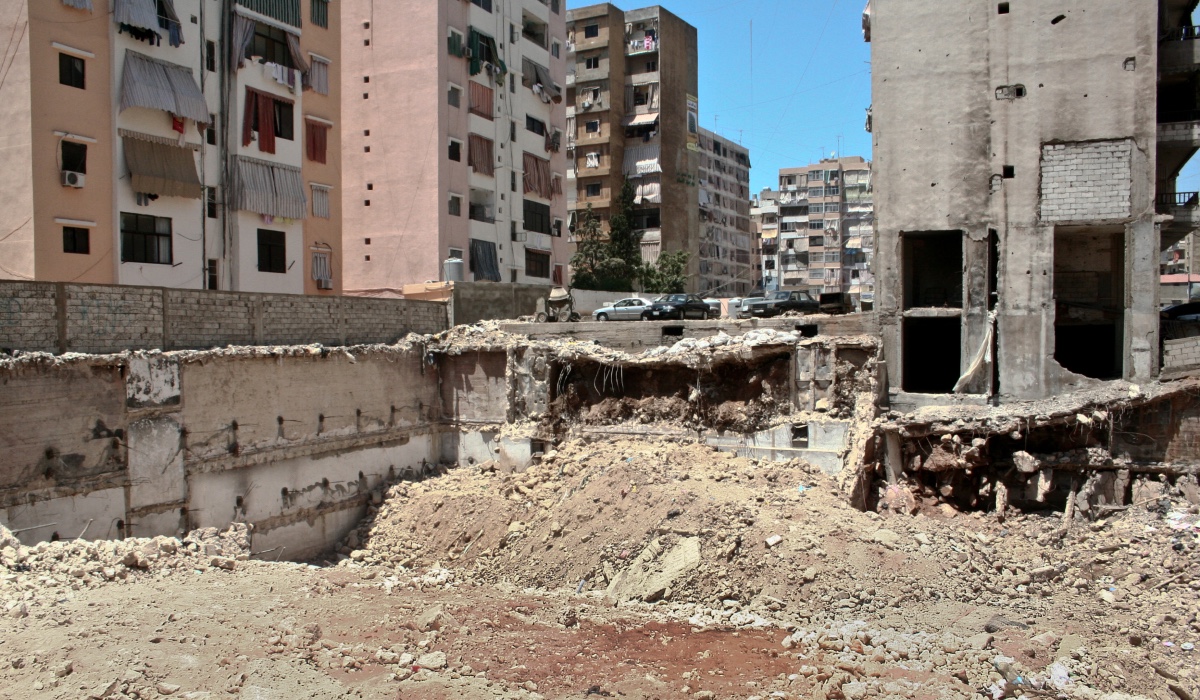
 Destruction of the Dahiya neighbourhood in Beirut, two years after the 2006 Israeli war on Lebanon./Magne Hagesæter, CC BY-SA 3.0, via Wikimedia Commons
Chris Bambery examines the thinking behind Israel’s war on civilians and the potential for it to spiral out of their control.
The assassination of Iran’s security chief Ali Larijani is another example of a long-held strategy by Tel Aviv: The Israelis believe that decapitating the Iranian leadership will lead to victory.
Yet, despite Israel’s success in killing Iran’s Supreme Leader, Ali Khamenei, and Hezbollah’s Hassan Nasrallah, this strategy has not led to Iran throwing in the towel. Iran is continuing, not just to resist, but has taken the offensive against the Gulf States. Hezbollah are also fighting back and are striking targets in northern Israel.
The election of Ali Khamenei’s son, Mojtaba, as the new Supreme Leader was a sign of Iranian defiance.
If Netanyahu and Trump thought victory would be easy they have been sorely disappointed, and both Israel and America are now relying on air power. Israel’s air war in Lebanon is especially vicious, targeting civilian areas rather than Hezbollah fighters.
Since the 2006 war in Lebanon Israel has evolved what it calls the “Dahiya Doctrine.” It is named after the Dahiya suburb of Beirut, where Hezbollah has its headquarters, and which the Israeli military leveled in 2006. The Israelis killed nearly 1,000 civilians, about a third of them children, and caused enormous damage to the country’s civilian infrastructure, including power plants, sewage treatment plants, bridges, and port facilities.
The present Israeli assault on Lebanon is repeating the 2006 atrocities. At that time General Gadi Eisenkot, the then Chief of Northern Command, outlined what a future war on Lebanon would look like:
‘What happened in the Dahiya quarter of Beirut in 2006 will happen in every village from which Israel is fired on… We will apply disproportionate force and cause great damage and destruction there. From our standpoint, these are not civilian villages, they are military bases… This is not a recommendation. This is a plan. And it has been approved.’
The Dahiya Doctrine was applied with appalling ferocity in Gaza, where Artificial Intelligence was used to target civilian infrastructure. The Palestinian healthcare system was virtually wiped out and high-intensity bombing drove nearly 2 million people from their homes.
The situation in Lebanon is a continuation of the slaughter in Gaza. Eight hundred and fifty people in Lebanon have been killed and over two thousand have been injured. Some eight hundred thousand people have been forced from their homes. Almost a fifth of people living in Lebanon are now registered as displaced, according to Lebanese government figures, and the United Nations says these numbers will increase.
Bombs and more bombs
International law expressly prohibits the use of disproportionate force and the targeting of civilians and civilian infrastructure, which are war crimes. The International Committee of the Red Cross states:
‘Applying the principle of proportionality is critically important for protecting civilians and critical infrastructure in situations of armed conflict… an attack against a military objective can be lawful only if the principles of proportionality and precautions are respected, meaning that the incidental civilian harm must not be excessive, and the attacker must have taken all feasible precautions to avoid this harm or at least reduce it.
Article 51of the Fourth Geneva Convention prohibits attacks ‘which may be expected to cause incidental loss of civilian life, injury to civilians, damage to civilian objects, or a combination thereof, which would be excessive in relation to the concrete and direct military advantage anticipated.’
Of course, both Israel and the US do not feel bound by international law, but this could well come back to haunt them. With aerial bombardment as the main war strategy civilian deaths are only going to increase and international condemnation and erode any international support for the war.
The Dahiya Doctrine is not without precedent.
The US has not thus far employed the kind of saturation bombing that reduced cities like Tokyo to dust in 1945, but civilians and the infrastructure they depend on, including the primary school in Minab, have been hit remorselessly. Every speech Trump makes threatens further escalation.
It is worth taking a quick look at what a decisive US bombing strategy meant in the Second World War. Japanese resistance to American military might terrified the US command who decided that pulverizing Tokyo would hasten Japanese surrender.
The US Air Force chose to target a small area of Tokyo area that housed an estimated 750,000 people. After a period of near drought conditions, the wooden structures of the city were bone-dry. On top of that, the winds on the night of March 9, and into the early morning of March 10, were strong.
The result was what the Americans were hoping for – a firestorm in which 110,000 people died. Saturation bombing caused more deaths than the atomic bomb attacks on Hiroshima and Nagasaki.
Interestingly, the decision to deploy atomic weapons was taken in the context of continued Japanese resistance despite their suffering horrific casualties. The similarity to developments in Iran couldn’t be clearer. If Iran holds out the dangers of an escalation of aerial bombardment is a real threat. American military thinking has form, and they will in all likelihood press on regardless of fatalities.
Trump’s plans to open up the Straits of Hormuz – a 30-mile-wide channel, which on its northern shore is lined with ballistic missiles, shore to ship missiles, underwater drones and navigable mines – could lead to serious US casualties and the next level of aerial bombardment.

Chris Bambery
Chris Bambery is an author, political activist and commentator, and a supporter of Rise, the radical left wing coalition in Scotland. His books include A People's History of Scotland and The Second World War: A Marxist Analysis.