
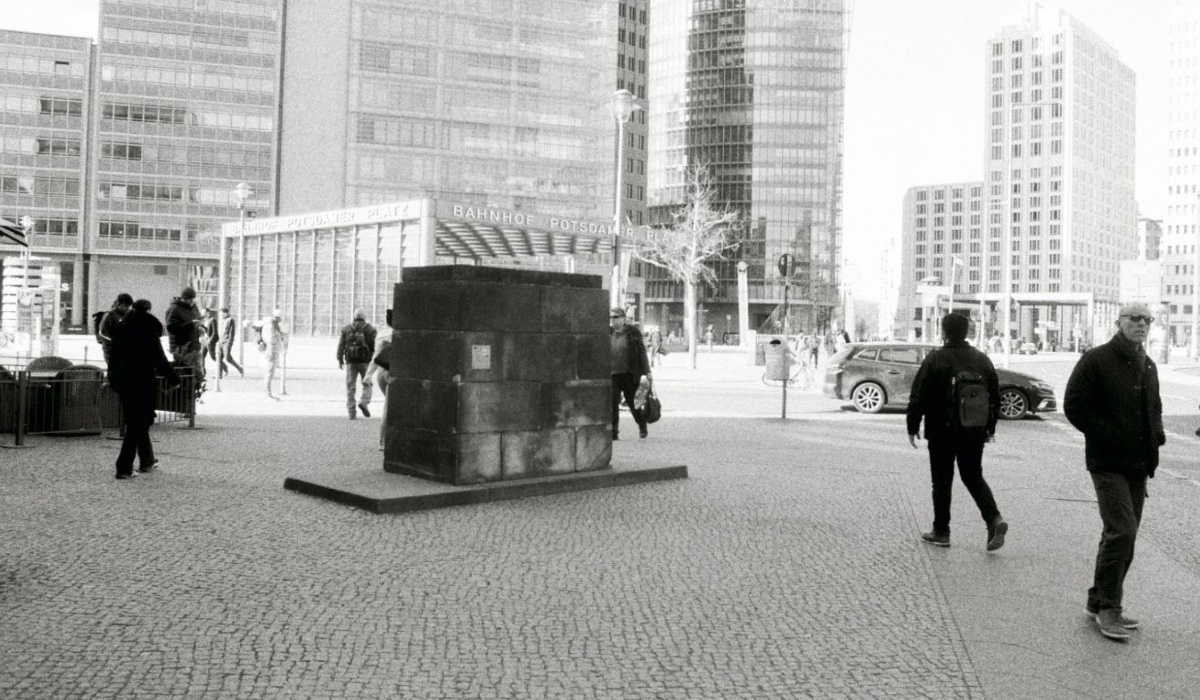
 Empty plinth where Karl Liebknecht spoke against the First World War on May Day 1916, Potsdamer Platz, Berlin/ Photo: Robert Dale
Support for the war in Ukraine is sustained by the long-practised propaganda of selective memory, omissions and lies which our movement has resisted since World War I, explains Robert Dale
Opposing the Ukraine misadventure is still a tough argument. First of all, it’s not publicly acknowledged how deeply embroiled the European powers are. The war is treated as something happening ‘over there’. ‘Plucky little Ukraine’, we are told, is standing up to a bully, and ‘we’ are supposedly helping out. But don’t mention the magnitude of the slaughter. The mangled bodies, wasted lives, grieving loved ones.
It all needs picking apart, piece by piece. This is not an easy task given the size and complexity of the conflict and the media barrage of disinformation. It’s a sprawling, metastising mess hidden behind a solid wall of propagada.
Repeat a lie often enough
I’ve been thinking a lot about war propaganda. Although I’m old enough to have seen the true-crime war movie too many times before, I was still shocked in 2022. The vehemence of the politicians and the media, the utter lack of any push-back.
You can always tell when our rulers are serious about war. Their talk switches instantly. Pretty much all the politicians and all their media in lockstep: this war is right, good, vital, must be supported. So-and-so is the next new Hitler and must be defeated.
So how does the propaganda work? Some of it is straight-up lies, but omission and selectivity are the larger part. The history and context of events are omitted altogether, or carefully curated. We are told only one side of the story, only the facts that fit their narrative. It’s a huge topic (and that’s part of our problem). I’m going to sketch the outlines here, and hope to come back to each of the parts in the coming weeks.
Do they tell us straight-up lies? Of course they do. Kaya Kallas – the European Union’s foreign policy chief – recently denied that Russia fought against Hitler in World War II. And ‘according to officials’ is often enough newspeak for ‘made up out of whole cloth’.
Context matters
The conflict apparently has no history. Just as in Gaza, where they act as though nothing of interest happened before 7 October 2023, the only thing we now hear about Ukraine before 22 February 2022 is some vague story of heroic Ukrainian nation-building.
Of course it wasn’t ‘right’ for Russia to invade. We have no dog in this fight. We carry no water for Russia’s rulers. But if we are to understand how the conflict came about, we should know the history, which includes centuries of Western aggression, Nato’s broken promise of 1990, and persistent bad faith in negotiations.
The most important argument I hear from war supporters revolves around the ‘Ukrainian national cause’. The right to national self-determination and so on. It’s an easy one to go along with; it seems to be common sense. But look a little closer and it’s anything but clear-cut. The ‘Ukrainian nation’ is not a simple unified bloc, and the borders of what is understood as ‘Ukraine’ have changed many times over history (ironically, part of today’s Ukraine was chopped off from Poland by Stalin). So again, we are being told only part of the story.
To reduce a complex argument to its bare bones: As socialists we oppose all war (what is it good for? absolutely nothing). But we may find ourselves supporting a fight for national self-determination where workers (and peasants) are queuing up to fight national oppression, where the road to workers’ liberation begins with national liberation. I can think of current examples, but would fall foul of Britain’s censorship laws if I named them.
Suffice to say, if brutal violence is required to force Ukrainian workers to fight, it’s probably not our fight. And brutal it is. Press gangs in minibuses drag men off the street and straight to the front, in their thousands, tens of thousands. The war supporters, on the other hand, fetishise the nation, and are perfectly happy to see workers sacrificed on the altar of nationalism. Again, this is a complex topic to come back to in greater detail.
Unfortunately, we also have to work to understand the military nitty-gritty, even if our rulers seem to think that ignorance is bliss. The bought-and-paid-for talking heads go on and on about territory, apparently unaware that Russia’s principal war aim is to neutralise perceived threats to its security (Nato itself and Nato-aligned Ukraine), rather than to occupy land. That was stated clearly in autumn 2021.
They are going about this methodically, by destroying Ukraine’s military potential. That’s why the Dneiper bridges remain intact, for example: to allow Ukrainian forces, equipment and supplies to move unimpeded to to the front, where they are destroyed. Gruesome. We can certainly build a case against the war without following all the ins and outs on the battlefield. But I think it helps to understand. (To understand is not necessarily to condone, in case you were wondering.)
In 1916, as World War I raged, the German communist Karl Liebknecht addressed workers in Berlin on May Day. He did not say that Germans should support the war because the Russians started it (although they did). Nor because the Russian Tsar was a despot (although he was). Nor because the Russian Empire was a ‘prison of nations’ (which it was). He catalogued the suffering and repression inflicted on German workers in the name of the war, and ended his speech with ‘We will have no more war. We will have peace – now!’
He was carted straight off to jail, where he stayed till the end of the war. Russian and German workers answered his call in 1917 and 1918, when they rose up to end the fighting.
We could do with some more of that clarity and bravery today. If you’d like to meet others who are standing up to be counted, why not come along to the conference against war on 20 June?
Robert Dale lives in the Berlin region, where he has been active in socialist politics since the 1980s.
Before you go
The ongoing genocide in Gaza, Starmer’s austerity and the danger of a resurgent far right demonstrate the urgent need for socialist organisation and ideas. Counterfire has been central to the Palestine revolt and we are committed to building mass, united movements of resistance. Become a member today and join the fightback.
