
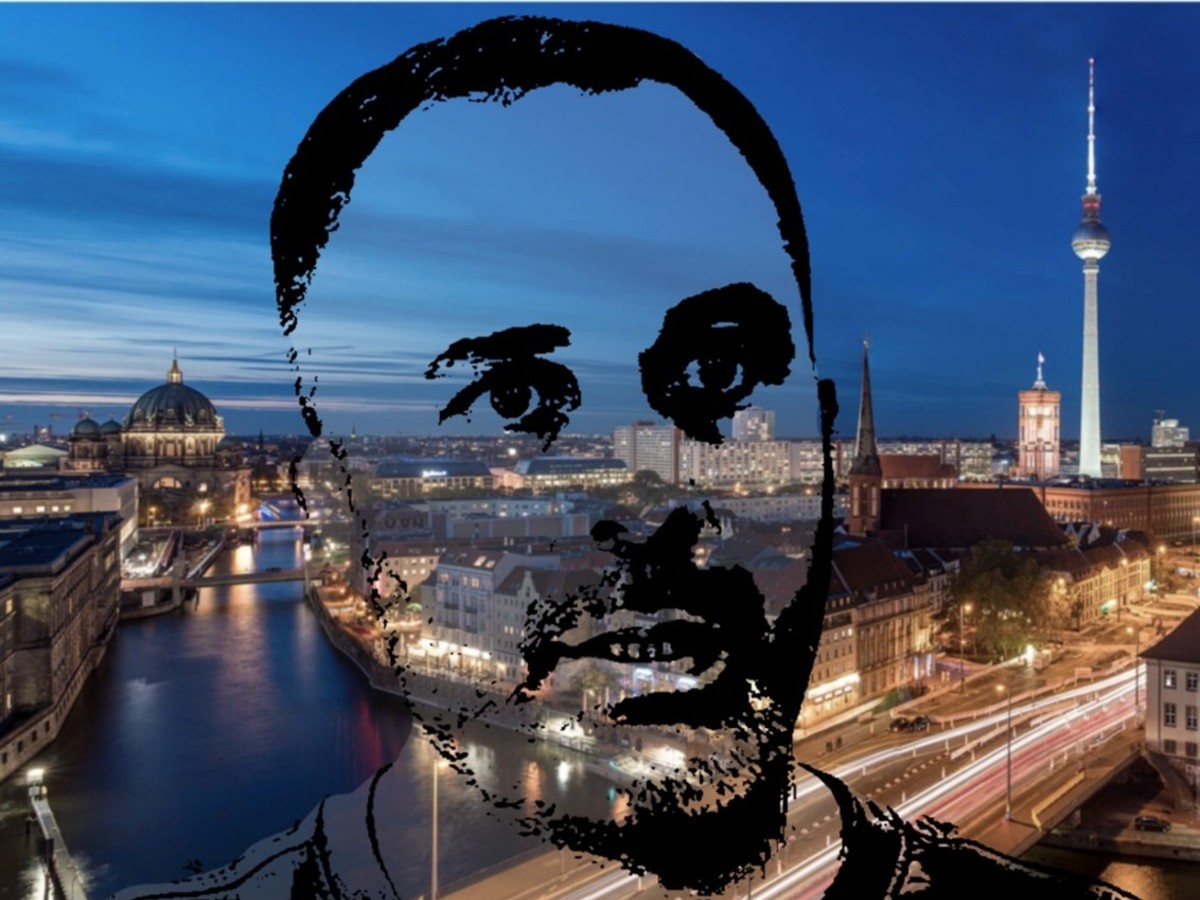
 Hüseyin Doğru Berlin. Photo: Fernando Pascullo / own work / CC BY-SA 4.0
Germany’s administrative persecution of an anti-war journalist is a disturbing case which has been largely ignored by both the liberal mainstream and the much of the left, explains Robert Dale
Our rulers and their toadies love to point the finger at ‘regimes’ in ‘rogue states’ where journalists are controlled and suppressed. Maybe they should take a look at the regime in Berlin, where Hüseyin Doğru has been placed under draconian restrictions. His story is truly Kafkaesque.
The crime: journalism
Doğru founded red.media in early 2023. The left-wing English-language video portal reported in particular on Gaza and the solidarity movement in Germany. The European Union construes this as supporting ‘actions by the Government of the Russian Federation which undermine or threaten stability and security in the Union’. (For the full listing see item 20 in the EU Council Decision.)
In other words, reporting on Palestine is supposedly undermining the war effort against Russia. I said it was Kafkaesque…
The punishment: internal exile, more or less
Although nobody is saying any law has been broken, Doğru’s name was included in the EU’s seventeenth package of sanctions against Russia. Although this is officially an EU matter, it was in all probability instigated by the German government, which has defended the decision when challenged.
The effects of a sanctions listing are comprehensive. Since May 2025, Doğru has been banned from leaving Germany (or re-entering if he did manage to leave). He has had to surrender his identity card. His bank account has been frozen and he is prohibited from working in any form. He and his family were denied health insurance for a time (his wife was pregnant when that happened). Officially, he is allowed €506 per month to subsist on, but even that has sometimes been hard to access. In effect, the authorities have declared him an unperson.
Bizarrely, they have also declared him a foreigner in his own country. Doğru is a German citizen of Turkish-Kurdish extraction. Yet the EU sanctioning decision lists him as having Turkish nationality.
If all that wasn’t bad enough, the German Bundestag passed new legislation in January, targeting anyone who (directly or indirectly) provides money or other resources to a person on the sanctions list. Doğru’s lawyer joked that the law had been made specially for him. Offences are punishable with up to five years’ imprisonment. Perversely, the far-right AfD was the only party to vote against; our lily-livered friends from the Greens and Left Party abstained.
But this will all get sorted out through the courts, you’re probably thinking. Nope. The beauty of the process, from the censor’s point of view, is that it is a purely administrative measure within the EU’s bureaucracy (although almost certainly instigated by the German government). So the German courts have no say on the matter. So much for ‘due process’. In theory, there would be some kind of path to the European Court of Justice, but that will be tricky for a plaintiff denied access to his own funds and prohibited from receiving donations. Catch-22.
Bourgeois press? Nada
You’d think that fellow journalists would be up in arms. Not a chance. For eight long months, not a single mainstream newspaper or broadcaster in Germany reported a word on his case. Doğru believes other journalists are scared they might be next, and spoke of colleagues who have stopped taking his calls. Many on the broader left are completely unaware of the story.
So all the more credit to those who have taken up his cause: the communist-leaning daily Junge Welt, a number of left-intellectual blogs like Nachdenkseiten and Overton, parts of the revolutionary left (all of them opposed to Germany’s involvement in Ukraine, probably no coincidence). And the parliamentary Left Party? Awol as usual when the going gets tough. Like the Assange odyssey, this is one where we will remember who stood up to be counted.
In good company
Hüseyin Doğru is not the only journalist affected by these measures. The same sanctions have also been applied to Thomas Röper and Alina Lipp (German journalists based in Russia), and Nathalie Yamb (a Cameroonian-Swiss activist noted for her opposition to French influence in West Africa). The most prominent is probably Jacques Baud, a Swiss retired colonel with extensive experience within the military and intelligence apparatus. His analyses of Nato’s debacle in Ukraine are scrupulously neutral, and all the more damning for that.
Baud, currently stuck in Brussels, is widely read in the circles who follow influential geopolitics bloggers like Larry Johnson, Judge Napolitano and Nima Alkhorshid. His case has provoked more pushback, which can only have been helpful for the others. And his story has been fairly widely reported in Switzerland, where again, hate to say it, it was the hard-right Weltwoche that dared to break the omerta.
In good spirits
I saw Hüseyin Doğru speak at a meeting the other week. He was cheerful despite it all, you’ll be glad to hear. The campaign is gaining a little traction, a number of the softer left-liberal publications have finally got round to giving him a mention. Certainly, high time he got his civil rights back. I would say though, that this does not feel like a successful clampdown. More like a government running scared and lashing out.
Robert Dale lives in the Berlin region, where he has been active in socialist politics since the 1980s.
Before you go
The ongoing genocide in Gaza, Starmer’s austerity and the danger of a resurgent far right demonstrate the urgent need for socialist organisation and ideas. Counterfire has been central to the Palestine revolt and we are committed to building mass, united movements of resistance. Become a member today and join the fightback.
