
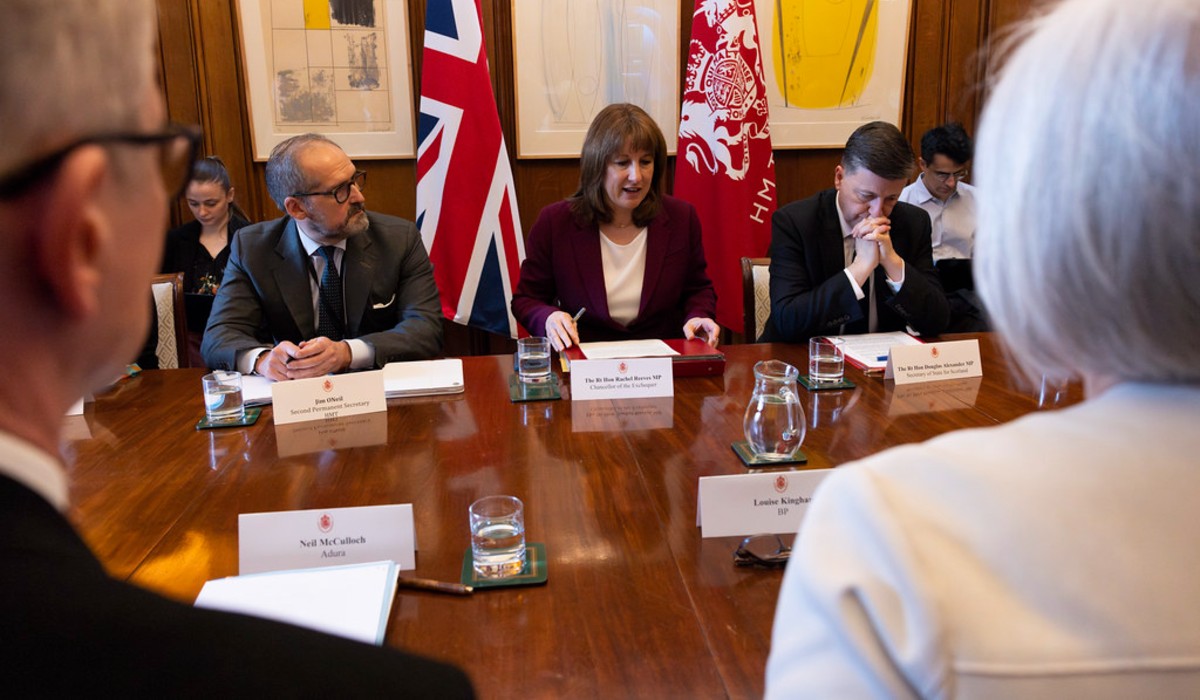
 Rachel Reeves hosting an oil and gas roundtable. Photo: HM Treasury / Flickr / CC BY-NC-ND 4.0
In the midst of the uncertainties of the war on Iran, the only sure thing is that our rulers will expect us to pay for renewed crisis, but a different path is possible, argues Dominic Alexander
The world economy, never mind the ailing UK one, was already in a vulnerable position at the beginning of 2026, but the latest round of US imperial aggression against Iran has not only made the short-term position even more dicey, but may well have already done long-term damage. The worrying outlook, with the sudden spike in oil prices over the weekend, and the stock-market falls, has already prompted Trump to make confused noises about ending the war against Iran sooner rather than later. At this point, it’s hard to guess what any of that will mean in practice for the resumption of normal oil and gas supplies through the Strait of Hormuz.
If the war ends soon, then it may be a startling sign of how far international markets now constrain US imperialism even in its Trumpian frenzy. Stock-market falls, rises in the cost of government borrowing, rising commodity costs and the prospect of an inflation spike together could still sober the hawks in charge of the US state into caution. It remains to be seen how long the drive to war can override these problems.
The chief executive of Aramco, the Saudi state oil company, said on the morning after Trump’s rambling about the war being short that continuing disruption meant that there ‘would be catastrophic consequences for the world’s oil markets, and the longer the disruption goes on … the more drastic the consequences for the global economy.’ As when Trump pulled back from his threats over Greenland after going to Davos, there’s a strong whiff of ‘the money-men say no’ about Trump’s confusions earlier this week. So long as it seems that only Chinese or Russian-linked shipping dares to cross the strait, the viability of Trump and Israel’s war remains in doubt.
Even if Saudi Arabia fulfils its promise to get 70% of its normal production flowing through the Red Sea in a few days’ time, the constraints have been made clear. Emergency oil reserves seem unlikely to bridge the gap in supply if Iran’s effective blockade of Hormuz carries on for long. Resurgent inflation seems likely to be the investable consequence, even if the impact starts easing soon.
The world economy had not in fact recovered entirely from the supply-shock of the Covid crisis, and even optimistic voices were being tentative about the possibility of growth picking up a bit this year. Pessimistic ones were concerned that inflation was being sticky, no thanks to Trump’s unpredictable trade wars. The OBR currently thinks inflation could rise by 1% more this year. The effects of even a couple of weeks of a hit to oil and gas supplies will ripple out over the whole economic landscape, from agriculture to consumer goods. That doesn’t even factor in the cost of the depletion of munitions, which is already an issue for the US in prolonging its war on Iran.
Paralysis in the UK
Meanwhile, in Britain, Rachel Reeves cannot muster more than to say that while prices remain volatile, she can only recommend something her government is patently unable to influence: ‘the most important thing we can do to address the cost of living challenges people face is to de-escalate the conflict in the Middle East.’ Absent any preparation since Covid for the next economic shock, such as seriously ramping up renewable capacity, or increasing the storage of natural gas in particular, the government has left itself with no recourse to the buffeting of international markets whenever there is a crisis. As we now all know, this can come from factors from the geopolitical to the environmental, with purely economic crisis, from a potential market bust for example, lurking ever more threateningly on the sidelines. Neither can the Bank of England step into help the government on this, since its only conventional lever is to raise interest rates. Experience has shown this has no meaningful impact on a supply-side crisis except to inflict still further pain and worsen the impact on working people.
Reeves’ Spring Statement revealed absolutely no new policy thinking whatsoever, so we are stuck in a limbo of a paralysed ruling class who, in the face of mounting crisis, are only able to cleave to the failed strategy of fiscal orthodoxy. The desperate hope is that continuing appeasement of the financial interests in the bond markets will eventually yield some of the economic growth that fuels profits and thus a return to some margin for investment within those constrained limits. Meanwhile the Starmer government’s other great hope for a productivity revolution, the boondoggle of AI investment, looks like it is fizzling out already in a slew of over-hyped promises of jobs and phantom corporate investments.
The economic prospects for Trump’s leap into protectionist imperialism seems not to be going markedly better, with costs due to tariffs being borne by ordinary Americans, and his own base, and little sign of any the rise in employment and industrial activity supposed to be the result of the tariff policy and the immigration crackdown. The latter in particular is likely to be massively counterproductive as far as many industries, such as agriculture, are concerned.
Whether in the UK or in the US, the ruling capitalist cliques are floundering. The one in power in the US thrashes about in a homicidal rage, attempting to reset the world by force since that’s the only lever it seems to have left, but it is finding the limits of effectiveness because it cannot escape the world economy’s continuing dependence upon fossil fuels. In the UK, the satrap economy, like its politicians, seems not to be able to do anything but be sucked into the gravity well of renewed crisis spawned by the greater imperialism. This could have been avoided, in the UK, if post-Covid, a real plan had been developed to invest in energy infrastructure and other public goods and services. That could then have provided some shielding against a renewed supply crisis. Instead, working people will again be expected to shoulder the burden of the costs of the crisis. A change of direction towards planning for resilience and social need would still be possible, and advisable, because the one thing that is sure, is that however long this crisis lasts, there will be another crisis from one direction or another along soon.
Before you go
The ongoing genocide in Gaza, Starmer’s austerity and the danger of a resurgent far right demonstrate the urgent need for socialist organisation and ideas. Counterfire has been central to the Palestine revolt and we are committed to building mass, united movements of resistance. Become a member today and join the fightback.

Dominic Alexander
Dominic Alexander is a member of Counterfire, for which he is the book review editor. He is a longstanding activist in north London. He is a historian whose work includes the book Saints and Animals in the Middle Ages (2008), a social history of medieval wonder tales, and articles on London’s first revolutionary, William Longbeard, and the revolt of 1196, in Viator 48:3 (2017), and Science and Society 84:3 (July 2020). He is also the author of the Counterfire books, The Limits of Keynesianism (2018) and Trotsky in the Bronze Age (2020).