
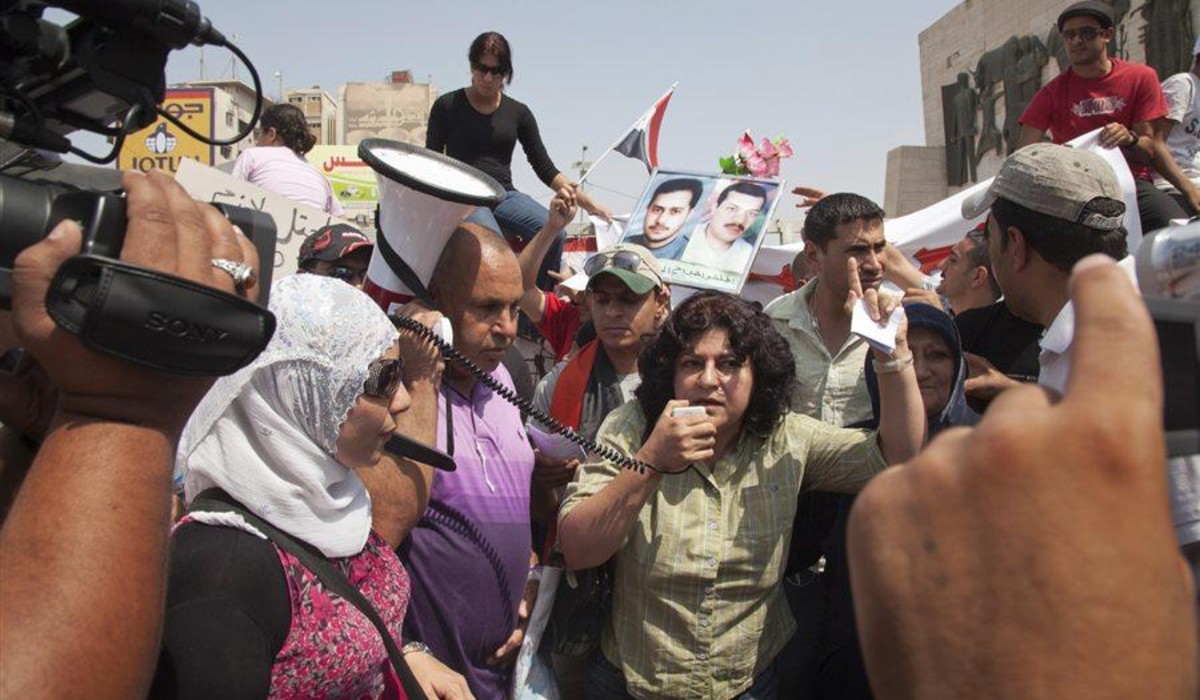
 Yanar Mohammed. Photo: Organization of Women’s Freedom in Iraq
Following the assassination of Yanar Mohammed on 2 March, Dr Mehiyar Kathem Al Sa’edi pays tribute to a fighter for women’s rights
Born in Baghdad in 1960, Yanar Mohammed graduated from the Baghdad University’s Department of Architecture in 1984, completing a Masters degree at the same university in 1993. Yanar describes pressure from her family to pursue an education in architecture but was never fond of the highly structured discipline that offered, as she described it, limited intellectual room for criticality and engagement in society. The catastrophe of the 1991 Gulf War and the ensuing international sanctions on Iraq would force Yanar Mohammed, along with her husband and young child, to flee to Canada in 1995. In Toronto, Yanar Mohammed founded in 1998 the Defense of Iraqi Women’s Rights, a Canadian registered NGO. Her work established a women’s safe house in the Kurdistan Region of Iraq in 2001.
Working in occupied Iraq
In May 2003, at the height of the US and British invasion and occupation of the country, Yanar Mohammed decided to return to her homeland. The following year she established the Organization of Women’s Freedom in Iraq (OWFI), an Iraqi NGO, which worked to promote women’s rights in the country. OWFI was one of the first NGOs to be established in Baghdad. I first met Yanar Mohammed at that time when Abu Abdullah, a family friend and member of the Worker-Communist Party, invited me to the founding meeting of OWFI in their newly established office in central Baghdad. I, like Abu Abdullah, voted on the founding chapters of the OWFI. Yanar Mohammed’s interest in group-work and collective action ensured that OWFI was an accessible organisation and its offices open to the public at a time when Iraq’s security was increasingly difficult to navigate.
OWFI’s offices were located on Naher Street in central Baghdad, only minutes from the Palestine and Sheraton Hotels, as well as Ferdous Square—the site where Saddam Hussein’s statue was famously toppled and shown around the world on television. In an apartment building, across the nearby Saadoun Street, linking Tahrir Square and Ferdous Square, Yanar Mohammed along with members of the Worker-Communist Party and trade unionists, established in 2003 a radio station, at a time when the internet, satellite dishes and mobile phones were being introduced for the first time after 13 years of US-imposed sanctions. Falah Alwan, a leading figure in the Worker-Communist Party of Iraq, and leader of Iraq’s Federation of Workers Councils and Unions of Iraq was a close colleague of Yanar Mohammed, and both worked to establish the newspaper and radio station Al-Musawat (or equality), an initiative of OWFI. While organisationally independent, for the next two decades, OWFI and Yanar Mohammed would maintain good communication and co-ordination with the Worker-Communist Party of Iraq and trade unions.
With the support of several funding European organisations and Yanar Mohammed’s perseverance and commitment to supporting vulnerable women, OWFI established shelters and safe houses in Baghdad, Nassiryah and Kirkuk, which offered emergency and secure spaces for women and girls who had endured rape or other forms of abuse, including helping victims of criminal sex trafficking networks. OWFI established those safe houses in carefully chosen locations so they could not be traced. The shelters served less privileged sections of society, the same classes that had been most detrimentally affected by international sanctions and the outcomes of the war against Iraq in 2003.
Yanar Mohammed saw the establishment of those shelters as her most significant contribution to Iraq. OWFI made sure to offer tangible support in a post-2003 period where women’s issues and feminist activism had become major talking points in Iraq’s civil society and secular spaces but rarely coupled with any real tangible benefits for women in the country. A major feature of OWFI was, unlike so much of the emerging US-European donor preferred secular-oriented Iraqi NGOs, was under Yanar Mohammed’s leadership, OWFI continued to ensure its work was anchored in the lived material realities of Iraqi women and wider society. Significantly, Yanar Mohammed offered employment opportunities for women, who had previously endured abuse, to work in the organisation and indeed, over time, many of her team were constituted by those she had helped. For that reason, she despised professional NGO workers who treated civil society work as a monied career that had little real interest in social transformation.
The establishment of the shelters had put Yanar Mohammed in direct confrontation with families and tribal members, religious political parties and sections of the Iraqi Government. Her commitment to the cause of Iraqi women meant she took on multiple roles and positions, as director, spokesperson and the public face of the organisation, and was also ultimately responsible for the financial and daily management of the organisation. For this, Yanar Mohammed and OWFI would regularly receive threats, though none transpired into physical harm, even when she famously burned a religious head scarf in 2003 and was later openly threatened by paramilitary groups in the country.
Yanar’s Marxism
Yanar Mohammed had life-long affiliation with Marxist perspectives, which informed her worldview and the type of activism she would pursue. She understood that women’s oppression did not emerge from ‘culture’ in the abstract sense but was an outcome of the destruction of Iraq’s economy, infrastructure and the militarisation of daily life. She openly criticised the US occupation for empowering sectarian and religious forces that had become formalised through Muhasasa (apportionment), or sectarian-political quotas that underpin Iraq’s post-2003 political system. Yanar Mohammed linked the rise in honour killings, polygamy, and the rollback of women’s everyday status not only to the post-2003 order, but also to economic sanctions that had driven the country into impoverishment.
In her 2015 address to the UN Security Council’s open debate on women, peace and security, she warned that the crisis facing Iraqi women could not be understood without “what has happened beginning in 2003,” arguing that the post-invasion order, built on sect, ethnicity and gendered exclusion, failed to uphold the basic rule of law and allowed extremists to take positions of power.[4] The last time I met Yanar Mohammed was at Chatham House, in London, where she would later write in a paper section for the think-tank that the US-led invasion had ‘solidified existing patriarchal structures and created the conditions for an increase in violence against women.’[3][2]
Immediately after the 2003 war, thousands of NGOs were established, many of them oriented toward capturing US and European funding. A significant portion of these grant-driven organisations functioned less as civic actors than as businesses designed to profit from foreign grants, a pattern that has persisted across multiple sectors tied to external funding in Iraq. In more recent years, women’s organisations, including those linked to political parties, have also proliferated. Some appear to operate as vehicles for what might be called “feminist washing”, a superficial promotion of women’s rights that serves to legitimise newly consolidated political elites, their families, and their patronage networks in the Kurdistan Region of Iraq and elsewhere in the country. Against this landscape, OWFI, under Yanar Mohammed’s leadership, stood out as one of the few organisations consistently driven by accountability to Iraqi women and their Iraqi society, rather than by compliance with donor priorities alone.
The Dutch Embassy’s long-term support for Yanar Mohammed’s work through OWFI would undoubtedly constitute one of embassies main post-2003 achievements and though pressured by such organisations as Al-Amal to quit funding OWFI, it made the right decision to support her over the past two decades. Her work garnered further financial support from several funding organisations, including European Union, MADRE, Norad, the UN Global Fund for Women, the Australian Embassy and many others. Without those sources of funding, OWFI’s shelters, legal interventions, and emergency support would have shut down. Recognition for her work in Iraq came primarily from Iraq itself, namely from the women and families she helped, and internationally from the Gruber Foundation Award for Women’s Rights in 2008 administered from Yale University, the Norway-based Rafto Prize in 2016 and in 2025 the Franco-German Prize for Human Rights and the Rule of Law. At different periods, Yanar Mohammed shared platforms with various important figures, including Jeremy Corbyn, Noam Chomsky, and was widely recognised internationally as a stalwart feminist driven by her principles and accountability to Iraq and the people she was helping.
OWFI provided important support for women in the Mosul and Dohuk, setting up a safe house in the latter for women affected by the war against the Islamic State group. In 2011 Yanar Mohammed contributed to the demonstrations in Baghdad’s Tahrir Square against corruption, poor services, and the sectarian-political order left behind by occupation and again participated in the much larger demonstrations in October 2019.
Yanar Mohammed and OWFI’s team were instrumental in shaping Iraq’s own anti-human trafficking laws, working closely with and advising Iraqi Government institutions in this regard and over other women and family matters.
Anti-imperialism
Unlike most other feminists and those claiming to promote women’s issues in Iraq and elsewhere, Yanar Mohammed never wavered from her anti-imperialism principles. Yanar Mohammed’s criticism of US imperialism was evidenced in her refusal in 2017 to participate in the US State Department’s Women of Courage Award. OWFI had been contacted by the US Embassy to nominate Yanar Mohammed, which was then flatly rejected by her.[5] On the OWFI website, Yanar Mohammed stated on 4 April 2017 that this was due to the political position of the organisation and its anti-occupation stance. In her statement, Yanar Mohammed went on to say:
‘That OWFI refuses to take the award from the US government which was the reason of the destruction that happened to Iraq and the endless violations against the lives and freedoms of Iraqi women.’ Yanar Mohammed goes on to write:
‘OWFI continues to hold its ground on its anti-imperialist position, rejecting both the American occupation and their reactionary allies in Iraq, who stand for all inhumane and misogynist changes in Iraq. It was the American occupation of Iraq that started the genocide of Iraqis at the hands of the American military arsenal, and later on at the hands of sectarian Islamic groups who were supported by the US the occupation, and who became later on the heroes of women’ enslavement and exploitation by Daesh and other extremist groups. The US occupation had similarly empowered other extremist groups to grow stronger against the women of Iraq, especially those who legislated the Jaafari law which allows the marriage of 5-year-old girls to adult men. Shame on a state which sends military envoys to kill us, divide us, supply Daesh with ammunition and empower women’s misogynist groups from one side, then hand awards for human rights to us in the other hand. We don’t want neither your awards nor your policies which have pushed Iraqi women to the bottom of the abyss.’[6]
In recent years, the changing nature of US-European aid funding for women’s issues would come to inadvertently undermine Yanar Mohammed’s core work in Iraq. Specifically, her work became even more exposed to public attack when LGBTQ+ rights entered her public vocabulary and organisational agenda. These issues were also supported through funding from European embassies in Iraq and from other US-European organisations. This shift was shaped in part by foreign donor priorities and in recent years have even come to replace conventional support for women’s rights work. Support by US and European embassies for LGBTQ+ issues in Iraq was especially visible to the point that Iraq represented an experimental playground for the promotion of those externally promoted agendas in the region, which were widely rejected by Iraqi society.
European donors bear responsibility for Yanar Mohammed’s increased exposure and vulnerability in Iraq as LGBTQ+ rights and advocacy increasingly became a prerequisite to secure funding for more conventional women’s rights programmes. In light of Yanar Mohammed’s long-term commitment to women’s issues in Iraq, her expanding organisational responsibilities, which included now six shelters, and the growing pressure of US and European funding frameworks that treated LGBTQ+ advocacy as an integral part of mainstream women’s rights programming, she was placed in a difficult position. It is also clear that after over two decades since the invasion of Iraq, domestic funding for women’s issues and rights remained non-existent, forcing her to rely on foreign funding and abide by the conditions and even language and media framing that foreign donors set and expected from their grantees.
Financial responsibility for keeping OWFI afloat compelled Yanar Mohammed, even if reluctantly, to address LGBTQ+ issues more publicly than she otherwise might have done. Her public statements and OWFI’s work on LGBTQ+ advocacy contributed to a growing series of formal petitions and legal campaigns calling for the organisation’s dissolution, alongside complaints from sections of society and Iraq’s political class directed at European embassies funding such programming in Iraq. Social media posts and videos also vilified Yanar Mohammed and framed her advocacy as evidence of foreign interference in Iraq’s internal affairs and society. As pressure intensified, the NGO Directorate, which falls under the General Secretariat of the Council of Ministers, moved to pressure OWFI to close or, at the very least, restrict and contain its activities. However, none of these attempts to curtail OWFI were successful in preventing Yanar Mohammed from continuing her work. A day before her untimely departure from this world, Yanar Mohammed and OWFI colleagues organised and participated in a conference in Baghdad that focused on sex trafficking and holding to account members of the Islamic State group who committed crimes against women in Iraq and Syria.
Yanar Mohammed always took threats levelled at her and her OWFI team seriously and particularly in the early years of the occupation carried a gun and often had an armed personal bodyguard by her side. Yanar Mohammed always made sure to reduce her mobility in Baghdad and Iraq, though in recent years with relative improvement in Iraq’s security situation, her previously strict adherence to safety was loosened. Yanar Mohammed was assassinated outside her home in Baghdad on the morning of 2 March 2026.
Her legacy
Yanar Mohammed fiercely campaigned against the adoption of laws that subjugated women, such as the 2025 parliamentary amendments to the Personal Status Law, which disadvantages women and girls, and formalizes religious and sect-based interpretations of gender issues and marriage. Even after major campaigns by OWFI and other Iraqi women’s rights organisations, those sectarian laws were however passed by agreement of ruling Kurdish, Sunni and Shia political parties whose interests continue converge to reinforce their hold on power. The failure of women’s organisations and wider civil society organisations to combat the sectarianisation of Iraqi social and marriage related laws attest to the ongoing weakness and even impotence of Iraq’s NGOs in the face of the interests of dominant political parties.
Over the past 23 years, Yanar Mohammed supported thousands of marginalised women and their families, trained hundreds of civil society workers and continued to collaborate with trade unionists and leftist activists across the country and internationally. She continued to support Iraq’s working class and trade union movement, including collaboration during this period with trade unionist Falah Alwan. As opposed to the two-party controlled Kurdistan Region of Iraq, where alternative political activity continues to be outlawed, Yanar Mohammed and her colleagues continued to pursue their goals and engage in political work in Baghdad. In 2018, she was central to the establishment of the Baghdad-based Organisation for the Communist Alternative, a new political initiative where she remained a member of its central organizing committee.
Yanar Mohammed exemplified the limits of pursuing struggle through the structures of professionalised NGOs, which over the past two decades have engulfed the space of civil society action and, in many respects, come to substitute for social transformation and political change in Iraq. She rejected Western, donor-driven notions of “neutrality” often promoted as a core principle of NGO and civil society work. In her political praxis, neutrality functioned less as an ethical stance than as a kind of virtue signalling and was ultimately inadequate for confronting problems that were fundamentally political.
The everyday realities of this work, including the constant pressures of safeguarding vulnerable women, were integral to Mohammed’s organising life. Sadly, in hindsight, much of this labour and the risks it entailed remain insufficiently documented, leaving wider society without a clear account of the scale, complexity, and achievements of OWFI’s work over the years.
Yanar Mohammed was a communist-feminist and cultural and political worker rooted in Iraq’s society and working classes. She treated her own work, and OWFI itself, as a life mission oriented toward equality between women and men in Iraq. Through the example of her life and practice, and her insistence that human dignity must be realised materially rather than merely proclaimed, she embodied a commitment to women and Iraq’s liberation from war and imperial domination. Her life and work stand as a rare example of socially anchored civil society activism, and as one of the most distinctive post-2003 Iraqi success stories. Iraqis should remember Yanar Mohammed as an emblem of principled struggle and of what Iraqi womanhood can represent and realise in times of great adversity.
Dr. Mehiyar Kathem Al Sa’edi is an Honorary Senior Research Fellow
History Department at the University College London
[1] Yanar Mohammed, ‘Two Decades of Feminist Struggle in Post-Invasion Iraq,’ Chatham House, 2023. URL: https://www.chathamhouse.org/2023/03/iraq-20-years-insider-reflections-war-and-its-aftermath/two-decades-feminist-struggle-post
[2] ‘Leading Iraqi Feminist Yanar Mohammed on Women’s Rights and the Deteriorating Security Situation in Iraq,’ Democracy Now!, 30 December 2003. URL: https://www.democracynow.org/2003/12/30/leading_iraqi_feminist_yanar_mohammed_on
[3] 2023 Chatham House essay, ‘Two Decades of Feminist Struggle in Post-Invasion Iraq,’
[4]https://www.womenpeacesecurity.org/wp-content/uploads/NGOWG_Statement_OpenDebate_Mohammad_Oct-2015_EN.pdf
[5] https://www.owfi.info/EN/article/owfi-refused-the-women-of-courage-award-from-the-department-of-foreign-affairs-of-the-us/[6]https://www.owfi.info/EN/article/owfi-refused-the-women-of-courage-award-from-the-department-of-foreign-affairs-of-the-us/
Before you go
The ongoing genocide in Gaza, Starmer’s austerity and the danger of a resurgent far right demonstrate the urgent need for socialist organisation and ideas. Counterfire has been central to the Palestine revolt and we are committed to building mass, united movements of resistance. Become a member today and join the fightback.
