
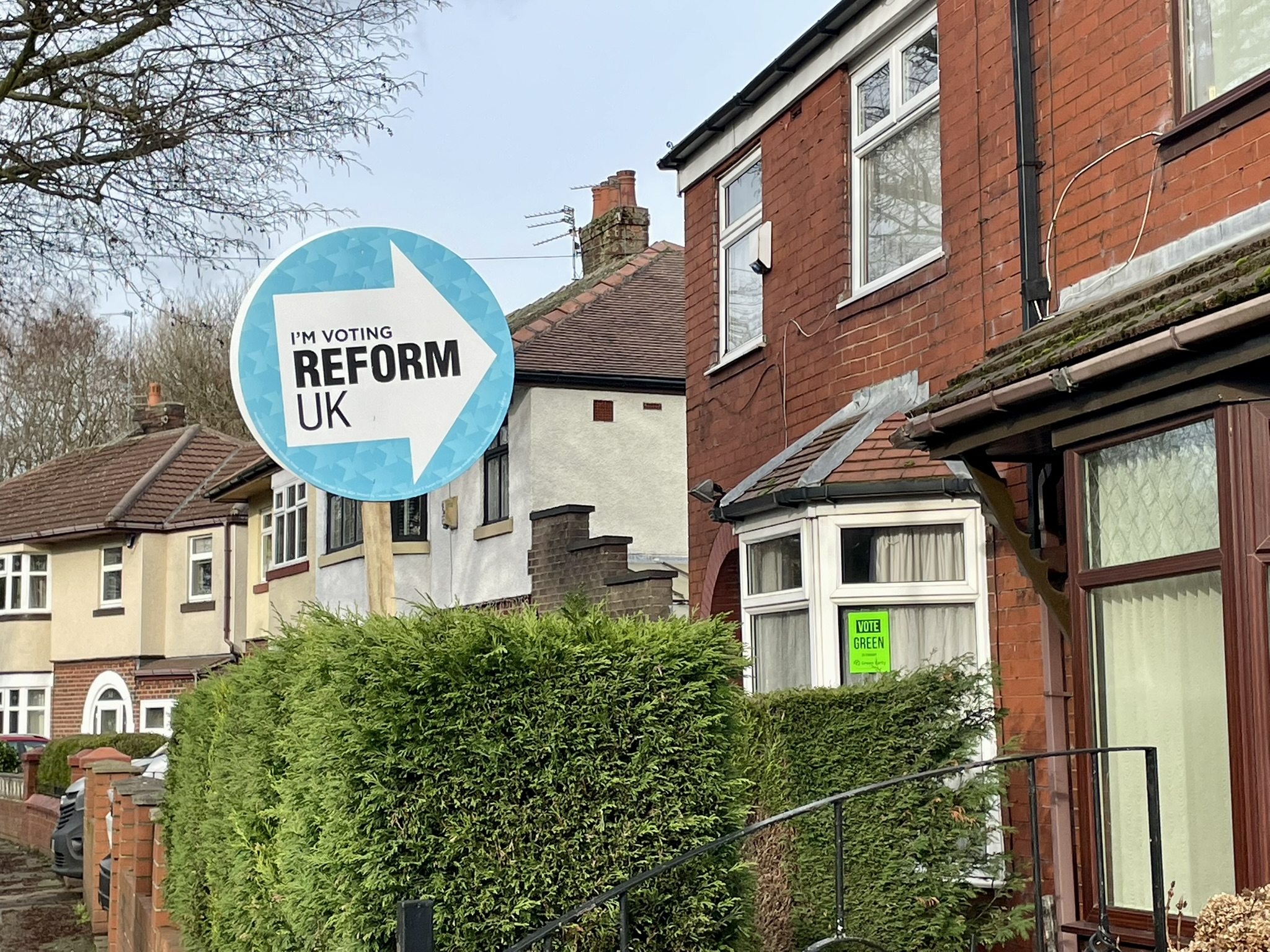
 Posters for Reform and the Green Party outside adjacent houses in Denton, Greater Manchester / Wikimedia Commons / CC0 1.0 Universal
The Gorton and Denton by-election upset confirms some of the left’s more optimistic hopes about the direction of British politics, argues Kevin Crane
Back in October, after the by-election for the Senedd (Welsh parliament) seat of Caerphilly, we analysed the shock defeat of Reform UK in a former safe Labour area and asked two questions:
1. Had Reform peaked in popularity too soon?
2. Could Labour reverse, or at least halt, their decline?
The backdrop to this was that when the left-of-centre Welsh independentist party Plaid Cymru actually won, it seemed to come out of nowhere for the political-media establishment in Britain. Everyone from the top ranks of politicians, through the elite journalists at the newspapers and the BBC, had decided on a narrative that the public faced a straight either/or choice between Labour and Reform. So, when voters chose an alternative to both, they essentially processed it as both the wrong answer, and also a peripheral blip that they could safely ignore.
The very last thing that these upper-class opinion formers either expected or wanted was to be informed that Caerphilly was not some anomaly, but actually an indication that their political preferences are not, in fact, an unchallenged consensus. Informed of it they have been, however, because to their horror that the same thing has pretty much happened again in Gorton and Denton.
You’d have to have a heart of stone not to laugh at all the idiots who have been shown up by this extremely satisfying result, as Labour’s previously vast majority in the seat collapsed far more than expected and Reform’s campaign basically didn’t land. It was also encouraging to see the successful Greens win the election decisively on an offer that was strongly focused on anti-austerity and also express people’s desire to support for Palestinian rights.
Beyond that, however, it is worth taking a look back at the dynamics from last year and see how they have progressed since October.
The Reform juggernaut is losing speed
It needs to be said, before describing some of the problems facing Reform UK, that the hard-right party is still leading the polls and would likely win a general election if one were called soon. However, late last year, it’s polling was by some measures 33% or even higher, where it has been gradually tapering off to around 24%. As many of us had thought, it had peaked somewhat too soon for its own good.
Hanging on to a huge lead in support was always going to be tricky for Nigel Farage’s party, even with its millionaire backers and strong support in the media. Farage has been visibly struggling with various elements of party management for the past few months. On policy, for instance, he has been forced to row back on a lot of previously popular economic positions – such as rescuing British steel production or bring water back into public ownership – because the issue of their incompatibility with his wider hardline Thatcherite agenda of low taxes and minimal state intervention was just getting too obvious to keep fudging. Relatedly, he has also been growing the Reform party’s senior ranks by welcoming in a succession of current and former Tory MPs. The optics of this have started to become a bit ridiculous, as even voters who generally don’t pay too much attention to specific political personalities are now aware that this party that casts itself as an anti-establishment has much of the rancid flotsam from Boris Johnson’s government washed up in it, which is another contradiction like the incoherent economic positioning.
Farage, however, has felt that he needs to bring ex-Tory ministers onboard because he is otherwise getting close to power without allies he, or the big finance interests he wants to reassure, trust to exercise it. That relates to yet another of his problems with party management, which is that he’s struggling to develop talent, something that was actually made fairly obvious in the Gorton and Denton election campaign.
Matthew Goodwin, Reform’s candidate, was very obviously not the man for the job. For a supposedly populist party, selecting one of their few academics to run in a solidly working-class Northern seat was already a surprising choice, but it was the form and content of Goodwin’s campaign that were really curious. Despite Reform’s claims that they had mobilized hundreds of their members for campaigning, outside reports from the constituency said that neither they nor Goodwin himself were much seen publicly. Reform seems to have heavily focused on online messaging, which relied upon Goodwin’s profile as a GB News pundit and right-wing commentator. That’s all very well for shoring up a core support base of mostly older, mostly male voters, but it’s not a basis for achieving crossover appeal.
Much as with the national picture, Reform locally seemed to acquiesce to its loss of peripheral support and shift towards playing to a relatively much narrower audience. This is actually something that can be very counterproductive to the radical right, because once they start to stray from widely-held views – chiefly hostility to immigration – they can end up rambling onto talking points that a lot of people find, well, rather weird. Goodwin displayed this pathology in absolute spades, for example making crazy proclamations about women (presumably white women) not having enough children.
The media, still broadly supportive of Reform, did it’s best to contain the spread of some of Goodwin’s nuttier comments, but it seems impossible to believe that at least some voters who might have been open to reform did hear them and were not impressed. Certainly, while the number of ordinary voters who have been taken in by relentless propaganda about refugees in small boats is large, the subset of those voters who buy into quasi-fascistic theories about race and sex is not. The fact that Reform ended up with posh oddball pushing such fringe ideas as a candidate for an ethnically diverse urban seat tells us something about the pool that Farage has to pull these people from: it is far from ideal and far from one that just enables him to win in every location. In Gorton and Denton, their appeal was really just not broad enough to win against a more inclusive opposition. Which was bad news for Labour…
Starmer’s Labour: choosing to fail, and willing to take democracy down with them
In hindsight, the government probably only had one move that would have enabled them to win the by-election, and the wouldn’t do it because it would also have cost Keir Starmer his job. Specifically, if Manchester mayor Andy Burnham – almost the only genuinely popular Labour politician in England at this point – had been allowed to stand, he probably could have used both his own reputation and the prospect of him doing a coup on Starmer to overcome massive discontent against his party. Starmer, ever the selfish coward, blocked Burnham and in doing so sacrificed the seat.
Whereas Reform’s campaign strategy was oddly invisible due it’s internet-brain quality, Labour’s was hard to spot because low morale and a complete absence of positive messaging left them with nothing much to say for themselves. The most noticeable propaganda they distributed was conspicuous in its sheer dishonesty and the Green Party has raised complaints about two notable instances. The first was a deceptive “tactical voting” leaflet distributed to households, designed to give the impression that an impartial third party was urging them to vote Labour as the only possible way to keep Reform out. The second, more shocking, one was a van driving around the constituency making absurd (and legally dubious) claims that the Greens wanted to promote illegal drug taking and prostitution amongst young people: a crazed piece of culture war agitation that we would normally expect to be in Matt Goodwin’s wheelhouse.
Ultimately, Labour tactics in the election reflected a combination of resignation and cynicism. Despite briefings to media allies that they genuinely believed that they, and only they, could beat Reform, it seems likely to me the Constituency Labour Party of Gorton and Denton were well aware that they were facing a heavy defeat, probably before formal campaigning even began. Their actions, therefore, were based how they would prefer to be defeated, which is where the cynicism comes in. They wanted to lose to Reform, not the Greens, and tailored their campaigning pretty much exclusively to depressing the Green vote as much as they could.
It really wasn’t wise for Labour to try and smear the Greens with allegations about sex trafficking when the obvious response is two words, “Mandelson” and “Epstein”, but it was also notable that they had no such harsh words for the blatantly misogynistic outbursts of the Reform candidate to whom they claim to be radically opposed. However, since Labour has reduced its scope of campaigning to nothing much beyond “it’s us or Reform”, they had talked themselves into a situation in which it was necessary to do Reform-esque attacks on anyone who was trying to politics on a more constructive basis.
The similarities between what Reform and Labour have been saying has continued after the result: both parties have taken to complaining about “Muslim sectarianism” in the constituency, Now, on one level, the correct response to this narrative is simply to laugh. The prominent leftwing Muslim political activist Salma Yaqoob absolutely nailed that response with this Tweet:
Almost feel sorry for the haters who are trying to spin Muslims voting for a woman in a party led by a gay Jewish man is evidence of Islamist sectarianism [laugh emoji]
In fact it’s evidence of genuine tolerance, rejection of superficial identity politics and ability to prioritise tackling common concerns of cost of living, protecting public services and rejecting war mongering. And the promotion of mutual respect and individual freedoms.”
Labour previously resorted to accusing Muslim voters of sectarianism when the “Gaza independents” were elected in former Labour seats in 2024. It was at the surface level plausible, though still completely racist, to make that claim regarding the election of Muslim candidates. It is preposterous on its face to make the same claims regarding Muslims voting for a multicultural party. The problem is that Labour does not care about that.
The theory and practice of right-wing Labour Party thinking for decades has been that leftwing voters – whether that’s members of ethnic minorities, well-organised workers or idealistic younger people – are to be treated by the party as political hostages and to be taken completely for granted. Making concessions to the views and interests of such people is considered a necessary evil, at best, because what matters is purely winning the votes of other demographics. In this mindset, any demonstration that those voters could choose other options has to be crushed at all costs. This is an ideological position that justifies almost any level of behaviour against threats to Labour’s left.
Under Starmer, this is going so far as to see Labour carrying out the far right’s agenda on their behalf. Amplifying and giving credibility to far right claims about Muslims refusing to integrate, racist claims about illegal voting practices (which are not supported by the police, by the way) and the left promoting criminality amongst the young is deepening growing authoritarianism in our society. Keir Starmer is likely to have two lasting legacies: one will be a shattered Labour party, the other will be diminished British democracy.
Space for a new opposition?
The Greens’ big win has naturally triggered a lot of excitement from people across the country who want to see an alternative to the establishment parties, and they certainly fought a good campaign. They were the only party to have a particularly traditional street operation in Gorton and Denton, and it had proved to have been both well organised and effective. Their successful candidate, Hannah Spencer, came across as likeable and a genuine breath of fresh air against both the stiff Labour leadership loyalist and the sweaty weirdo from Reform. The fact that the Greens also chose campaign themes well made it very difficult to argue that they were not engaged in key political questions.
How the media choses to take the Greens as they increase in political relevance is something we do not yet know. Up to this point, they had been mostly, and very deliberately, denied publicity as much as possible. The party has historically complained about the unfairness of the lack of airtime they receive – rightly so when compared to Nigel Farage’s various outfits – but it needs to be said that one of the side effects of a lack of media exposure is also a lack of scrutiny. No one has, up to this point, been giving much focus to the Green Party’s internal dynamics. I suspect that is going to change, now that they are poised to start making electoral breakthroughs on a much larger scale.
Recently elected leader Zack Polanski can point to Gorton and Denton as a strong proof-of-concept for his more explicitly leftwing strategy for the party, but that doesn’t mean that deeper tensions inside the Greens will have permanently been swept away by this one gain. The English Greens’ support base is significantly divided between two fairly distinct camps: a more leftwing one clustered in university cities, and a more centrist one in the countryside. The differences between these haven’t often been brought to a head in the past, but that will certainly change as the party grows and questions about issues like housing and electrical infrastructure become contested between urban and rural interests with very different worldviews. It also remains to be seen which way the English Greens are going to go on the increasingly crucial question of militarisation and arms spending, when they have been drifting to the right over questions like NATO and the Ukraine war for some time.
Whatever the prospects for the English Greens, in the short term it does seem likely that they are going to do well in the May locals as an explicitly leftwing alternative to the relentless racism and austerity represented by Starmer’s decaying administration. At the same time, the Scottish Nationalists and Plaid Cymru are positioned to play the same role in their national elections. The challenge for the radical left in the immediate term is to work with these forces, the hundreds of thousands of people they mobilise and inspire, to build an extra-parliamentary opposition alongside them.
Before you go
The ongoing genocide in Gaza, Starmer’s austerity and the danger of a resurgent far right demonstrate the urgent need for socialist organisation and ideas. Counterfire has been central to the Palestine revolt and we are committed to building mass, united movements of resistance. Become a member today and join the fightback.
