
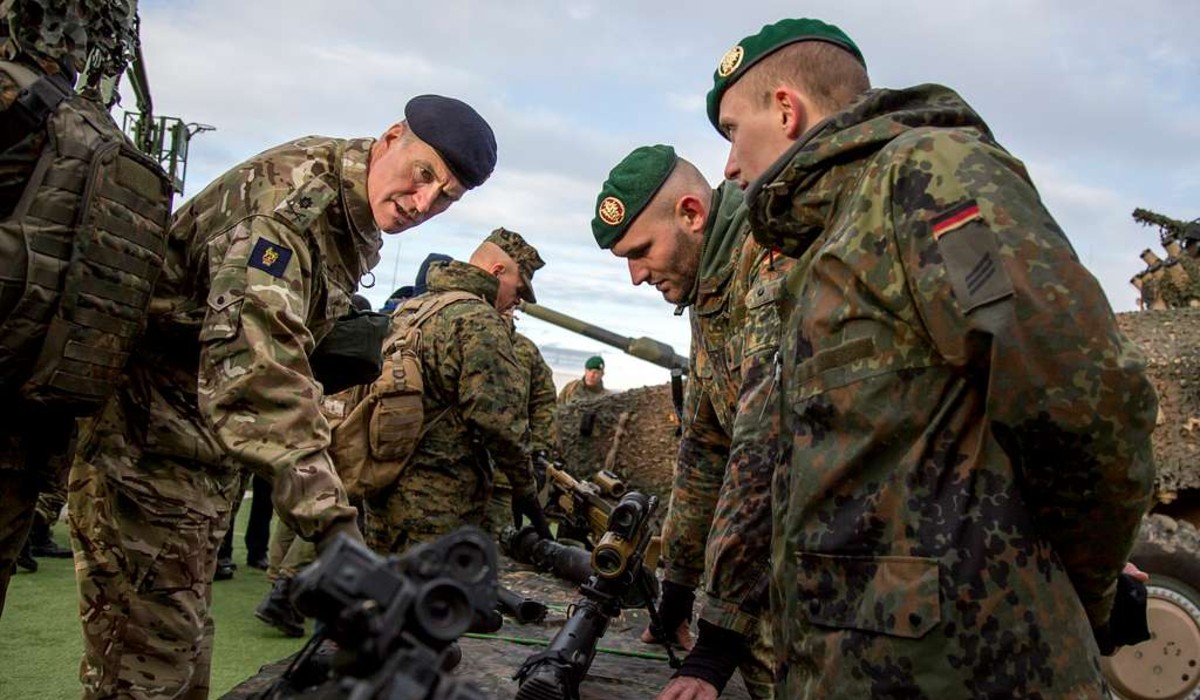
 German soldiers from the 91st Infantry Battalion (Jägerbataillon 91). Photo: Defense Visual Information Distribution Service / Public Domain Dedication
John Rees on the warmongers get-together, and the plans for the anti-war movement international conference
The Munich Agreement, Neville Chamberlain’s infamous appeasement of Hitler, is, it seems, about to get a modern re-enactment.
European leaders meeting at the Munich Security Conference have been contorting themselves to appease Donald Trump’s demand that Europe rearms. This year’s Munich meeting comes against a backdrop of multiple conflicts, including wars in Ukraine, Gaza and Sudan. Transatlantic ties have long been central to the Munich Security Conference, which began as a Cold War forum for Western defence debate. But the unquestioned assumption of cooperation that underpinned it has been upended by Trump, forcing the Europeans to pay for more weaponry in order to keep Trump engaged.
The head of Nato, Mark Rutte, said: ‘We have years, decades of complaints by the U.S. about the fact that in Europe we were not spending enough on defence. That has changed with the summit in The Hague … Europe is really stepping up, Europe taking more of a leadership role within NATO. Europe, also taking more care of its own defence. And this is really a staggering change and this will make NATO stronger because it means that a strong Europe in a strong NATO means that the transatlantic bond will be stronger than ever because we have dealt with that big irritant on the U.S. side of Europe not doing the same as the Americans were doing.’
Outside the conference, Greenpeace protestors called on the participants to ‘break free of tyrants’ in front of inflatable figures of Trump and Putin. Inside the conference, that was the last thing on anyone’s mind.
US Secretary of State, Marco Rubio, met Chinese Foreign Minister, Wang Yi, on the sidelines of the conference, as Washington and Beijing eye a visit by President Donald Trump to China in April. This month, Trump held a phone call with Chinese President Xi Jinping, which the Republican president described as ‘very positive’. Rubio and Wang made no remarks and ignored a shouted question from a Reuters reporter.
Danish Prime Minister Mette Frederiksen urged European nations to bolster their collective defence and economic resilience, warning that the post-World War II global order has devolved into a ‘world disorder,’ requiring a stronger and more unified Europe. ‘The world order that has been built up since the Second World War … that’s gone now,’ Frederiksen told journalists upon her arrival at the Munich Security Conference.
Ukrainian President Volodymyr Zelensky arrived in Germany on Friday to lead Kyiv’s delegation to the conference. Zelensky said the visit could bring ‘new steps toward our shared security’ including plans for a joint Ukrainian-German drone-production venture and meetings with international partners. US Secretary of State, Marco Rubio, said a meeting with Zelensky was possible though not yet fully confirmed.
At a fringe event, the drive to war was bolstered by a message from Olexandr Falschchynski, head of Ukraine’s 7th Rapid Response Corps, who said: ‘Change or die. That’s the slogan of today’s exhibition. But it’s not the slogan for Ukraine. It’s a warning for Europe: you need to prepare yourselves before war comes to you. And in this, we Ukrainians are the best partners for you because we already live in a future of war. And we pay for this the highest price: the Lives of Ukrainian People.’
European leaders are ever more determined to ramp up arms spending and propagandise the need for their citizens to accept the war preparation that is already diverting welfare spending into the pockets of shareholders of the arms industry. The international anti-war movement is resisting this war preparation and it’s finding an increasingly deep echo among working-class people. Hundreds of organisations across Europe are already preparing an international peace conference in London in June.
Before you go
The ongoing genocide in Gaza, Starmer’s austerity and the danger of a resurgent far right demonstrate the urgent need for socialist organisation and ideas. Counterfire has been central to the Palestine revolt and we are committed to building mass, united movements of resistance. Become a member today and join the fightback.

John Rees
John Rees is a writer, broadcaster and activist, and is one of the organisers of the People’s Assembly. His books include ‘The Algebra of Revolution’, ‘Imperialism and Resistance’, ‘Timelines, A Political History of the Modern World’, ‘The People Demand, A Short History of the Arab Revolutions’ (with Joseph Daher), ‘A People’s History of London’ (with Lindsey German) and The Leveller Revolution. He is co-founder of the Stop the War Coalition.