
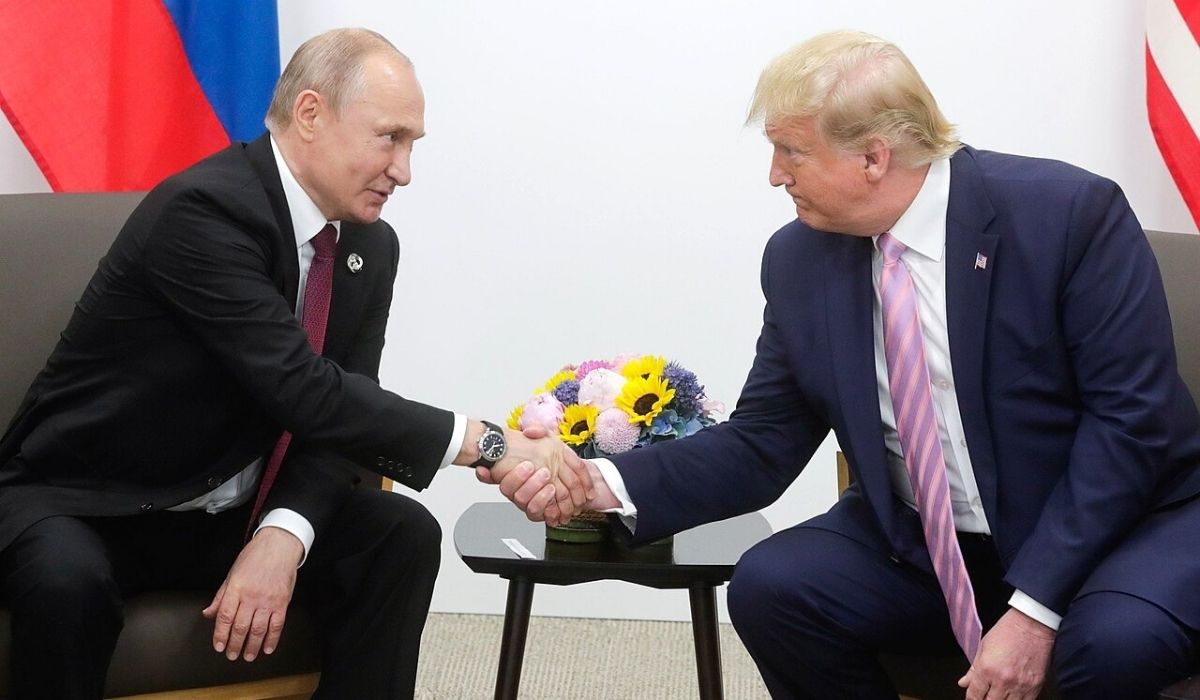
 Putin with Trump, June 2019. Source: Presidential Press and Information Office - wikicommons / cropped from original / CC BY 4.0
Chris Bambery explores the reasons behind Trump’s failure to secure a peace deal over Ukraine
Most people will have missed the fact that over the festivities, the Trump-brokered peace deal to end the Russo-Ukrainian war failed. Moscow rejected the idea that there should be a demilitarised zone between the two states, policed by European and other Nato troops.
Moscow has always insisted that any peace deal needs to agree to Ukraine being neutral and that Washington enter into talks with Russia over Nato expansion. Russian President Vladimir Putin and Foreign Minister Sergei Lavrov have repeated that this is not negotiable. They have also made clear they regard the Donbas and Luhansk as an integral part of the Russian Federation. They might also have rejected the proposed treaty term, giving Ukraine an army of 800,000, far in excess of what it fields now.
Since then, however, a series of events seems to have scotched any chance of Trump brokering any peace deal in the Russo-Ukrainian war, at least from Moscow’s point of view, and has led to a dangerous deterioration in Russo-American relations.
On Monday, 28 December, Russia claims Ukraine tried to hit Vladimir Putin’s country residence in a mass drone attack. The attack incensed the Russian leadership, with Lavrov saying Russian air defences shot down 91 drones, calling the attack an act of ‘state terrorism.’
The Guardian’s Shaun Walker claimed that there was no evidence produced by Putin and Lavrov of such an attack, but had to admit: ‘Ukraine certainly has a history of carrying out strikes deep inside Russia, including assassinations of military figures, drone attacks on oil refineries and, most spectacularly, Operation Spiderweb, in which camouflaged drones launched from trucks destroyed numerous Russian strategic [nuclear] bombers deep inside Russia.’
Moscow announced that it had given the US military attaché evidence of CIA involvement in the attack; part of a Ukrainian drone containing data he said proved that the Ukrainian military had targeted a Russian presidential residence.
Within hours, Washington denied that any such attack had taken place:
‘The US National Security Agency has concluded that Ukraine did not attempt to strike the residence of Russian leader Vladimir Putin, claims of an alleged assassination attempt.’
It continued ‘This assessment is backed by the US Central Intelligence Agency (CIA), which also found no evidence of preparations for an attack on Putin. The CIA declined to comment officially, but a US official familiar with the intelligence confirmed the information to journalists.’
Retaliation
It is widely seen that Russia’s response to all this came last Friday when it fired an Oreshnik hypersonic ballistic missile into Ukraine, only the second time this weapon has been used in this war:
Russia claimed it fired the missile at a critical target in Ukraine in response to the attempted drone strike on one of President Vladimir Putin’s residences.
The US and UK raised the strike at the UN Security Council seeking a condemnation from that body, but, of course, Russia and China have vetoes.
Tammy Bruce, the US’s deputy ambassador to the UN, said Russia’s use of the missile ‘Constitutes another dangerous and inexplicable escalation of this war, even as the United States is urgently working with Kyiv, other partners and Moscow to end the war through a negotiated settlement.’ Bruce added, ‘We condemn Russia’s continuing and intensifying attacks on Ukraine’s energy facilities and other civilian infrastructure.’
No doubt the Russians and Chinese are too polite to point out the hijacking of Russian-flagged and Chinese-bound oil tankers on the high seas and the killing of people in small boats of the coasts of Venezuela and Colombia.
The acting British ambassador to the UN, James Kariuki, called the attack “reckless”, saying that ‘It threatens regional and international security and carries significant risk of escalation and miscalculation.’ and ‘President Putin claims to want peace, and yet his actions tell a different story.’
Kariuki concluded that: ‘[If] President Putin thinks this violence will deter Ukraine’s partners, he is wrong about that too. We will continue to ensure that Ukraine gets the military and financial support it needs to defend itself. And we will increase pressure on Russia to de-escalate and engage in meaningful negotiations.’
Below, I will argue that far from Britain wanting peace, it is acting with France and Germany to prolong the war.
Reports state that the Oreshnik hit the Bilche-Volitsko-Uhersky underground gas storage facility, which has a storage capacity of 17.05 billion cubic meters, which is more than 50% of the total capacity of all gas storage facilities in Ukraine.
Meanwhile, Russia has hit three US owned facilities in Ukraine. On 6 January, Russia launched major missile strikes against US-owned facilities in Ukraine. In the Dnipropetrovsk region, Russian ballistic missiles decimated the Oleina oil extraction plant, which is owned by the American Bunge agribusiness company based in St Louis, Missouri.
In the Transcarpathian region, in western Ukraine, Russian kamikaze drones, together with missiles, caused critical damage to the Flex plant, which also belongs to Flex Ltd. (formerly Flextronics), a Singaporean-American company headquartered in Austin, Texas.
The third attack was in the Odessa region, on the American-owned marine terminal Olimpex, the largest in the region. It was hit despite the fact it is defended by US-provided Patriot missiles.
Russia is winning this cruel war, which began with Putin’s criminal invasion of Ukraine. United Nations monitors recorded more civilian deaths in Ukraine in 2025 than in any other year except 2022. All civilian deaths are unacceptable, and it is a shocking figure, but it pales in comparison with Gaza or Sudan.
But in this meatgrinder of a war, Russia is steadily pushing west towards the Dnieper River. Ukraine is short of men, with young Ukrainians avoiding the draft en masse. President Volodymyr Zelensky government has been rocked by a serious corruption scandal.
The British response
Let’s return to the UK’s involvement. Last Friday, UK Defence Secretary John Healey said on a visit to Kyiv that ‘he would want to abduct Putin’ and ‘take Putin into custody and hold him to account for war crimes.’
Why might the newspaper ask such a question a week and a half after Trump kidnapped Maduro? Why did Healey reply? His buffoonery will have been noted in Moscow.
Meanwhile, on a more serious note, the Starmer government has responded to the deployment of the Oreshnik ballistic missile with Operation Nightfall:
‘The British government is asking defence firms to rapidly produce a new ground-launched ballistic missile to aid Ukraine’s fight against Russia – hardware that might also be adopted by UK’s armed forces in future. Under the codename Project Nightfall, Britain’s Ministry of Defence (MoD) is kicking off a competition to develop a ground-launched ballistic missile system with a range of more than 500 kilometres, capable of delivering a 200 kg conventional high explosive warhead. It aims to provide Ukraine with a long-range punch capable of countering Russian forces. At the range specified, it should be possible to strike threats located within Russia from the front line inside Ukraine.’
Three industry teams will each be awarded a £9 million development contract to design and deliver three missiles for test firing within 12 months.
What no one is saying is that it’s not just Britain supplying Kyiv with ballistic missiles that can hit Moscow or St Petersburg, but that they will be initially targeted and fired by British personnel, until they train Ukrainians to do that. The danger is that, given the number of Nato operatives in Ukraine, any such attacks might well see Russia retaliate against them.
Conscription plans
Meanwhile, on 27 December (a lot gets announced in Xmas week!), the Starmer government launched a new scheme to boost recruitment to the armed forces:
A ‘gap year’ scheme to give school and college leavers a taste of the Army, Royal Navy or RAF without a long-term commitment, is to be launched by the government. The course is aimed at under-25s and is part of efforts to solve long-term recruitment and retention problems in the armed forces. Applications to be part of the first of 150 recruits open in the spring, with plans for that number to grow to 1,000 young people a year. The programme will be paid, but officials have yet to announce a salary. Defence Secretary John Healey said the scheme would offer young people “incredible skills and training.”’
The scheme falls short of bringing back conscription, as in Germany and France, but indicates the direction of travel in Whitehall.
Trump has effectively walked away from the war in Ukraine, but the US deep state has not. The White House wants the Europeans to foot the bill for keeping Ukraine in the way. Starmer, Macron and Merz don’t have the money or the material. They will either have to borrow or cut welfare. Either way, their economies are virtually stagnant. War-driven austerity will, I predict, prove deeply unpopular across Europe.
Global instability
What does all this matter? Because it adds to the growing global instability. Just imagine you are Putin (a not very attractive thought, but…). Since Christmas, he has watched the failed drone attack on his residence; the illegal abduction of Venezuelan President Maduro, a Russian ally; Trump’s threats to attack Greenland, which borders Russia in the Arctic; the piratical hijacking of a Russian ship in the North Atlantic, helped by Britain. Add to all that Trump’s threat to attack Iran, another Russian ally.
Former CIA analyst, Larry C. Johnson, concludes: ‘If you’re sitting in Moscow and reflecting on the actions of the United States since December 28… you are likely to conclude that Trump is not serious about normalizing relations with Russia and that he is looking for a confrontation. It is foolish to poke a cranky bear because you are only going to further provoke the animal and incite him to eat you.’
For Donald Trump, ‘might is right.’ He has ripped up the international rules-based order (which always benefited the US), and there is now no rule book.
Russia is not a superpower, so the Russian bear can’t eat Trump, but it is now closely allied with China, not least in the Artic where both states are looking to open the north-east passage linking the Pacific to the Atlantic. Militarily China cannot match the US, yet. But economically, it is in a strong position. US debt is enormous, $38,440,311,611,013. That’s $112,622 for each inhabitant of the USA.
A fall in the price of the dollar or fear that the US cannot repay this debt would have an enormous impact internally within the USA.
Before you go
The ongoing genocide in Gaza, Starmer’s austerity and the danger of a resurgent far right demonstrate the urgent need for socialist organisation and ideas. Counterfire has been central to the Palestine revolt and we are committed to building mass, united movements of resistance. Become a member today and join the fightback.

Chris Bambery
Chris Bambery is an author, political activist and commentator, and a supporter of Rise, the radical left wing coalition in Scotland. His books include A People's History of Scotland and The Second World War: A Marxist Analysis.