
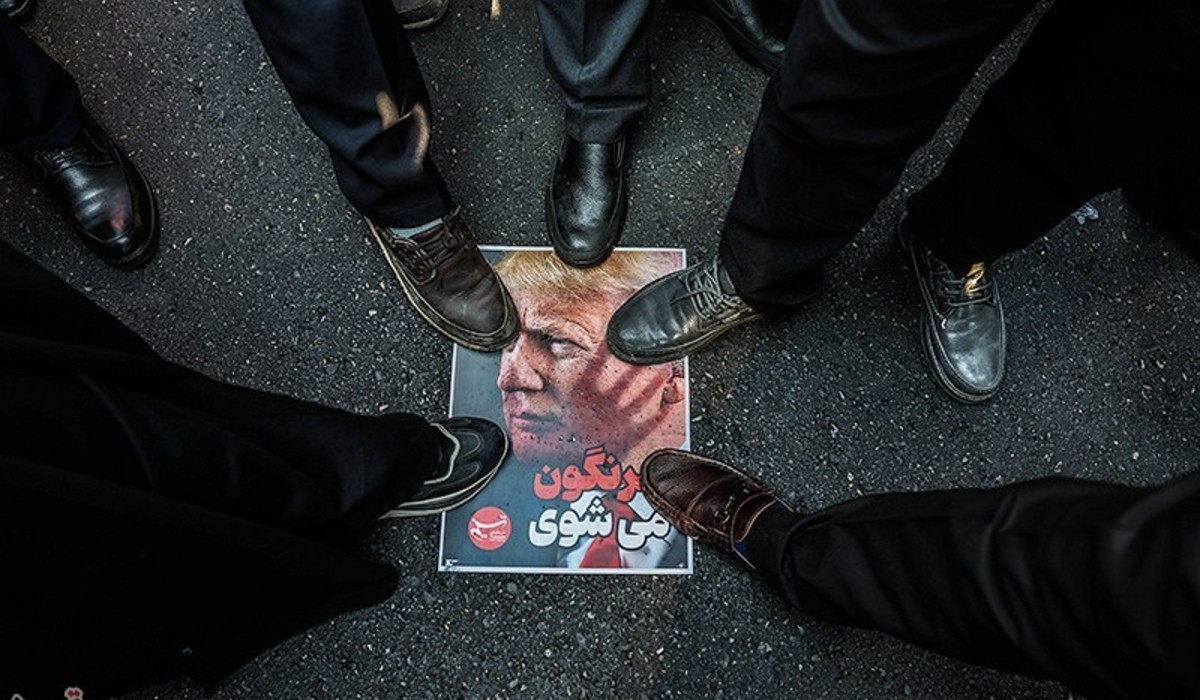
 Popular rally in Tehran / Taken on 12 January 2026 / Wikimedia Comms/ Photo: Mostafa Tehrani/ CC BY 4.0
As Trump threatens Iran, our task is to campaign against Western ‘regime change’ and support the Iranian people in determining their own future, argues John Rees
Mass protests against the government have entered their third week in Iran, leaving at least 2000 dead, according to the regime’s own figures.
President Trump is threatening military intervention if the Iranian regime kills more protestors.
Yet, the sanctions imposed by the US and its allies are an important cause of the economic distress that has provoked the revolt. The US also directly attacked Iran during the Israeli offensive in Gaza, as did the Israelis themselves.
The late Shah of Iran’s son, currently exiled in America, is making the most of the unrest and attempting to engineer his, and the monarchy’s, return, reversing the overthrow of his father by the 1979 Iranian revolution.
Few Iranians wish for the return of the monarchy, which was at least as repressive as the existing regime. Equally, few Iranians, looking at the experience of their neighbours in Iraq, pine for regime change fostered by President Trump.
But they do have their own reasons for wanting fundamental economic and political change. The number of people living below the absolute poverty line in Iran doubled from 15 per cent to 30 per cent between 2018 and 2020.
A former head of the Social Security Research Centre has painted a bleak picture of the growing poverty in Iran, stating that the amount of the population living below the poverty line has doubled while the number of workers below that line has increased fivefold, based on official statistics.
And this is not the first round of protest that Iran has seen in recent years, as David Bush, and others, have pointed out:
‘In 2019, protests were largely working class and in rural areas, mostly concerned with economic grievances. They were repressed in a bloody crackdown.
In 2022, protests exploded again in largely urban areas. This time they were led by women reacting to Iran’s morality police, but wider forces demanding democratic freedoms also became involved. The regime again answered with repression.
The current wave of protests has returned to economic issues and is largely working-class led – involving more worker organizations and workplace actions than previously, although the left is weaker than before due to previous rounds of repression.’
One indication of the mood of some of the protestors comes from the Syndicate of Workers of the Tehran and Suburbs Bus Company. It says, ‘We have said it many times, and we repeat it again: the road to liberation for workers and working people does not run through manufactured “leaders” imposed from above, reliance on foreign powers, or factions within the ruling establishment. It runs through unity, solidarity, and building independent organizations in workplaces and communities, and at the national level. We must not allow ourselves to once again become victims of power games and the interests of the ruling classes.’
That’s a message which will not be well received either by the Iranian government, the son of the Shah of Iran, or President Trump.
The task of socialists and the anti-war movement is simple. We are not in Iran, we are in countries who are crippling Iran economically, have repeatedly attacked or backed military attacks on Iran, and are preparing to do so again.
Our primary task is to get our governments off the back of the Iranian people and to prevent another Western ‘regime change’ disaster of the kind already inflicted on Iraq and Libya. That will, at a stroke, give the Iranian people the best possible chance of determining their own future.
Before you go
The ongoing genocide in Gaza, Starmer’s austerity and the danger of a resurgent far right demonstrate the urgent need for socialist organisation and ideas. Counterfire has been central to the Palestine revolt and we are committed to building mass, united movements of resistance. Become a member today and join the fightback.

John Rees
John Rees is a writer, broadcaster and activist, and is one of the organisers of the People’s Assembly. His books include ‘The Algebra of Revolution’, ‘Imperialism and Resistance’, ‘Timelines, A Political History of the Modern World’, ‘The People Demand, A Short History of the Arab Revolutions’ (with Joseph Daher), ‘A People’s History of London’ (with Lindsey German) and The Leveller Revolution. He is co-founder of the Stop the War Coalition.