
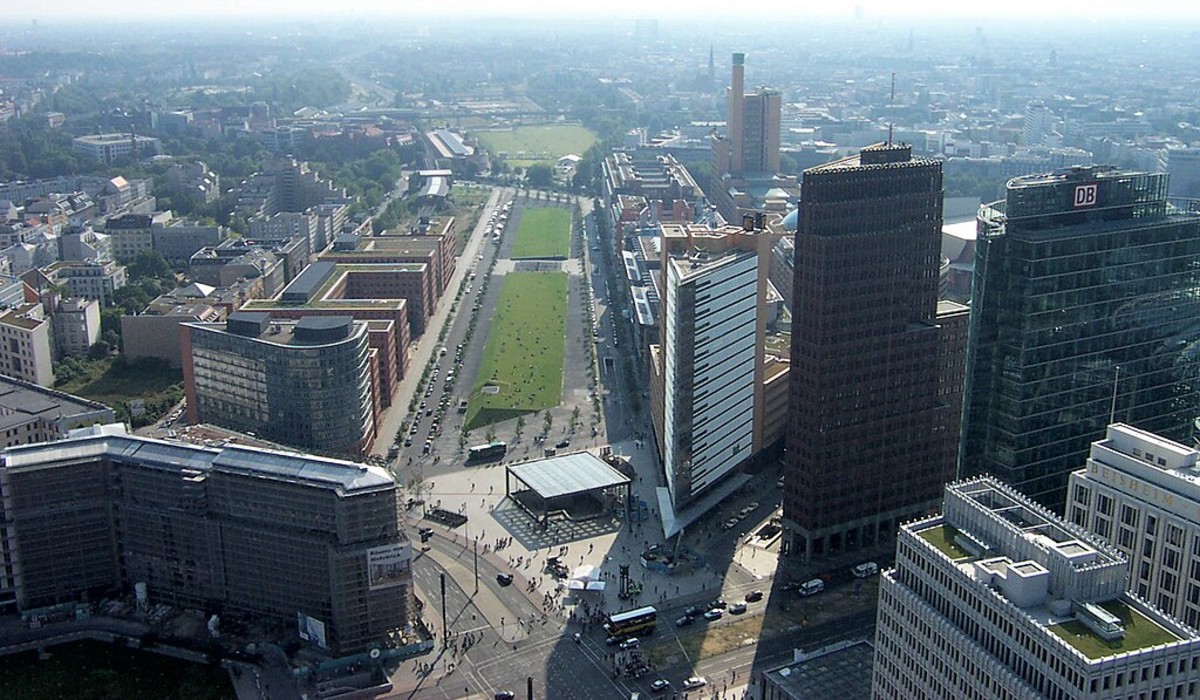
 Potsdamer Platz in Berlin. Photo: Tonythepixel / Wikimedia Commons / Public domain
A socialist activist in Berlin explains the conditions under which unionisation in the German tech sector is able to take place, and the successes so far
Context:
It is necessary to be anonymous in order to protect workers and the unionisation drive which is still in its infancy, therefore identifiable details have been omitted or obscured.
My employer is a major e-commerce tech platform headquartered in Berlin, Germany. In 2023, the company was acquired by the private-equity company Blackstone, and is now in the stage of maximising profit extraction since it has captured the majority of the market, or ‘enshitifying’, as Cory Doctorow conceptualised it. The company is now highly profitable with an EBITDA (earnings before interest, taxes, depreciation, and amortisation) of circa 60-70% of revenue (which is pretty standard for e-commerce tech platforms of our type and size).
In my first update for Counterfire in May 2024, I recounted the experience of founding the Works Council as a necessary first-step towards unionisation and a vehicle through which to help organise for unionisation. The workforce is relatively well paid and the employer competes globally with major tech companies such as Meta, Google, and Amazon as well as other Berlin-based brands like HelloFresh, Zalando, and N26, for engineering talent. However, in recent years, tech-worker pay has been eroded by inflation, jobs are much harder to find, and the intensification of work has increased substantially. This has opened the opportunity for potential unionisation.
The relationship between Work Councils and unions
At the time of writing that last update, we had just elected a majority pro-worker Work Council and fought off an attempt by the employer to elect a pro-business majority of Work Councillors. Due to the unique German context of organising the tech industry, it is a prerequisite to form a Work Council in order to be in a position to form a union. Additionally, in an environment of low working-class consciousness, the Work Council as a legal institution, is much more palatable than a union (a union was, or is still, seen by some, as too ‘rebellious’, ‘bureaucratic’, or ‘leftie’ etc).
Generally speaking, the legal powers conferred to a Work Council allow it to protect the union in its infancy (WoCo legislation has the power to prevent attacks, for example, in the form of sackings). The union, once established with organised worker power, protects a Work Council through strike action (or the threat of).
It’s important to make this point, because unions and Work Councils are often confused with each other (in Germany) when in fact they are quite distinct. When the Financial Times refers to the ‘Powerful Works Council’ at Volkswagen, the power of the Work Council really comes from the (latent) power of the Volkswagen IG Metall union and the shopfloor workers behind it, not the legal power of the Work Council on its own (VW has very high union density of more than 90%). A Work Council, which in its explicit form is a legal entity, on its own, is a paper tiger without a union behind it.
I will repeat the most important points from my last update about what a Work Council is in Germany as it significantly alters the organising situation, especially in the non-unionised tech industry.
A Work Council (Betriebsrat in German), is a council of workers elected by workers (executives cannot vote or sit on the Works Council) every four years. It has enforceable co-determination rights in law which give it legal power to sue the employer in court if the co-determination process is not respected. You can see the co-determination rights in section 87 of the German Works Constitution Act which covers working hours, remote work, distribution of pay, health and safety, and other working conditions. Work Councillors have dismissal protection and enjoy other benefits such as three weeks educational leave (bildungsurlaub). The establishment and operation of the Work Council is fully funded by the employer and employees are paid their usual salary regardless of the amount of hours displaced by Work Council activity (though in practice, it is very difficult balancing the two: the fear of ‘getting left behind’ means quite often Work Councillors don’t actually do much Work Council work).
Sounds great right? In theory, you could be forgiven for thinking ‘why do we need a union?’ (was that the point?), but in practice, as we have seen in Berlin at the likes of Zalando, DeliveryHero, and HelloFresh, many tech-company Works Council initiatives have been defeated (by defeated, I mean Works Councils that failed materially to protect or uplift working conditions for workers).
We are one of a small handful of success stories as a tech-company Works Council (along with the N26 and SoundCloud Works Councils) because we understood that wins, or co-determination rights, would be gained in the court of employee opinion rather than in the court of law.
Since the foundation of the Electoral Board, we have achieved three specific wins, which I will recount here, and emphasise why it was collective worker power that was the decisive factor behind these wins.
The election of a pro-worker Works Council
Our first major win, which I already mentioned above, was electing a majority of members that intend to act in favour of worker interests, i.e. a pro-worker Work Council, fighting off an attempt by management to infiltrate it, and going on to form a majority of 80% of seats of the works council with the management stooges taking only the remaining 20% seats.
In our election campaign, we emphasised that our success in representing employee interests would depend on ongoing democratic participation and active engagement of the workforce in the co-determination process itself in the form of one-to ones, interviews, and surveys. We achieved a 67% participation in the election (very high by inaugural Work Council election standards) and as I already mentioned, an 80% majority pro-worker Works Council.
Our second win came in the form of a negotiation with the employer over the amount of money available for workers in a reorganisation, one in we ‘cut our teeth’ (as described by our lawyer), one in which we distinguished ourselves from the majority of other Tech company Work Councils in Berlin that typically get corrupted. The employer deployed a number of sophisticated union-busting tactics on us but we emerged stronger and won by successfully reducing the layoffs to near zero and winning compensation for workers affected in various ways which they wouldn’t have otherwise got.
In this negotiation, which played out over a number of weeks, the amount of pressure the work councillors were under was enormous, but with a significant majority of the workforce behind us and supporting us (60% of the company voted for a Works Council) the employer could not use overt tactics to undermine us, due to the risk of a major employee relations crisis, and at the eleventh hour, they conceded our demands and a compromise deal was reached.
As is common in many tech companies before they reach a certain size, they rely on the willing consent, or the ‘we are all one happy family’ tactic, to enforce high levels of exploitation and control over the workforce. If it becomes too obvious that as an employer you are deliberately undermining the Work Council, this will cost you real productivity, especially if certain key employees start to leave or protest.
Return to Office mandate (RTO)
The employer tried to mandate a Return to Office order of one day per week without consulting the Works Council which is co-determined in Section 87 (1) of the BetrVG. The employer mobilised a number of tactics to divide the Work Force on the question of office attendance. The Works Council went on the offensive for the first time and held a public meeting to announce the legal position of the Works Council to the entire workforce. It soon became clear that the employer had over-extended its hand and the RTO became unenforceable with most managers refusing to comply or enforce disciplinary procedures. It was an employee-relations disaster and the employer (the head of HR, not the CEO who initially announced the RTO) was forced to issue an apology.
This was a major material win when you consider we are one of the few major tech companies in Berlin which has not forced its employees back into the office between three and five days per week (the mandate was for one day per week!).
The Work Council increased its communications-channel membership from 57% to 71% in that period of open confrontation. The jump could have been even higher perhaps had we not been going through a period of significant workforce growth in which the total employee base grew by 37%!
Another more subtle way in which this was a major win for the Work Council and especially for the future of the unionisation drive is the fact that it demonstrated that workers favour a fighting Works Council or union! A typical way in which the employer attacks the works council is by accusing it of being confrontational. If and when we reach a majority and announce collective bargaining negotiations as a union, we will be entering into a major confrontation with the employer. Workers will need to understand that this is a major confrontation and that a lot will be at stake.
The task ahead
In September 2025, I switched my efforts from Works Council activity to union organising activity. Organising in tech, as the title implies, is particularly hard. Based on my own experience, a lot of tech workers experience a high-level of ‘self-exploitation’ due to a mix of liberal, techno-optimist, and ‘professional middle-class’ (PMC) ideology as well as the usual management tactics namely outsourcing, and other practices that drive increased rates of self-exploitation.
However, these mainstream ideas are being seriously confronted by realities on the ground. In my case, most workers have not seen a pay rise in three years and working conditions have rapidly eroded over the last three years and in the course of two acquisitions (one acquisition was by a publicly listed company and, in the next, we were taken private by Blackstone).
Despite this worsening of conditions, I do not believe this situation is enough on its own to drive the kind of unionisation membership we need – a majority of the company – to take on the employer for the aforementioned reasons and given current conditions. We are relying on two as-yet-to-happen developments to drive union membership 1) the Annual Salary Review in April 2026, in which the vast majority of workers will receive a 0% pay rise (i.e. a real-terms pay cut due to inflation) and 2) an imminent (third) acquisition by another private-equity company.
Therefore, the task for us will be to put the internal union infrastructure in place (Telegram groups, regular education sessions, and trained activists) to transform anger and fear from the Annual Salary Review and another company sale and the fear of job losses (in a very challenging labour market environment) into union membership. The very first of these meetings which one of the major German service-sector unions is hosting, will be in January 2026 now that we have met the required size for them to release resources.
I have never been engaged in union organising before, so it is difficult for me to understand if this stage of the unionisation drive will ultimately be successful, that is, of reaching a majority of the company in terms of union membership. Based on my current understanding and at the current moment, I believe all the internal and hopefully external conditions are in place for that membership growth to take place and that will be a very positive development indeed for tech workers in Berlin and for the strength of the union movement.
Before you go
The ongoing genocide in Gaza, Starmer’s austerity and the danger of a resurgent far right demonstrate the urgent need for socialist organisation and ideas. Counterfire has been central to the Palestine revolt and we are committed to building mass, united movements of resistance. Become a member today and join the fightback.
