
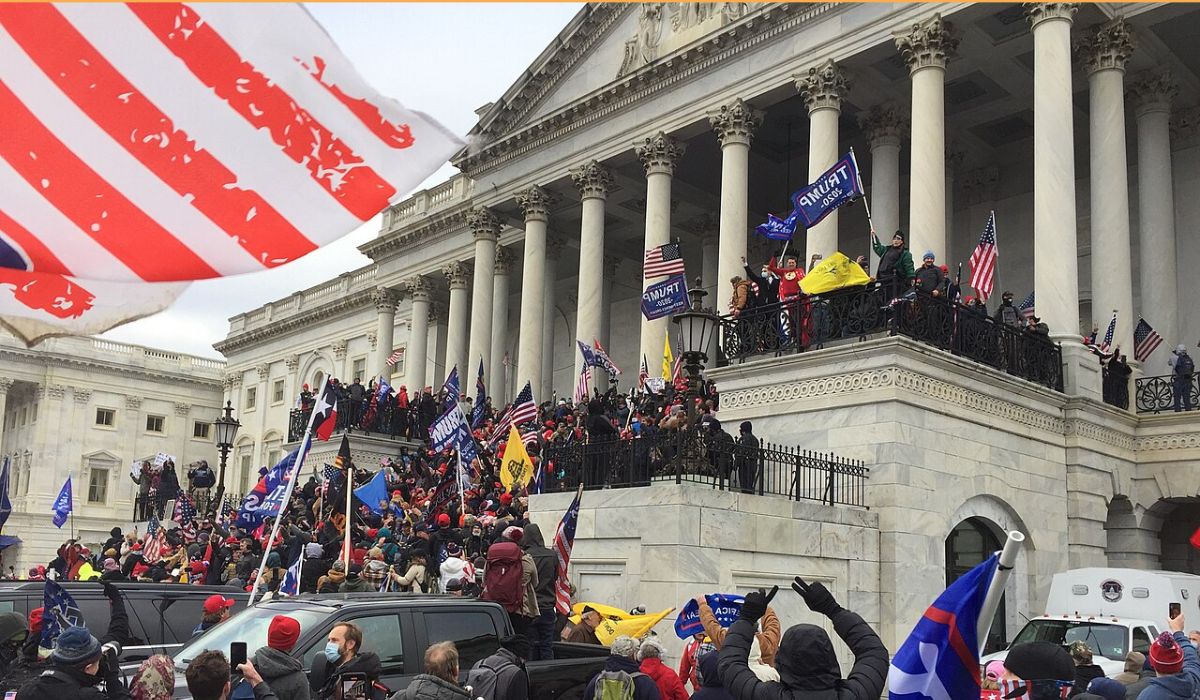
 Crowd of Trump supporters marching on the US Capitol on 6 January 2021. Source: TapTheForwardAssist - Wikicommons / cropped from original / CC BY-SA 4.0
Despite the egregious failings of the BBC, Trump’s bullying must not be allowed to silence any and all critics in the media, argues Des Freedman
Donald Trump has announced that he will definitely sue the BBC for what he describes as the Corporation’s defamatory and misleading edit of a speech he gave on January 6, 2021, urging his supporters to march to the US Capitol to protest the ‘stolen’ 2020 presidential election.
The Panorama programme, broadcast shortly before the 2024 election, spliced together two clips from different parts of the speech to suggest that Trump was inciting people to engage in violence: to ‘fight like hell’. Trump is claiming that the BBC ‘intentionally and maliciously’ sought to turn viewers against him and is claiming $10 billion in damages.
The dodgy edit was first revealed by the Daily Telegraph as part of a dossier alleging systematic liberal institutional bias. The BBC has apologised for its behaviour and the scandal has already seen the resignation of both the director general, Tim Davie, and head of news, Deborah Turness.
Trump, however, wants more than a couple of scalps. The lawsuit is part of a comprehensive attack on mainstream media outlets who dare to make any criticism of his administration or his personal life. He’s already extracted out-of-court settlements from both CBS/Paramount and ABC News and is still at war with the Wall Street Journal (with a $10 billion lawsuit against its claim that he sent a sexually explicit note to Jeffrey Epstein) and the New York Times (who he’s suing for $15 billion alleging that it’s ‘mouthpiece’ of the Democratic Party).
These are the actions of an authoritarian leader who’s desperate to bully critics and opponents into submission through intimidation and fear. Yet, at the same time, however, there are all sorts of problems with Trump’s case.
First, Trump announced his intention to proceed with the lawsuit by saying that the BBC had put ‘words in my mouth’ and even used AI in assembling the Panorama programme. Of course, this isn’t the case: all the words used in the programme were Trump’s but edited together to achieve a particular outcome: that he was inciting his supporters.
Second, while the specific edit may have been potentially misleading, most journalists on January 6, 2021 understood Trump’s speech to be inflammatory. Even the Daily Telegraph, the title that splashed with news of the edit, acknowledged this. Its story on 7 January, 2021, headlined ‘Shocking scenes of rampant hordes will be Trump’s appalling legacy’, noted that the invasion of the US Capitol ‘looked like sedition, an attempted coup, and Mr Trump failed to stop it – even encouraged it.’
The Daily Mail, in its story headlined ‘A Mob Led Astray’, argued that Trump’s supporters were: ‘egged on by a leader who dispensed with any semblance of responsibility or dignity. In truth, he’s been egging them to this moment for four years. A president who had promised to drain the swamp of Washington instead effectively set the city aflame, inciting an army of his supporters to storm the Capitol.’ The idea that Trump’s speech was inciting violence was hardly the exclusive preserve of liberal journalists.
Resist the bullying
Third, Trump is going to have to prove substantial damage to his reputation. The lawsuit argues that he has suffered ‘massive economic damage to his brand value and significant damage and injury to his future financial prospects.’ Given that he won the presidential election shortly after the programme was broadcast and that there is no evidence that a single citizen of Florida – where the legal action is being heard – ever watched the programme, this is going to be very hard to determine.
Fourth, Trump’s lawyers will have to show that Panorama deliberately set out to deceive the public and that the BBC were guilty of a ‘reckless disregard for its falsity’. Given that, as I’ve already argued, that there was a widespread consensus across the political spectrum that Trump’s speech was highly inflammatory, this will also be really difficult to prove, especially in the US where there is a high bar to defamation claims.
The BBC has rightly promised to contest the charges. This is essential both because it would lose all credibility in its claim to be a ‘trusted’ news provider if it settled out of court but also because not a single penny of licence-fee revenue should go towards rewarding Trump’s bullying. Additionally, the government should be far more outspoken in its support for the BBC but that, of course, would clash with its desire not to upset the president in the naïve hope that it will be treated favourably in trade negotiations.
However the real danger isn’t that Trump will bankrupt the BBC with a multi-billion dollar payout. Instead, the worry is that the mere threat of legal action will further chill the prospect of holding Trump to account for his ugly presidency: for his determination to start a war with Venezuela, for his mass deportation of undocumented migrants and for his militarisation of large US cities.
The BBC, in a particularly fragile position at the start of a Charter Review process that will determine its future, has already alienated millions of people with its dehumanising coverage of Gaza. It consistently fails to hold the powerful to account and yet its status as a public broadcaster means that it will always be attacked by market fundamentalists who want to ‘expunge the term “public service broadcasting”’ and to see a media landscape completely dominated by for-profit outlets with only the lightest touch regulation.
Donald Trump was originally seen as a cash cow for US media. Back in 2016, the CEO of US network CBS argued that a Trump presidency ‘may not be good for America, but it’s damn good for CBS’. Few media bosses are suggesting that now and are instead licking their wounds from his assaults.
This also means that for all the justified criticisms that the left has of the BBC, it’s vital that Trump isn’t allowed to decimate media organisations that he has a problem with. As I argued when the scandal first erupted in November: ‘The right want to reshape the world in its own image and it’s far more comfortable with outlets owned either by billionaire media moguls or tech oligarchs than with organisations formally accountable to and owned by the public.’
This doesn’t mean letting the BBC off the hook for a single minute but it also doesn’t mean that we should be indifferent to the attempt by the world’s most powerful man to crush and silence even the most flawed news organisations.
Before you go
The ongoing genocide in Gaza, Starmer’s austerity and the danger of a resurgent far right demonstrate the urgent need for socialist organisation and ideas. Counterfire has been central to the Palestine revolt and we are committed to building mass, united movements of resistance. Become a member today and join the fightback.

Des Freedman
Des Freedman is Professor of Media and Communications in the Department of Media and Communications at Goldsmiths, University of London. He is the co-author of 'The Media Manifesto' (Polity 2020, author of 'The Contradictions of Media Power' (Bloomsbury 2014), co-editor of 'The Assault on Universities: A Manifesto for Resistance' (Pluto 2011), and former Chair of the Media Reform Coalition.