
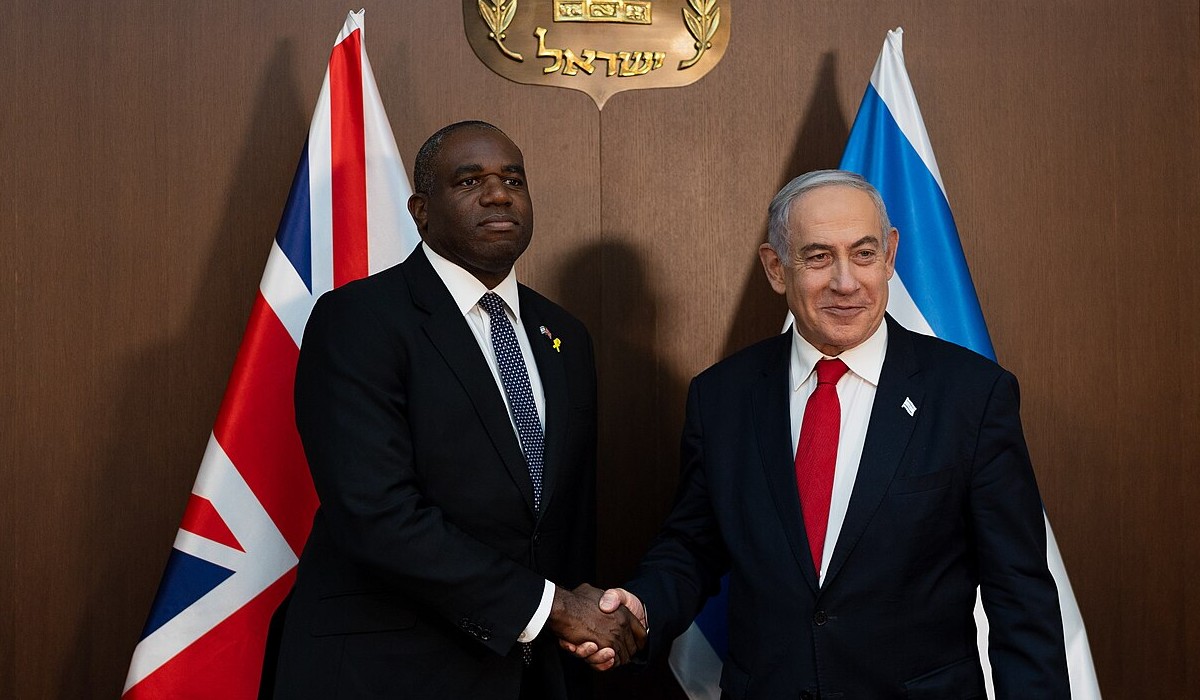
 David Lammy meets with Prime Minister Netanyahu. Photo: Ben Dance FCDO / Wikimedia Commons / CC BY-SA 2.0
The Labour government’s indifference to the Palestine Action hunger strike mimics the most authoritarian elements of modern British politics.
News that imprisoned Palestine Action members are undertaking strike action, reports that Qesser Zuhrah collapsed in her cell and was left on the floor begging for medical treatment, and footage of the strikers waving and singing from their cell windows recall events at the height of the suffragette movement over a century ago.
Today, politicians across the political spectrum pay tribute to the suffragettes as courageous fighters for democracy. Yet the government’s response to the activists taking the same action as the suffragettes has been characterised by staggering levels of disrespect and complacency.
When confronted by a sister of one of the hunger strikers, Secretary of State for Justice David Lammy said, ‘I don’t know anything about this,’ and asked if it was happening in the UK. The Speaker of the House of Commons has stated it is ‘totally unacceptable’ that Lammy has not responded to requests to meet the hunger strikers’ families. When Jeremy Corbyn asked the Justice Minister, Jake Richards, for a meeting with the hunger strikers’ families, some MPs enjoyed a good laugh when Richards responded ‘no’.
Many people fear that the government’s inaction is going to result in the death of the hunger strikers. A comparison with the treatment of past hunger strikes shows that this Labour government is not standing in the tradition of the suffragettes or Gandhi (hunger strikers recently celebrated by David Lammy), instead it resembles some of the most reactionary and authoritarian political forces produced by British politics.
Hunger striking: past and present
Modern hunger strikes are typically used to fight for civil rights by prisoners who have limited ways to protest. Kevin Grant’s book, Last Weapons: Hunger Strikes and Fasts in the British Empire, 1890-1948 has argued that the first British hunger strikers, the suffragettes, were inspired by hunger strikes of imprisoned Russian revolutionaries.
The suffragettes’ hunger strikes protested at their treatment in prison where they were not recognised as ‘political’ prisoners and instead assigned to hard labour. Their actions inspired similar ones by those incarcerated in the British Empire, from Ireland to India. The government understood the connection: in the National Archives, a file mostly relating to suffragettes gives way towards the end to notes on dealing with hunger strikes in British India.
The Irish hunger strikers in 1981 protested at the withdrawal of Special Category Status, which had recognised them as prisoners of war. Hunger strikers in America’s Guantanamo Bay protested at their indefinite detention.
Like these previous hunger strikes, the Palestine Action strike was prompted by their treatment at the hands of the state. Their organisation has been controversially proscribed as a terrorist group. Although none have been convicted, some of the activists face being held in custody until trial dates set for 2027. They also complain that mail, calls and visits have been restricted on spurious grounds or without explanation, that legal mail has been opened unlawfully, access to books has been blocked, inmates have been taken off or banned from prison jobs for ‘security reasons’ and ‘non-association orders’ have been implemented between their clients.
Government responses: past and present
Historically, British governments have been resistant even to dialogue with prisoners who have adopted the desperate protest of the hunger strike. Instead of recategorizing suffragette prisoners, the Liberal government began forcibly feeding the hunger strikers. This was a dangerous and degrading procedure which some suffragettes compared with rape.
The Conservative opposition objected to this, but not on humanitarian grounds. Conservative MP Henry Smith, whose brother FE Smith was a leading figure urging a right-wing armed rebellion against the government over plans for Irish Home Rule, possessed no fraternal feelings for women who broke the law: ‘If, by a great misfortune, one woman was to die, there would be no more. After all, one has to remember this, horrible as it is, that it is worse to allow the law, on which the safety of the whole country depends, to be made a mockery of than to allow one foolish woman to suffer the consequences of her own folly.’
Conservative MP Oliver Locker-Lampson, who was raising money for the armed struggle against Home Rule, argued that if government did not have the ‘little courage and backbone’ to watch women starve to death, they should step aside and let a ‘strong man’ take over.
The ‘strong man’ option was put into practice by Conservative Prime Minister Margaret Thatcher in 1981, which resulted in the death of ten Irish hunger strikers, before the hunger strike was called off.
Today’s Labour government looks set to follow in Thatcher’s footsteps. This accompanies a wider development by the government which is drafting increasingly draconian restrictions on the right to protest, whilst the security services tell us we must ‘step up’ for a global war. The task of building a mass movement of resistance to this government becomes increasingly urgent.
Before you go
The ongoing genocide in Gaza, Starmer’s austerity and the danger of a resurgent far right demonstrate the urgent need for socialist organisation and ideas. Counterfire has been central to the Palestine revolt and we are committed to building mass, united movements of resistance. Become a member today and join the fightback.

Katherine Connelly
Kate Connelly is a writer and historian. She led school student strikes in the British anti-war movement in 2003, co-ordinated the Emily Wilding Davison Memorial Campaign in 2013 and is a leading member of Counterfire. She wrote the acclaimed biography, 'Sylvia Pankhurst: Suffragette, Socialist and Scourge of Empire' and recently edited and introduced 'A Suffragette in America: Reflections on Prisoners, Pickets and Political Change'.