
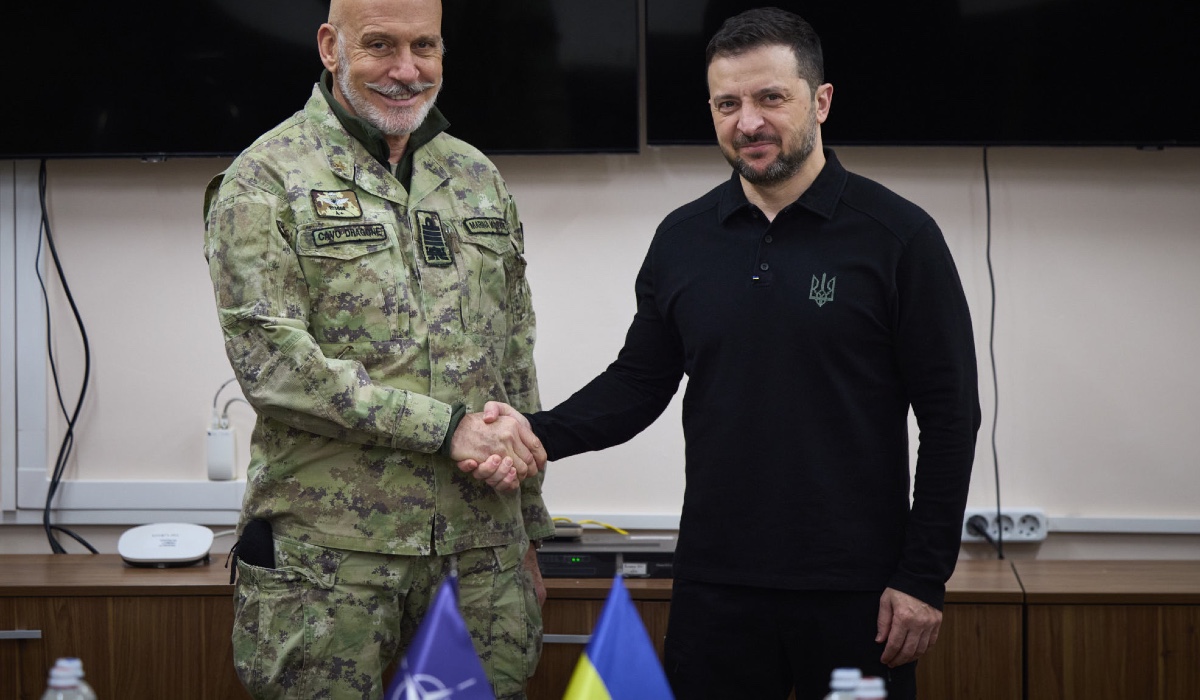
 Meeting between Zelensky NATO military chair, Giuseppe Cavo Dragone on 8 February 2025 / President Of Ukraine from Україна, CC0, via Wikimedia Commons
With the Russians making huge gains at the front, the financing of war facing an impasse, and collapsing morale on Ukraine’s front, the war looks lost, reports Chris Bambery
As US President Donald Trump’s special envoy, Steve Witkoff, and son-in-law, Jared Kushner, arrive in Moscow for fresh peace talks, Russia is claiming that its forces have taken control of the strategic city of Pokrovsk in Ukraine. Kyiv claims that its forces remain in the northern part of the city but the Guardian reports: ‘Ukrainian analysts and military bloggers have acknowledged that Russia now holds most of Pokrovsk, with battlefield maps showing its forces largely in control.’
Pokrovsk is a road and rail junction in Ukraine’s eastern Donetsk region. Previously, it was an important logistics hub for the Ukrainian army, being located on a key road the Ukrainian army used to supply other embattled outposts along the frontline.
Russia now controls 90% of the Donetsk region. Capturing Pokrovsk gives it a platform from which to drive north towards the two biggest remaining Ukrainian-controlled cities in Donetsk: Kramatorsk and Slovyansk.
Russian gains
Russian President, Vladimir Putin, claims the Donetsk region as an integral part of the Russian Federation. While Western leaders and media continue to dismiss Russian success, and keep predicting its military and economic collapse, Russia is attacking Ukrainian positions along eight axes.
The US-based Institute for the Study of War (ISW) found that, in November, the Russian army made its biggest advance in Ukraine in a year. Over that month, Russia captured 701 square kilometres. Since the beginning of 2025, Russia has captured nearly 5,400 square kilometres of territory in Ukraine, almost 2,000 square kilometres more than in the same period the previous year.
Putin said, prior to negotiations resuming in Moscow, that the European states do not have a peaceful agenda and are on the side of war, and are pushing demands that are not acceptable to Russia. ‘We’re not planning to go to war with Europe, I’ve said that a hundred times. But if Europe suddenly wants to fight us and starts, we’re ready right now. There can be no doubt about that. If Europe suddenly wants to start a war with us and does, then a situation could very quickly arise in which we have no one to negotiate with.’
Putin added that European leaders are trying to hinder the Trump administration in their efforts to reach a peace agreement through talks. On cue, Nato secretary-general, Mark Rutte, said he expects anything related to Ukrainian membership to be ‘dealt with separately’ in peace negotiations and for Nato to join such talks.
Rutte knows that Russia will insist that there is a permanent guarantee that Ukraine will not join Nato. That’s a red line for Moscow. Joining Nato would require the consent of all Nato members and the governments of Hungary, Bulgaria and Slovakia would likely veto that. Public opinion in all three countries is against the war.
Russia will also insist that any peace deal recognises Crimea, Zaporizhzhia, Kherson, Donetsk and Luhansk as part of the Russian Federation. Under the Russian constitution, as amended and updated following the 2022 annexation process, Donetsk, Luhansk, Zaporizhzhia, and Kherson are formally recognised as federal constituents of the Federation.
Debt and corruption
Meanwhile, Ukraine has been rocked by a major corruption scandal. Zelensky’s closest advisor, chief of staff, Andriy Yermak, had to resigned following an anti-corruption raid on his home. He had been appointed by Zelensky to lead peace negotiations with the USA.
The BBC reports: ‘In the past few weeks investigators have linked several high-profile figures to an alleged $100m (£75m) embezzlement scandal in the energy sector. They said they had uncovered an extensive scheme to take kickbacks and influence state-owned companies including state nuclear energy firm Energoatom.’
Zelensky had already fired Energy Minister Svitlana Grynchuk and Justice Minister Herman Halushchenko and several suspects have been detained in the growing corruption scandal that has angered public opinion because it is alleged that money was diverted from key infrastructure projects vital for safeguarding Ukrainian power supplies.
Former Prime Minister Nikolay Azarov claims up to $100 billion may have been stolen since 2022. Western institutions estimate that between 15% and 30% of aid money is lost to corruption, with anti-graft agencies.
Ukraine is also facing a burgeoning debt crisis: ‘Pre-war, the ratio was stable and declining as part of post-2014 recovery efforts. The war triggered massive defense spending (over 25% of GDP annually), revenue shortfalls from disrupted trade and occupation of ~20% of territory, and reliance on international aid and borrowing. This has more than doubled the ratio, pushing it toward unsustainable levels (projected over 100% by year-end 2025). Data primarily draws from IMF, OECD, and World Bank sources, with some variance due to GDP estimation challenges amid conflict (e.g., nominal GDP fell ~30% in 2022 before partial recovery).
‘The ratio has roughly doubled (from 48.9% to ~100%), reflecting a shift from fiscal consolidation to war financing. Pre-2022, Ukraine aimed for <50% under IMF programs; now, it’s comparable to high-debt peers like Argentina (~90%) but with war as the accelerator … the debt-to-GDP ratio is expected to soar to 132%+ by 2026.’
Europe’s impasse
Ukraine lacks trained manpower and is faced with unsustainable losses in personnel, but its economy is crumbling, which means it will be more dependent on Europe to finance Ukrainian government operations, such as salaries, as well as the military campaign. Yet, the economies of EU states are in a parlous state and cannot provide the financing required without resorting to debt, at a time when their own debt-to-GDP ratios are worsening significantly.
One solution is to use the €140 billion of frozen Russian assets, the majority in Belgian banks. The EU planned to do just that but baulked at Belgian demands that EU governments give Belgium financial guarantees that exceed the €140 billion and that can be paid out within days. European governments are accusing Belgium of making excessive demands for a ‘blank cheque’.
One European diplomat was quoted as saying: ‘If [the guarantees] are infinite and without limits, then what are we getting ourselves into?’ The Belgian government righty fears it will be taken to court by Russia if it gives over the assets. Politico points out: ‘If there is no progress, the most likely alternative is to issue more EU debt to cover Ukraine’s budget shortfall. But the idea is unpopular among most EU governments because it involves using taxpayer money.’
Ukraine faces a series of mounting problems. Four out of five Ukrainians are fleeing military training centres after being drafted into the army, states Roman Kostenko, the secretary of the Ukrainian parliament’s security, defence and intelligence committee: ‘There will soon be as many people who have abandoned their units as there are in our army. Eighty per cent of [recruits] are now fleeing training centres and the country is doing nothing to bring them back or create conditions for them to be afraid to run away and do their duty.’
Since the Russian invasion in 2022, more than 280,000 cases of desertion from the Ukrainian army or instances of absence without leave from military units have been recorded, according to the prosecutor-general’s office in Kyiv. There have been more deserters this year than in 2022-2024 combined, with numbers reaching a record of over 21,000 in October.
The same report which quoted Kostenko, points out that: ‘Russia’s number of active-duty personnel reached over 1.13 million in 2025, according to The Military Balance, with Syrskiy claiming 640,000 of them were on Ukrainian territory. Meanwhile, Ukraine’s total manpower might stretch over 1 million, but the Warsaw-based Centre for Eastern Studies (OSW) says no more than 300,000 of them are deployed on the front lines.’
Over August, September and October, 100,000 young Ukrainian men fled the country, many heading to Germany via Poland. Chancellor Merz has demanded Zelensky stop this: ‘I asked the Ukrainian president to ensure that young men, from Ukraine in particular, do not come to Germany in ever-increasing numbers, but rather serve in their own country. They are needed there.’
Whatever Witkoff and Kushner can agree with Putin and his team in Moscow – and the latter are not going to accept any dilution of the terms Putin outlined to Trump when they met in Anchorage, Alaska – the Russians are confident that if negotiations break down, they can achieve their goals on the battlefield.
Before you go
The ongoing genocide in Gaza, Starmer’s austerity and the danger of a resurgent far right demonstrate the urgent need for socialist organisation and ideas. Counterfire has been central to the Palestine revolt and we are committed to building mass, united movements of resistance. Become a member today and join the fightback.

Chris Bambery
Chris Bambery is an author, political activist and commentator, and a supporter of Rise, the radical left wing coalition in Scotland. His books include A People's History of Scotland and The Second World War: A Marxist Analysis.