
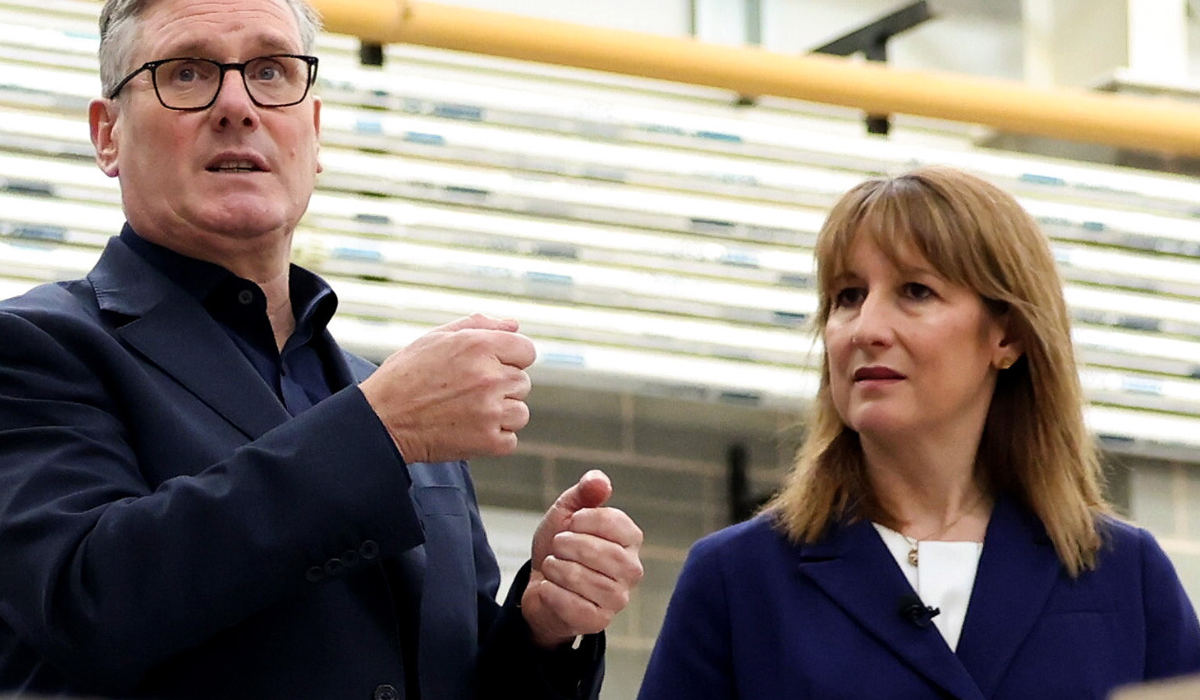
 Sir Keir Stamer and Rachel Reeves at Llangefni, November 2025. Photo: Number 10/Simon Dawson
Lindsey German on a calamitous government and some guidance for Your Party
The prime minister and chancellor are a dead man and a dead woman walking after this week. This will be the last budget that Rachel Reeves delivers, and Starmer’s exit is now being widely predicted as imminent. Their reputations are in shreds. Already deeply unpopular, the two connected debacles of last week have finally ended any idea that they could stage a political recovery.
First there was the anonymous briefing to Westminster journalists that health secretary Wes Streeting was after Starmer’s job (which of course he is along with Shabana Mahmood, Angela Rayner, Andy Burnham~all of whom feel they could do better than Mr Woodentop). The briefing which clearly emanated from the top in Downing Street had the opposite of its intended effect: Streeting emerged with his reputation enhanced while that of Starmer and his chief of staff Morgan McSweeney was further diminished.
Then there was the astonishing spectacle of Reeves. She has spent weeks ‘rolling the pitch’ for her budget to prepare for big rises in income tax and therefore breaking the government’s most important election pledge. Then on Friday she announced this wasn’t going to happen (following a leak in the Financial Times.) Suddenly she latched on to an OBR report to claim that the ‘black hole’ in the economy wasn’t as big as she had previously thought so she didn’t have to raise income tax after all.
No one should be in any doubt that this was a predominantly political, not economic, decision. A report in the Observer relates how Starmer was getting cold feet about the tax increases, and he and McSweeney were concerned that cabinet ministers were both reflecting and fomenting the anger felt by Labour MPs and more widely at the cost of living crisis and the breaking of election pledges. They recognised that he had no authority to resist a rebellion among backbench MPs over tax or anything else in the budget. Hence the briefing that backfired so spectacularly and the u-turn over tax.
Ironically, Starmer and Reeves (or their briefers) claimed that getting rid of them would unsettle the money markets and cause economic turmoil. Really? That turmoil came after Reeves made her u-turn. The Financial Times opined in a damning editorial that,
‘This is a government that, thanks to its own mis-steps, has burned right through the political capital its landslide election victory earned it just 16 months ago.’
The fear of the business newspaper is that Labour isn’t tough enough to ‘reassure markets’ and continue the systematic attacks on working class wages and living conditions that we have endured for nearly two decades. For the millions who voted Labour last year, there is the opposite fear: that the government is attacking the NHS, public services, and living standards and refusing to take on the employers who are making our lives so difficult.
By the weekend Starmer had tried to smooth over the row over Streeting – although one Sunday paper reported a ‘shouty row’ between the latter and McSweeney just before the briefing. McSweeney has been absolutely key to the ‘Starmer project’ from the beginning – when at the outset the prime minister disingenuously advocated left wing policies to get elected following Jeremy Corbyn which he then abandoned. Streeting was part of the right-wing Labour Together project which aimed to finish the left in Labour for good.
The assumption among these people is that Labour won the election by moving to the right, and that McSweeney is the political genius who achieved this. The reality is now being exposed in the government’s deep unpopularity. McSweeney was highly effective in attacking and destroying much of the left. It’s obvious his antennae for working class politics, however, are extremely weak. He constantly plays to the right, arguing for the most reactionary policies, and it is only recently that Labour appears to be aware that it is losing votes to the left – to the Greens and independent socialists – as well as to Reform. Yet one of the major sources of Starmer’s unpopularity is that his government has not made any improvement in working class people’s lives, while also scapegoating those on benefits and pensioners.
Those policies have been advocated by McSweeney. Two of Starmer’s biggest political blunders – the appointment of Peter Mandelson as US ambassador and the racist ‘island of strangers’ speech – both have McSweeney’s fingerprints all over them. The continuing push to the right only helps strengthen Reform. Shabana Mahmood’s latest attack on asylum seekers’ rights is one example of this. The claims that the ‘Danish model’ helps the centre parties fend off the far right is manifestly false. They are helping to feed far right ideas by accepting their legitimacy.
Given that the budget will increase taxes on workers, by freezing the thresholds rather than linking them to inflation, and there will be many other policies which make working class people worse off, it is unlikely to be popular and may trigger an overt move against Starmer. The failure of both mainstream parties to achieve stable government or to stem their rapid falls in support gives an opening to the far right. It is one we cannot allow to succeed.
Your Party needs to get its act together – fast
The anger, despair and disillusionment with Your Party’s leadership is palpable among many of those hundreds of thousands of us who wish the organisation well. It is in danger of becoming a Labour Party mark 2, with weak policies, bitter divisions at the top, not-so-anonymous briefings to the press, threats to take Zarah Sultana to court over money. Now we have the resignation from it of one of the Independent Alliance MPs, Adnan Hussein.
There has never been a greater need for a left socialist party, especially given the meltdown of Labour we are witnessing. But it needs to shape up fast if it is going to fulfil its earlier promise. A few thoughts on how that can be achieved.
- Stop the fighting at the top and all the threats and bullying you hear about. Jeremy Corbyn and Zarah Sultana have a great deal to offer and would be a good joint leadership team. That requires a joint common programme (YP is pretty politics lite at the moment) and a commitment to work together. Money issues can be solved without going to court – and it was open to all the MPs to be directors of the company controlling it.
- If that really isn’t possible, then I would suggest an interim collective leadership to steer the party in its first months before any election.
- The aim of this party should be to reach out to the mass of working-class people disillusioned with Labour. It is not about the activists talking to themselves. That requires focusing on key questions above all the cost-of-living crisis. To those who say these are ‘just bread and butter issues’ I would respond stop patronising working class people who don’t know how they are going to get a house or pay the bills every month. We must keep support for Palestine, opposition to imperialism, and anti-racism at the core of our politics, but we must give immediate answers to the problems working class people face. Too much of the left behaves as though that essential task is beneath them.
- That requires debate and discussion. I don’t agree with Adnan Hussein on equating right-wing demonstrators with those on the left. But any serious party would recognise this is a fairly widespread view that has to be argued with, given the lack of mass political culture on the left. And it would have a serious orientation on winning people not just denouncing them. This is true on a range of issues where we have to challenge right wing discourse but must go beyond sloganising in order to do so, for example, over oppression.
- One very negative consequence of this is it can lead to an unnecessary division between the left and the Muslim community. The term ‘socially conservative’ is too often a dog whistle for the assumption that all Muslims have right wing views on social issues. It’s not true, they like any other group have a range of views. And it is hypocritical. Did the left take the same attitude to Irish or Polish workers who often held religious conservative views?
- Above all we need politics. The highly undemocratic structures prioritise procedure almost totally rather than mobilising and arguing for political action. That must change if we are to make an impact in British society.
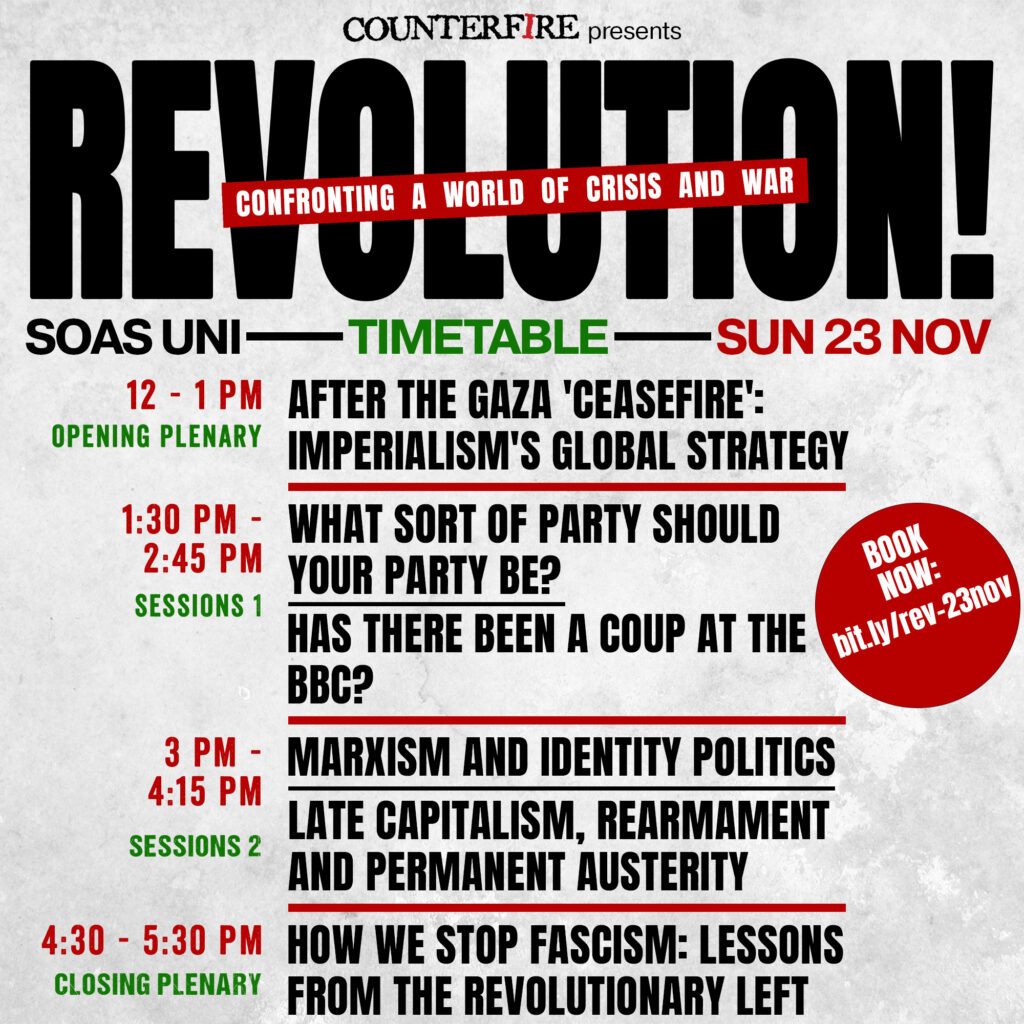
This week: I’m doing a hand in of a letter at Downing Street today organised by CND against nukes in Britain and I will be speaking at their conference on Saturday. On Sunday I will be at Counterfire’s Revolution! event in London with loads of great politics. Please join us. I’ve watched some of David Olusoga’s BBC series on the British empire. Very interesting.
Before you go
The ongoing genocide in Gaza, Starmer’s austerity and the danger of a resurgent far right demonstrate the urgent need for socialist organisation and ideas. Counterfire has been central to the Palestine revolt and we are committed to building mass, united movements of resistance. Become a member today and join the fightback.

Lindsey German
As national convenor of the Stop the War Coalition, Lindsey was a key organiser of the largest demonstration, and one of the largest mass movements, in British history.
Her books include ‘Material Girls: Women, Men and Work’, ‘Sex, Class and Socialism’, ‘A People’s History of London’ (with John Rees) and ‘How a Century of War Changed the Lives of Women’.