
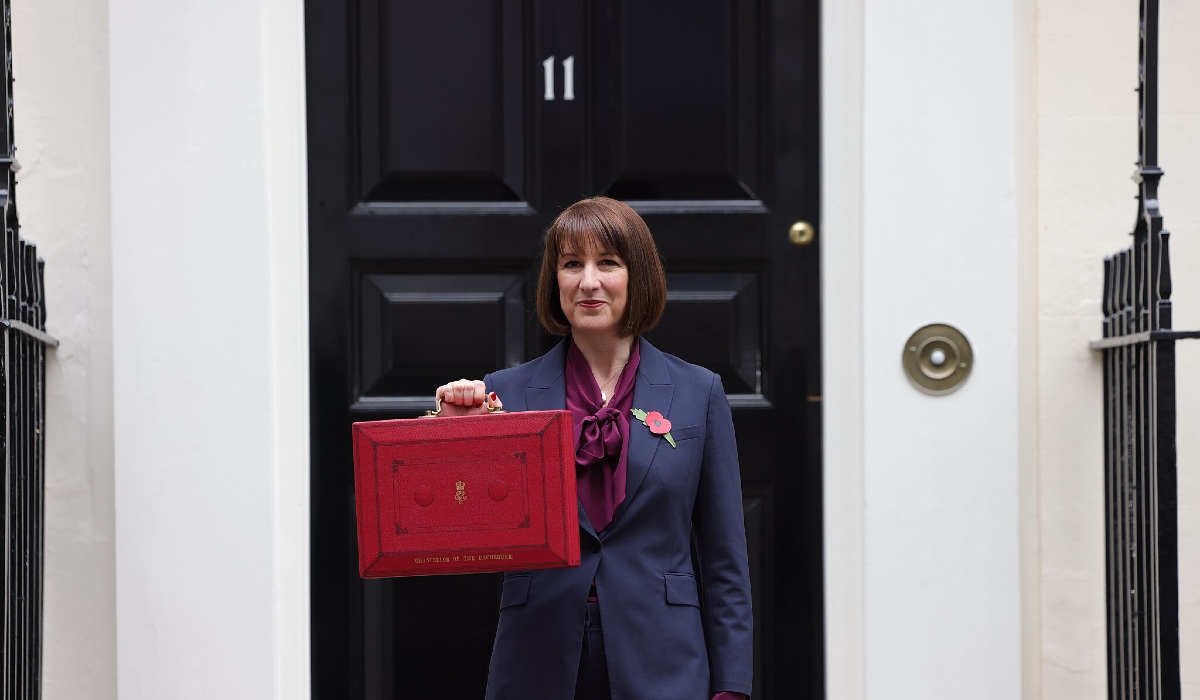
 Rachel Reeves delivering the Autumn 2024 Budget. Photo: Kirsty O'Connor / Treasury, OGL 3/ Wikimedia Commons
Starmer and Reeves have painted themselves into a corner with their refusal to contemplate a break from neoliberal economics, and it’s showing, argues Kevin Crane
No one in Labour’s present cabinet comes across as particularly upbeat and enthusiastic right now, but Chancellor Rachel Reeves has become a particularly pathetic figure even by the dismal standards of her colleagues. Her first budget a year ago basically unravelled in just a few months, and the time is fast approaching for her to have to try again. She could barely seem less ready for it.
It’s not uncommon for chancellors to keep budgets tightly under wraps before the official announcement, however the vibe one gets right now is not so much that a masterplan is being fined-tuned and polished, but that there is really no plan at all. Reeves’ limited public statements began sounding very much as though she is likely to increase income tax, as indicated by her statement that: ‘Each of us must do our bit.’ However, with the government’s public-approval ratings being catastrophically low at the moment, the prospect of simply taking even more money from the public while standards of living continue to plummet appears to have become too unpalatable even for the most right wing of Labour politicians.
The effect of this is that rumours are now circulating that the Chancellor may actually try to reduce austerity measures on the poorest people, in particular by reversing the hated two-child benefit cap that Theresa May’s Tories enacted in 2017. The Chancellor has said that she regards the cost-of-living crisis as ‘a priority’. Few people have much faith that this is going to mean much positive change in real terms, and they’re right not to.
Reeves’ lost summer
Until a few weeks ago, the silence from our Chancellor had been getting absolutely deafening. After none of the gimmicks and quick fixes she had used to try to fudge the question of austerity in her previous budget had worked, Reeves seemed increasingly befuddled by how wrong everything was going. Then, after Labour took a pasting in the local elections, the party’s MPs staged a rebellion on the further cuts to benefits that she had presented as crucial to her financial schemes. These were duly defeated in parliament, and we were then treated to the unedifying sight of the second-most senior member of the government crying in the House of Commons because she hadn’t got her way.
Pathetically, some centrist commentators attempted to defend Reeves’ display as some sort of ‘new feminine approach’ to politics. Aside from the obvious disregard this shows to previous generations of female politicians – we never saw the likes of Barbara Castle or Mo Mowlam blubbing in the chamber – it also says a lot about the elitism of journalists that they never stop to think about how many and how often working-class mothers cry because of the difficulty of making ends meet.
It was, in any case, the last we heard of her for some months. The chancellor made virtually no major announcements throughout the entire summer. Any suggestion that this was because she was holed up with teams of experts, studiously pouring over ideas for a new way forward could be easily dispelled by the fact that she was finding the time to go out door-knocking with Labour canvassers: clear procrastination from a person who was just looking for excuses not to get on with the task at hand.
Excuses are one thing that Rachel Reeves does produce in spades at the moment: she blames the previous Tory government, she blames world events, she even – astonishingly, given how little Labour talked about it at all for half a decade – blames Brexit. What she never does is reflect on her own arguments and approach.
There’s no reason to act all surprised
The economic situation Labour finds itself in is the one it was always going to be in with the policies it had in the run up to the election last year. Both Reeves and Keir Starmer had assured economic and financial elites that a Labour government would not reverse austerity, would not tax wealth and profits, and would not question the strategy favoured by the Treasury and the Bank of England. Both of these institutions are absolutely wedded to maintaining their idea of financial ‘stability’ through methods like continued austerity measures and ‘quantitative tightening’ to use public funds to satisfy financial interests.
While Labour was still in opposition, Reeves argued that it wouldn’t be necessary to question any of this because she was going to bring about such fantastic capitalist economic growth that there would suddenly be enough money to solve everything. As an argument, this was barely step up from ‘I just won’t have an economic crisis’.
Never at any time did Reeves actually specify what was meant suddenly to make the British economy grow: she seems to have believed a lot of her party’s propaganda that the only reason things were going badly was that the Tories were simply so incompetent that they were almost wilfully failing, as if growth wasn’t happening because they just didn’t want it enough. Now, you might think that that’s a pretty stupid thing to think – and you’d be right – but it’s kind of what you have to convince yourself of if you’re a politician like Reeves or Starmer who hates politics.
Something the Prime Minister and Chancellor both say when confronted with Labour’s collapsing electoral support and membership is that: ‘People are frustrated because we aren’t bringing about change fast enough.’ This bit of rhetoric acknowledges how unpopular their governance is but does not acknowledge that there could be any debate about the way they govern. They do not accept the existence of any alternative to the policies that they enforce on behalf of economic elites: this is just the way the economy is run; it cannot be done in any way differently.
Starmer tries to back out of this trap by being ‘radical’ on other issues, which was the thinking behind his massive right-wing lurch on immigration over the summer, but Reeves doesn’t have any option to do anything like that. She also has Starmer making her financial woes even harder due to his slavish devotion to obeying commands issued from America: he commits even more British taxpayers’ money to increased arms spending and a ludicrous digital ID scheme on Donald Trump’s orders, and she just has to make us pay it.
The government is under huge pressure to do something to regain public support, and Starmer’s premiership is almost certainly going to come to an early end if it can’t do that. Reeves is probably unlikely to get the sack until Starmer does, because the job of chancellor has become such a crown of thorns that no one in his loyal camp wants the job. If she’s willing now to show some flexibility on the two-child cap (and remember Labour MPs were being kicked out of the party last year for making that very demand), it does demonstrate that they realise that they’ve got to make some sort of popular offer before they face total electoral oblivion.
However, Reeves’ role in Number 11 Downing Street is to act as the lightning rod of the cost-of-living storm, and we already saw last year that she thinks she can use ‘clever’ sideways manoeuvres – like her disastrous rise in national insurance – to solve serious economic questions. The likelihood is therefore that any relief of financial burdens on the poorest will only be achieved by increasing such burdens on the marginally better-off, while leaving the super-rich to enjoy their increasing wealth. The prospect of genuine measures to redistribute wealth in Britain – such as wealth taxes – remain very distant, and so does Labour’s hope of staving off the historic decline of the party.
Before you go
More war, escalating authoritarianism, a deepening cost of living crisis – the left faces big challenges.
But resistance is also growing.
Counterfire has been at the heart of the mass movements against war, in solidarity with Palestine, and against austerity. Given the scale of the crisis, we urgently need to ramp up our operations. We need your help to raise £30,000 to make that happen.
