
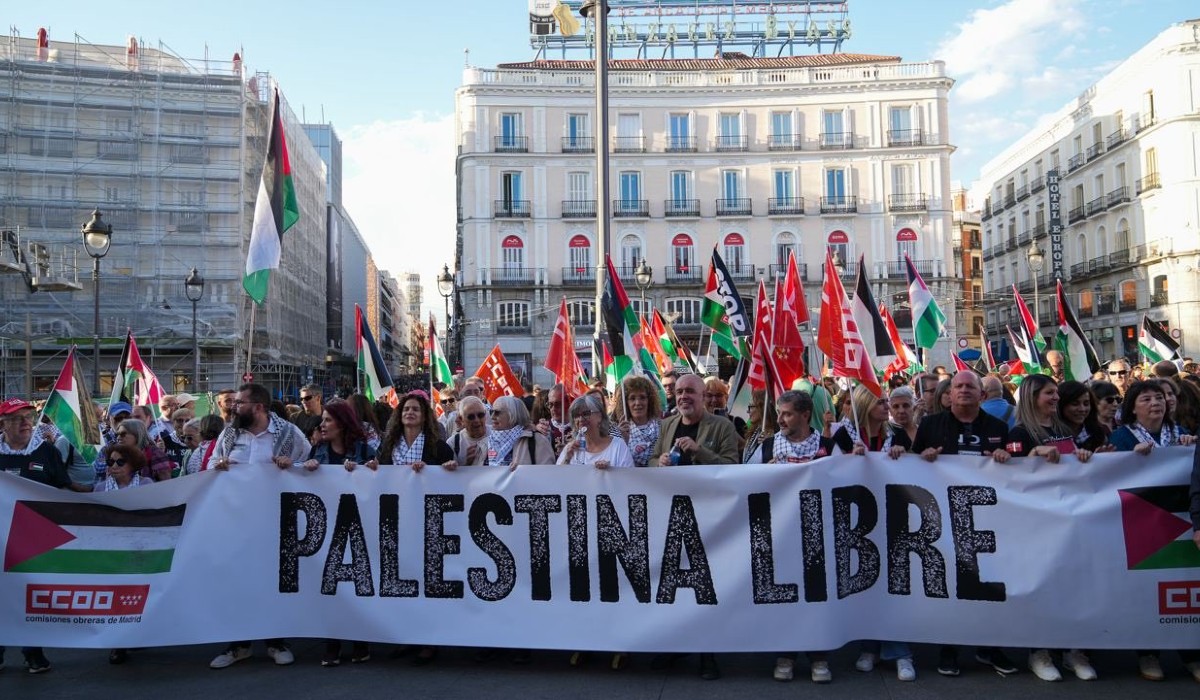
 Walk-out for Palestine, Spain, 15 October. Photo: @CCOO / X
Pedro García Cano, a leading trade unionist in Madrid, discusses an important step forward for the Palestine movement in Spain
The day of action on 15 October in the Spanish state, in support of the Palestinian people, was marked most notably by the partial strikes called by the two main trade unions, Comisiones Obreras (CCOO) and the Unión General de Trabajadores (UGT), who called for two-hour work stoppages in each shift.
This day of action came after an important increase of participation in the Palestine movement this summer at various stages of the cycling competition the Vuelta de España. There were a number of incidents, particularly in Bilbao and Madrid, where the competition was halted by protests. This also comes after mass mobilisations in support of the members of the Global Sumud Flotilla, which saw 300,000 demonstrate in Barcelona and 500,000 in Madrid on 4 October.
The announcement of the day of action for 15 October, including a two-hour walkout in every shift, came too late for many trade unionists, who believed it should have been called earlier. However, it was undoubtedly called in line with resolutions adopted at trade-union congresses. For example, by the CCOO, both in some of its branch or sector organisations and in the territorial ones, which met in April and May, as well as in the resolution of the confederal congress itself, which took place in June.
The leaders of the UGT and CCOO registered the call for 15 October strikes on the 29 September. On 3 October, various smaller unions and student organisations joined the call for a 24-hour general strike on the same day, 15 October.
There is no doubt that the enormous media coverage praising Trump’s signing of the so-called ‘peace agreement’ last Monday, 13 October, in Egypt, which led to a ceasefire in Gaza and a prisoner exchange, has served as a powerful tool for demobilisation and put pressure on the organising groups themselves to call off the strikes and mobilisations. This did not happen, though the impact in the workplaces was very limited.
In our workplace, we held assemblies organised by CCOO the day before and on the same day as the walk-out. On the day of the walk-out, another joint assembly was held by the CCOO and UGT. This led to several dozen colleagues joining us during the two-hour morning shift stoppage to go to the town square in Getafe (on the outskirts of Madrid) and take part in a demonstration organised by the CCOO. Our union branch joined with a banner reading ‘Stop the genocide, cut ties with Israel.’
Walk-outs and demands
The call for walk-outs and strikes was quite divided between the different trade unions. There were notable differences in the major unions’ level of involvement in the demonstrations. In Madrid, UGT pulled out from the local rallies held in the morning, and from the afternoon demonstration in Puerta del Sol. This was not the case in Barcelona, where both unions did take part in the demonstrations. No doubt the work of the ‘UGT members for Palestine’ group, formed in Catalonia, played a role in this.
Although the actual impact of the walk-outs called by the major unions and the so-called general strike called by the smaller ones was quite limited, except in sectors like education, several demonstrations involving tens of thousands of people took place in major cities, although still far from the level of turnout seen on Saturday 4 October.
However, the biggest victory of the day of action on 15 October was that for the first time in two years, the labour movement decided to take an active role in the struggle against the genocide in Palestine and has brought this struggle into the workplace, with the use of strikes and walk-outs, where 1,000 works councils and union branches have backed the day of action, leading to assemblies being held in workplaces, rallies in each area, and calls to hold demonstrations in the main cities.
In all of the mobilisations on 15 October, the same demands that have been raised before were once again present to varying degrees. Namely, that the Spanish government cut all ties with the genocidal state of Israel, the implementation of a real and effective arms embargo (which, now that a ceasefire agreement has been reached, the Spanish government intends to suspend, even though the recently approved embargo was already weak and merely symbolic), and the demand for sanctions against the state of Israel to ensure that the ceasefire holds, that humanitarian aid is allowed into Gaza, and ultimately, to secure freedom, the right of return, and the right to self-determination for the Palestinian people.
In the call to action by the main unions, the UGT and CCOO, and in the declarations by their leaders, several key questions have been put forward. For example, the necessity of continuing to mobilise ourselves in order to put a definitive end to the genocide, to be critical of and point of the limitations of last Monday’s ‘truce’, drawing on the resolutions of various international bodies regarding the reality of the genocide, to hold those responsible accountable, to defend human rights, to denounce that the US government, with the collaboration of other governments, is seeking to impose a so-called plan for Gaza on the Palestinian people without involving them, while the massacre of Palestinians is still ongoing. Additionally, the unions have put special emphasis on holding firm against pressure from Trump, and his threats to impose unilateral tariffs on Spain if the government of Pedro Sánchez doesn’t increase military spending to 5% of the GDP.
Resisting Trump and militarisation
Trump’s threats (which include expelling Spain from Nato) are particularly shocking when we remember that Spain has sharply increased its arms purchases in the last two years, raising military spending from 1.4% to 2.5% of the GDP, according to the Delás Centre for Peace studies. This is an increase of more than $11bn per year, money that should be going to public services to meet the needs of the majority of the population, instead of boosting ‘defence’ spending. This increase is already having an impact and will undoubtedly lead to more cuts in public spending.
Today in the newspaper El País, it was revealed that, between 2023 and 2024, Spain bought nearly $4bn Euros worth of military equipment from the United States. The amount spent solely on dozens of US-made ‘Patriot’ missile systems and equipment made up half of the military’s procurement spending in 2024 alone.
Today, we have also seen in La Vanguardia that the Minister of Defence, Margarita Robles, told Nato that Spain could join the group of countries about to buy US arms for Ukraine. The aim of this new procurement programme is to replace the military equipment donations the US had been providing to the Ukrainian government, shifting the cost directly onto European countries.
I think that now more than ever it is necessary that we argue that the struggle in support of Palestine is inseparable from the struggle against rearmament and the brutal rise in military spending in our own countries, as well as from the involvement of Spanish troops, fighter jets, missile systems, and warships in sustaining the war in Ukraine.
In my view, the significance of the day of action on 15 October lies in its potential to sustain and build the movement for Palestine. It must serve to broaden the involvement of the wider working class, and for this to happen, it is crucial that we deepen the involvement of trade unions. We need to explain, in workplaces, the farce of the agreements imposed by Trump and other governments who act as little more than accomplices. At the heart of this must be holding the Spanish government accountable: demanding that it break, once and for all, all forms of relations with the genocidal state of Israel, that it impose and enforce a genuine, effective trade embargo, and that it demand sanctions and accountability for the crimes committed by the Israeli state. It is essential that we are unified and all major trade unions, political and social campaigns join the movement to give the immense social majority in our country, which rejects the genocide in Gaza, the opportunity to continue to make their voices heard more and more convincingly.
Thanks to the international movement by the people in each country, such as the impressive march in London on 11 October, which 600,000 people joined, or the general strike and walk-outs in Italy, the pressure is on our respective governments that they maintain the ceasefire, and that there is ultimately a definitive end to the massacre of the Palestinian people. What must finally emerge is the genuine establishment of a Palestinian right to exist, and a future which they can freely determine for themselves.
Building an internationally united movement
The eruption of hundreds of thousands of protestors in Spain in the last few weeks against the genocide reminds us of the impressive social movement against the war in Iraq from twenty years ago, similar to the movement in the United Kingdom. Thanks to the unity and the involvement of all the major political and trade-union organisations in the movement against the Iraq war, amongst other things, eventually, the Aznar government, which had dragged us into the invasion and occupation of Iraq based on lies, was ousted, and the new president’s first action was to withdraw Spanish troops from Iraq.
The international coordination and spread of the movements and strikes in various countries is crucial. In this regard, the international conference against the war held on 4 and 5 October in Paris was a significant milestone. It brought together over 150 delegates from eighteen countries and culminated in a rally of more than 4,000 people at the Dome de Paris. This event will be followed by a major conference and demonstration planned for next June in London, organised by the Stop the War Coalition in the UK, together with the international organising committee formed in Paris. In Spain, there are over 200 trade unionists as well as various political and social movement leaders from across the country, including several members of parliament, who have signed up to the demands of the international organisers of the conference and rally in Paris. We must jointly organise public events to broaden the preparations for the London rally, help expand the mobilisations, and continue taking initiatives to express clearly to the government our rejection of the increase in military spending. Not a single euro or life should be devoted to war, and the government must break all ties with the genocidal state of Israel.
Compared to other governments, the Spanish government has gone further to denounce the genocide. However, it still aligns itself with global institutions and other governments and is largely complicit and passive in what Trump imposes and what Netanyahu does. It is dedicated to making sterile appeals and pleas to the US and Israel to return to the supposed peace process, based on the failed ‘two-state solution’ idea. Several countries even state that they haven’t ruled out sending troops to Gaza. At these times, it is obvious that a true Palestinian state cannot exist while Israel’s genocidal institutions are in place.
In my opinion, it is clear that with the severity of the brutality demonstrated in the last two years, with a genocide and absolute persecution of the Palestinians, not only in Gaza but also in all occupied territories, in the West Bank, the entire region, and even inside the state of Israel, that no peaceful solution is possible if the Zionist state is maintained. The only real solution can be found in respecting a people’s right to decide their own future: the formation of one single democratic state named Palestine. This must respect the right to return of millions of refugees and exiles. No type of discrimination or apartheid must be allowed to survive, and Arabs and Jews must stand together for equality, liberty, security and a genuine peace from all sides.
Pedro García Cano is a federal council member of the Confederación Sindical de Comisiones Obreras (CCOO) de Industria.
Before you go
The ongoing genocide in Gaza, Starmer’s austerity and the danger of a resurgent far right demonstrate the urgent need for socialist organisation and ideas. Counterfire has been central to the Palestine revolt and we are committed to building mass, united movements of resistance. Become a member today and join the fightback.
