
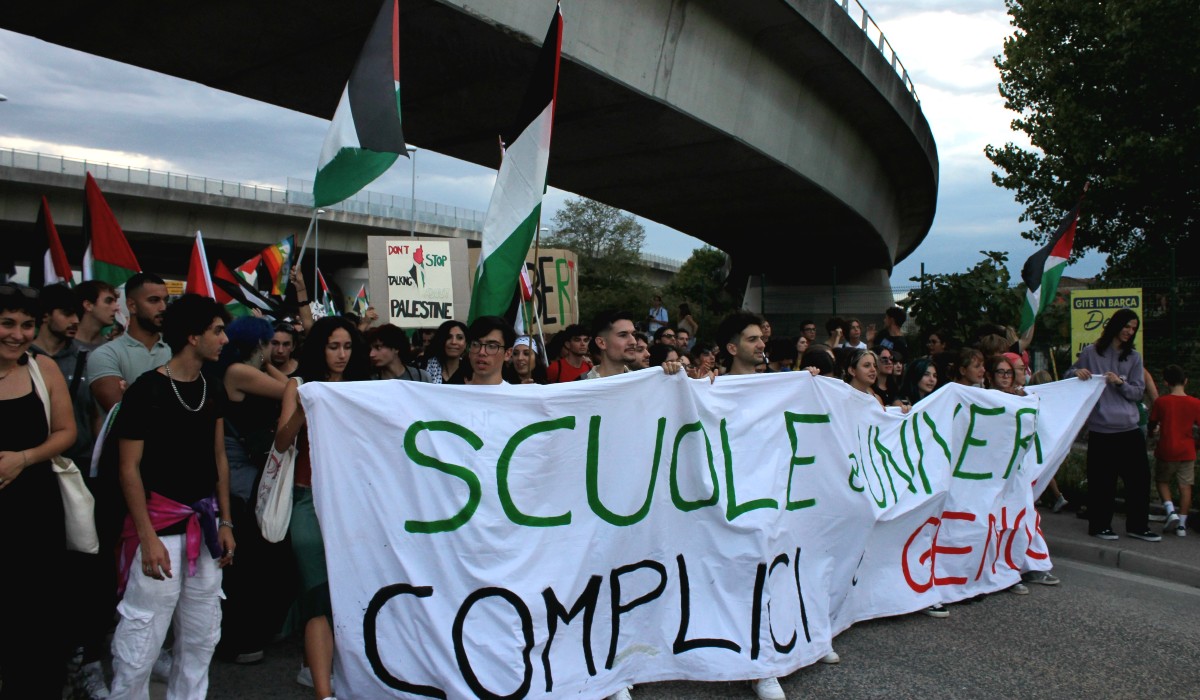
 Students on the general strike for Gaza, Ancona. Photo: Ukrain4Pal / CC BY 4.0
Maurizio Coppola of Power to the People examines the massive growth of the Palestine movement and the impact it is having on wider Italian politics
Since 7 October 2023, the Palestine solidarity movement in Italy has been experiencing a renaissance. University occupations, local and national demonstrations, protests in front of the US and Israeli embassies have become everyday actions against the genocide of the Palestinian people, against the complicity of the Italian government, and against the inaction of the parliamentary opposition (Democratic Party, Five-Star Movement, Left-Green Alliance). This ‘Palestine moment’ marked an important turning point, ending more than a decade of ‘social peace’ in Italy. It has reactivated the popular classes and brought to light a multitude of social and political contradictions.
Palestine opens our eyes
The tireless and decades-long struggle of the Palestinian resistance against colonial occupation has proven to us once again that we are not doomed to accept exploitation and oppression as victims, but that we must actively organise and fight against it. An important insight from this ‘identification with Palestine’ is that not only does Palestine need us, but we also need Palestine to sharpen our consciousness and fight against our internal enemies. In other words, before we could turn ‘all eyes on Palestine,’ we had to open our eyes, and Palestine has done this.
Today, two years since the beginning of the genocide in Gaza, Italy is experiencing one of the strongest solidarity movements in its history. Last month saw a quantitative accumulation of forces that led to large mass mobilisations. Day after day, it became increasingly clear that the Italian government’s inability and unwillingness to do its part to end the genocide (remember that Italy is Israel’s third largest arms supplier after the United States and Germany) is closely linked to the massive precariousness into which the Italian working class has been plunged over the last two decades. This is expressed in the slogan ‘down with arms, up with wages’, which – together with ‘stop the genocide’ – has become one of the main slogans of the demonstrations.
The power of the working class
But why are we seeing such a strong movement today? It would be a mistake to believe that the Italian streets have filled up en masse simply because of Italy’s extraordinary history of solidarity with Palestine and peace activism, or simply because of the spontaneity of the masses. The general strikes on 22 September and 3 October were attended by one million and two million people respectively, all of whom were inspired by great determination. There were not only mass demonstrations in the country’s major cities, but also actions in small towns and blockades of ports, railway stations, highways and even airports. We still need to deepen our understanding of why, after decades of passivity on the part of Italian society, we are now witnessing this qualitative leap; but we can already offer some clues as to the reasons.
A first element is the central role of the working class in this movement, led by the dockworkers in Genoa, who in recent years have repeatedly refused to load arms shipments to war zones and thus become accomplices to death and genocide; in previous years (2019, 2021) in Saudi Arabia’s war against Yemen, and from 2023 onward in Israel’s massive destruction of Palestine. Since then, the Unione sindacale di base (USB), the grassroots union to which they belong, has also set in motion an organisational process in other Italian ports (Livorno, Civitavecchia, Salerno, Ravenna, etc.), and within two years, their capacity for action has increased significantly.
When the Global Sumud Flotilla began its mission to Gaza, one of the spokespeople for the Genoa dockworkers, José Nivoi, joined the crew. During the preparations for the crossing, the movement in Genoa launched a call to collect aid supplies for Gaza; within a few days, 300 tonnes of material had been collected. In addition, the solidarity movement organised a demonstration attended by 40,000 people. In his speech to the crowd, one of the dockworkers said: ‘If we lose contact with our people on the flotilla for even 20 minutes, we will block everything. Not even a nail will reach Israel.’ The trade-union movement thus not only appeared as part of the movement but also took on a leading role in it.
The radicalisation of ‘Generation Gaza’
A second element that must be considered is the tenacity of political organisations and grassroots trade unions. We have already mentioned the role of the USB (and we must not forget the other grassroots unions that have organised workers in the most precarious sectors in recent decades), but we must also highlight the role of political organisations such as Potere al Popolo! and numerous other youth and student organisations, social spaces and political collectives throughout the country. Every small solidarity and flyer campaign, every small demonstration was a seed that has now grown into the (delicate) flower of political struggle and international solidarity.
It was precisely the youth, often described by the media and politicians as ‘apathic’ and ‘uninterested’, who, alongside the organised working class, became a central subject of the protests through the Palestine cause. For the long-term organisational process of these young people, it is important not to simply define them as ‘Gen Z’ because they are determined by digital technology. Rather, it is important to grasp the ethical-political awareness process behind which lies organisational potential. Solidarity with Palestine has not become one of the most important campaigns because it was seen as a ‘trend topic’ or simply approached as an ‘event’, but because it has developed from a humanitarian demand into a deeply political struggle: ‘Generation Gaza’ has succeeded in linking international solidarity with the struggle for social justice in its own country.
Palestine is reshuffling the cards in the trade-union movement
All this leads to contradictions within our traditional political landscape, both within the traditional trade unions and within the government itself. When the USB called for a general strike on 22 September in response to the Israeli attacks on the flotilla in Tunisia, the CGIL, Italy’s largest trade-union confederation, was forced to take a stand as well. Initially, it did not join the USB’s demand and even announced its own ‘4-hour work stoppage’ (sic!) on 19 September. This arrogant move proved counterproductive for the CGIL itself: the action was a complete failure with very low participation, and many its own members decided to join the grassroots unions’ strike on 22 September. As a result, the CGIL was forced to follow the grassroots unions’ call for a general strike on 3 October. Palestine is therefore currently reshuffling the cards in the Italian trade-union movement, and a radical, anti-militarist peace policy is finally finding its way into the large trade-union confederations.
In addition, the Italian government and Prime Minister Giorgia Meloni were forced to take a stand on Palestine and the Global Sumud Flotilla. The Palestine movement also represents a rupture in this regard: over the last three years, the Meloni government has been characterised by its ‘small politics’, i.e. dealing with important social issues in an ‘administrative’ and ‘apolitical’ manner. With the genocide of the Palestinian population and Italy’s complicity, this method has met with ethical and political outrage in society.
The movement thus highlights the contradictions within the government regarding the increase in military spending, the recognition of the genocide and the Palestinian State, but also regarding internal issues such as the criminalisation of social movements, the fundamental right to strike and social issues. The parliamentary opposition parties were also drawn into this maelstrom, demonstrating the inconsistency of their positions by being completely unable to express themselves coherently on both the genocide and the ongoing mobilisations. They were very late in jumping on the Palestine solidarity bandwagon.
Now we need to organise!
Much of what is currently happening in Italy still needs to be analysed in more detail. But some things have become clear: in a country where starvation wages have not risen for three decades, hundreds of thousands of people have decided to forego a day’s wages out of solidarity with the Palestinian resistance to take part in strikes and demonstrations. Hundreds of thousands of people have placed their trust in grassroots unions and political organisations that have previously been described in the mainstream media as ‘radical’ or ‘irrelevant’ because they were the only ones capable of taking a consistent position and occupying a social and political space that had remained empty. The fact that this censorship no longer works for hundreds of thousands of people is proof that something is changing in Italian society.
Now everything depends on the ability of these grassroots unions and political organisations to deepen the political contradictions that have opened up thanks to the new perspective that Palestine has given us.
Maurizio Coppola is a member of the national coordination of Power to the People! Italy
Before you go
The ongoing genocide in Gaza, Starmer’s austerity and the danger of a resurgent far right demonstrate the urgent need for socialist organisation and ideas. Counterfire has been central to the Palestine revolt and we are committed to building mass, united movements of resistance. Become a member today and join the fightback.
