
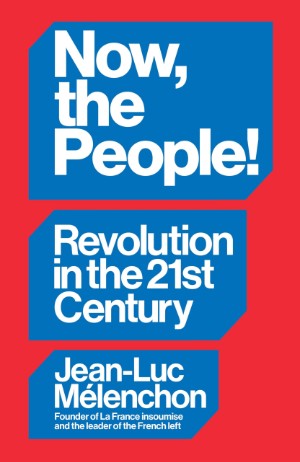
 Jean-Luc Mélenchon, Now the People! Revolution in the Twenty-First Century (Verso 2025), 320pp.
The leader of France’s radical-left party has written an inspirational call to arms but we must keep the centrality of class in view, argues Chris Nineham
Jean-Luc Mélenchon is the founder of La France Insoumise, the party that has led the revival of the left in France over the last nine years. It has championed the campaigns against President Macron’s austerity and headed up a mass movement that stopped the fascist Marine Le Pen winning the 2024 Presidential election. In the process, it has won 74 seats in the National Assembly and ensured that the New Popular Front left alliance won the most seats in 2024’s snap parliamentary elections. No wonder Mélenchon writes in the introduction, ‘My aim in all this is not just to describe the current impasse, but to suggest how we might find our way out of it’ (p.4).
Like his political activism, Mélenchon’s new book is a breath of fresh air. Its intellectual range alone is stunning. In just 270 accessible pages, Mélenchon combines an analysis of the social impact of late neoliberalism with a philosophical consideration of what the battle for human freedom means in the twenty-first century. The book takes in the crisis of social democracy, the ecological impact of big data, the political roots of suicide, the novelties of networked capitalism, the way neoliberalism warps time and the emerging battles over of space and the undersea world.
Another of the book’s qualities is that, unlike so much left-wing analysis of where we are, it is not a doom screed. In this, it is a product of a country of mass struggles against the predations of modern capitalism. Mélenchon brings fresh eyes to new trends and sees liberating potential as well as the damage done. Networks, virtual and material, he says ‘can be the key to extracting profit or the basis for meeting our collective needs’ (p.149). ‘In the end,’ he says, ‘what would become of any of us if we were removed from the various networks into which we are integrated? Nothing or almost nothing’ (p.139). In particular, he points out that the multi-level interconnectedness of modern capitalism gives workers enormous potential power:
‘By virtue of their numbers in each hub, and their place in the general circuit of goods for both production and sale, the new network workforce has a strategic place in the fight to define social relations today. Meanwhile, transport workers hold the possibility of blocking the whole system of exchange, so crucial to the globalised economy, and therefore of shutting off the many kinds of supply lines necessary to keep everything going’ (p.148).
From neoliberalism to revolution
At the book’s heart is a powerful critique of neoliberal capitalism, ‘We see how the instability in today’s societies is rooted in the deregulation of the social relations of production and exchange’ (p.8). As Mélenchon argues, the blind and unchecked pursuit of profit is not just causing massive social and environmental damage, it is a threat to human freedom: ‘They talk a great deal about freedom but really what they mean is freedom for capital, and freedom for capital actually ‘comes at the cost of all other freedoms’.
Mélenchon outlines a very different attitude to the state than found in the usual neoliberal orthodoxy: ‘There is no longer any question of liberating the energies that are supposedly hemmed in by regulations. Rather, they want to use a dense thicket of regulations to hold back any forced alternative to their own ways of doing things, the results of which are so damning’ (pp.76-7).
This in turn leads to growing authoritarianism and repression of any group fighting for change: ‘It is worth stressing how much this neoliberal government is – violently – fighting for its survival, not only against traditional mobilisations by organised labour but also against environmental movements and their activists’ (p.76).
Centring capitalist relations means Mélenchon challenges the tendency to deal with problems of oppression separately as issues of identity. The excellent section on women’s role in social change is a case in point, ‘It is not enough to note that women have been a massive force in citizens’ revolutions’, he says, ‘It also needs explaining. I am not at all convinced that there is some feminine “nature” that holds for all eras and all places. Where would we even look for such a thing?… Essentialist explanations end up trapping both men and women in a regressive outlook. The more important factor, here, is women’s place in social relations – the relations of production, and therefore of exploitation and domination … the gendered organisation of society makes women responsible for keeping up the day-to-day continuity of material life. It forces women to keep everything going, while, at the same time it makes this impossible’ (p.205).
This radical analysis of actually existing capitalism also leads Mélenchon, once a Trotskyist, to the view that revolution is necessary to uproot the social relations of capitalism. The impulse for contemporary revolution comes, in Mélenchon’s view, from two basic characteristics of the moment:
‘First are neoliberal policies aimed at reducing the size of the state and of public services. After all the transfer of essential services to the private sector is always socially discriminatory – and then seen as unjust. Added to that are the various disasters linked to climate change and the environment caused by the systems of production. This spreads chaos and demonstrates how powerless the market is to solve people’s problems’ (p.169).
The revolution would target three pillars of the social order. First, private ownership of what should be public goods would be replaced by collective ownership. Second, ‘free and undistorted competition’, would give way to solidarity and cooperation. Third, there would be a revolution in the institutional order, potentially leading to new political forms of popular rule.
Mélenchon’s engaging discussion of the revolutionary process is clearly informed by involvement in and studies of actual mass movements. He points to the tendency for powerful movements to ‘grow over’ from the particular to the general:
‘In the first instance, the finger is pointed at everything that does not work quite as it should, and at the people deemed responsible for this. The challenge to the government for one reason or another, expands into a process that raises questions regarding society as a whole’ (p.176).
Such confidence in the ability of ‘ordinary people’ to learn through struggle, to generalise and to become agents of change is another great virtue of this book and of Mélenchon’s political outlook. What a contrast to the pessimism and narrow electoralism of so much of the left today! It is no wonder that La France Insoumise has been able to help lead enormous social struggles and shift the axis of politics in France.
Class is still central
In the spirit of pursuing the debate Now the People has sparked, I have to say it reproduces some confusing positions common on the international left. Most importantly, Mélenchon at least in theory accepts the idea that the class division between capitalists and workers has been replaced with one between oligarchy and the people (p.4). In the discussions that follow, there is, however, a good deal of ambiguity about this point, no doubt reflecting the central role that workers have played in the French movements of the last few decades.
Mélenchon does in fact talk about exploitation and the importance of workers in social struggles. However, the left populism indicated by a quotation from the French reformist Jean Jaurès that ‘political democracy is expressed in a central idea, or better still a single idea: the political sovereignty of the people’, contains real dangers (p.161).
The fact that Mélenchon can say that the ‘national flag is a reminder of the people’s fundamental unity’ shows how this idea can lead away from a recognition that society is fundamentally divided and raises questions about why a revolution is necessary in the first place (p.200).
Specifically, downplaying the special role of workers in the revolutionary process risks reducing revolution to a purely political matter, to something that leaves the economic relations at capitalism’s heart untouched.
Here some of the details of his discussion of revolution are significant. In 2011, citizens took control of central spaces from Tahrir Square in Egypt to the Puerto de Sol in Madrid and Zuccotti Park in New York. In Egypt, the enormous popular movement succeeded in a political overturn. For Mélenchon, these occupations were ‘a form of seizing power’ and provide some model for the future (p.197). These were important struggles, and the Egyptian revolution was a mighty challenge to the power of the ruling class there and Western imperialism’s hold on the region.
However, outside of Egypt, these were protests or assemblies and precisely not ‘a form of taking power’. Even in Egypt, the limits of the revolution, its inability to link up with the considerable power of the Egyptian working class and to dismantle the military state, led to its tragic defeat.
More generally, Mélenchon’s downplaying of class means he doesn’t always draw the conclusions from his own arguments. There are times when he appears to lose sight of the scale of the systemic and state obstacles to change presented by modern capitalism and slips into a misplaced confidence in the United Nations or ‘international cooperation’ in general to resolve the problems faced by humanity. These are serious issues but Now the People! remains full of insights and is an inspirational call to arms.
Before you go
The ongoing genocide in Gaza, Starmer’s austerity and the danger of a resurgent far right demonstrate the urgent need for socialist organisation and ideas. Counterfire has been central to the Palestine revolt and we are committed to building mass, united movements of resistance. Become a member today and join the fightback.

Chris Nineham
Chris Nineham is a founder member of Stop the War and Counterfire, speaking regularly around the country on behalf of both. He is author of The People Versus Tony Blair and Capitalism and Class Consciousness: the ideas of Georg Lukacs.