
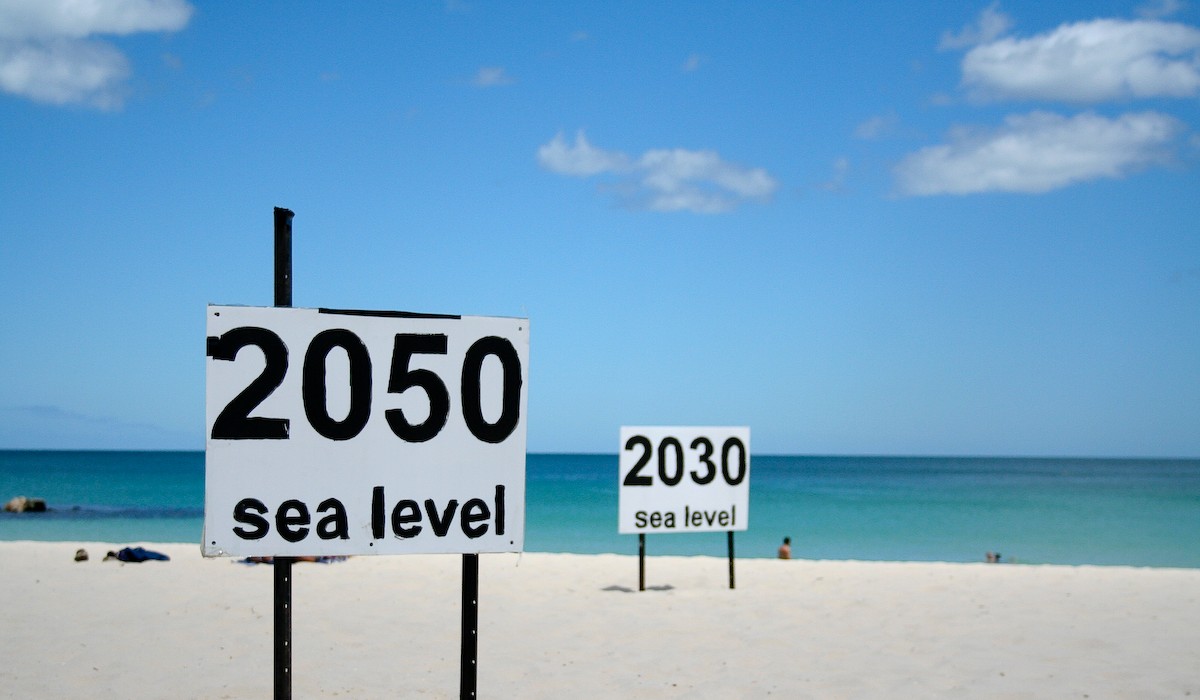
 Photo: Go Greener Oz / Flickr / CC BY-ND 2.0.
As forests burn in unprecedented blazes, sea levels are rising fast, and will cause massive inland migrations, but capitalism is barely even slowing down, explains John Clarke
As the global impact of climate change intensifies, we are experiencing the ironic situation where sea levels are rising dangerously while, at the same time, large portions of the earth are experiencing increased heatwaves, worsening droughts and dried-out forests that are burning at a greatly increased rate.
This year, new information has been put forward on the pace and dire implications of rising sea levels. An article that appeared in the Guardian in May, reported on a new study that had been published in the journal Communications Earth and Environment. This came to the horrifying conclusion that sea ‘level rise will become unmanageable at just 1.5C of global heating and lead to “catastrophic inland migration”.’
It is now well-established, however, that the prospect of limiting the global-heating process to a 1.5C increase is now very bleak and, in fact, the world is on track to reach an increase of between 2.5C and 2.9C. This ‘would almost certainly be beyond tipping points for the collapse of the Greenland and west Antarctic ice sheets. The melting of those ice sheets would lead to a “really dire” 12 metres of sea level rise.’
To appreciate the implications of such major sea level increases, it is worth noting that today, ‘about 230 million people live within 1 metre above current sea level, and 1 billion live within 10 metres above sea level.’ In the context of the UK, ‘just 1 metre of sea level rise would see large parts of the Fens and Humberside below sea level.’
The study suggests that any level of rising sea levels that went beyond 1cm per year, would compromise the capacity of human populations to adapt to the process. This would result in ‘massive land migration on scales that we’ve never witnessed in modern civilisation.’ Very obviously, the countries of the Global South would find it far more difficult to protect their populations in the face of this situation than wealthy countries.
‘Absolutely guaranteed’
A previous Guardian article, written some two years ago, was already able to conclude that not ‘only is dangerous sea level rise “absolutely guaranteed”, but it will keep rising for centuries or millennia even if the world stopped emitting greenhouse gases tomorrow, experts say … Even in the best-case scenario, it’s too late to hold back the ocean.’
Drawing on its Global Risks Report 2025, the World Economic Forum has pointed to the unexpected speed at which the waters are rising. In 2024, scientists ‘were anticipating a rise of 0.43 centimetres, but instead recorded a rate of 0.59cm.’ This is taking place in a context where, ‘Pacific Island nations like Tuvalu, Kiribati and Fiji have been battling rising sea levels for years now and NASA predicts they will experience a further 15cm of sea level rise in the next three decades, even if greenhouse gas emissions are brought under control.’
The article also provides some revealing information on the issue of rising sea levels and the centrality of the world’s oceans to the whole issue of climate change. As is commonly understood, the melting of glacial ice is a huge factor and, in this regard, there are a number of ‘negative feedback loops’ that may seriously increase the scale of the problem.
Chief among these is the Thwaites Glacier in Antarctica, which ‘is disintegrating more quickly than anticipated. It’s nicknamed the “doomsday glacier” because sea levels could rise more than three metres without it and its supporting ice shelves.’
The run off of melting ice is also greatly compounded by the obvious consideration that warming water expands and takes up a greater volume. In fact, heat ‘stored in the ocean is responsible for between a third and half of global sea level rise, NASA says. The past decade has been the ocean’s warmest since at least 1800, and ocean temperatures reached a new high in 2023/2024.’ Most alarmingly, since ‘1971, oceans have absorbed over 90% of excess heat in the Earth system caused by rising greenhouse gas emissions.’
Ironically, even as rampant carbon emissions create a situation where the earth’s oceans will reclaim a major part of the land mass, country after country is experiencing the impact of global heating in the form of extreme heat, drought and raging wildfires.
A ‘nationally significant’ water shortfall is affecting England, with the problem likely to linger into the autumn, while five areas of the country are presently gripped by drought. At the same time, wildfires ‘ravaging the EU have torched more than 1m hectares this year, marking 2025 as the worst year on record, a full month before the fire season ends.’
The fires in Europe, moreover, though they may be seen as an effect of climate change, are themselves a source of major carbon emissions. The Guardian reports that the ‘destructive blazes have pumped out 37m tonnes of carbon dioxide – about as much as the yearly CO2 emissions of Portugal or Sweden, each home to 10 million people.’
Meanwhile, Canada is experiencing its second-worst wildfire season with the area that has been burned, 7.3 million hectares, some seven times larger than that consumed by the European fires. According to the CBC, this year’s fires have impacted an area that is ‘double the 10-year average for this time of year.’
Catastrophic course
At this point in time, we are in course to surpass the 1.5C mark in the process of global heating. It is abundantly clear, moreover, that the world could no longer escape very major impacts from this development even if a rapid transition to sustainable economic activity were to happen. However, the brutal reality is that we are very far from such a situation and global capitalism is charting an utterly catastrophic course when it comes to global warming and carbon emissions.
The Trump administration in the US is by no means the only culprit, when it comes to compounding the climate crisis, but it is a highly influential player on the world stage and the leading force in promoting outright climate denial at the moment. Indeed, the present US administration is breaking new ground, when it comes to disinformation and the suppression of evidence on the rapidly developing global climate crisis.
On 1 August, an article in the Guardian dealt with the efforts of Trump’s glaringly misnamed Environmental Protection Agency (EPA) to ‘justify a mass rollback of environmental regulations.’ Specifically, the agency seeks to ‘undo the 2009 “endangerment finding”, which allows it to limit planet-heating pollution from cars and trucks, power plants and other industrial sources.’
In a Department of Energy (DOE) report supporting this rollback, Trump’s energy secretary, Chris Wright, baldly asserts that climate ‘is a challenge – not a catastrophe.’ In response to this report, the noted climate scientist Michael Mann observed that its contents are what might be expected ‘if you took a chatbot and you trained it on the top 10 fossil fuel industry-funded climate denier websites.’
From an ecosocialist perspective, the combination of a rapidly intensifying global climate disaster with the extreme recklessness with which the profit needs of fossil-fuel capitalism are being advanced, leads to two conclusions. Firstly, not only is capitalism’s destructive disharmony with the natural world firmly entrenched but we have entered a period in which the catastrophic consequences that flow from this have reached levels that pose a dire threat to billions of people and to human civilisation itself.
Secondly, when we consider the level of global heating that is now underway and the degree to which the world’s oceans are warming and rising, we must also acknowledge that we are past the point of no return when it comes to major climate consequences. This will be a legacy of capitalism that the rational and sustainable socialist society we seek to build will have to contend with and it will not be a small task. To a greater degree than ever, challenging the capitalist system has become a question of our survival.
Before you go
The ongoing genocide in Gaza, Starmer’s austerity and the danger of a resurgent far right demonstrate the urgent need for socialist organisation and ideas. Counterfire has been central to the Palestine revolt and we are committed to building mass, united movements of resistance. Become a member today and join the fightback.

John Clarke
John Clarke became an organiser with the Ontario Coalition Against Poverty when it was formed in 1990 and has been involved in mobilising poor communities under attack ever since.