
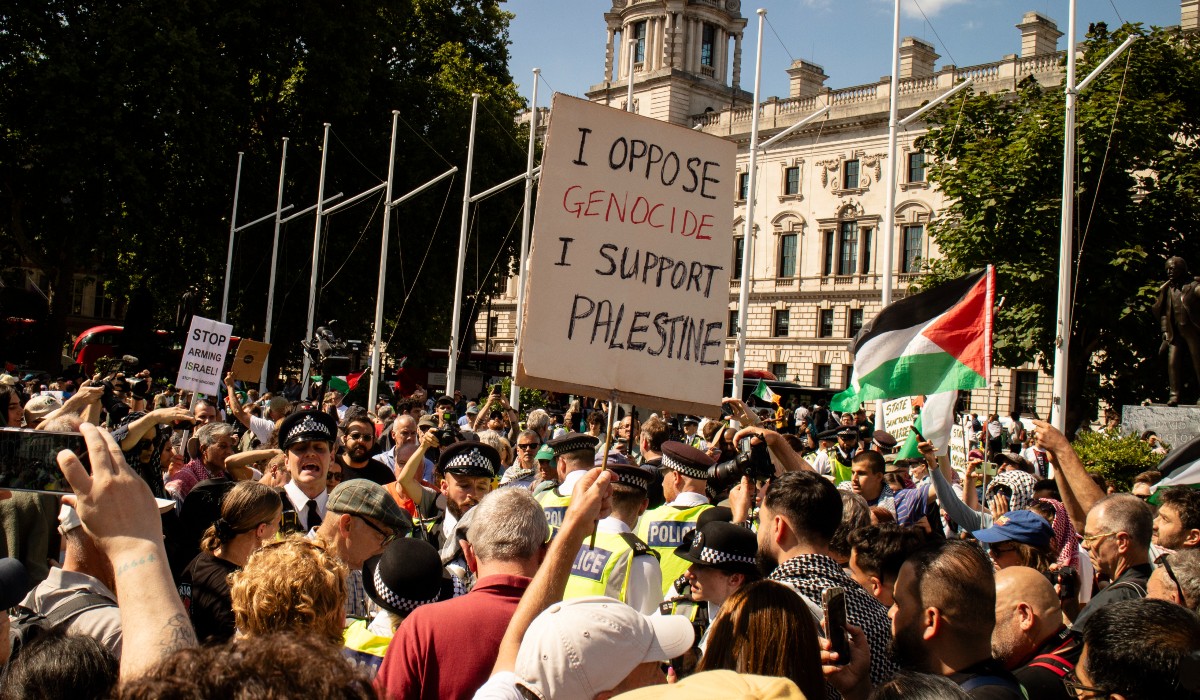
 Defend Our Juries protest in Parliament Square, 9 August. Photo: Steve Eason / CC BY-NC 2.0
Steph Pike reports on Saturday’s demonstration against the government’s ban of Palestine Action under terrorism legislation
As Big Ben struck 1pm on Saturday 9 August in Parliament Square, I and about 600-700 other people sat down in the baking heat, wrote ‘I OPPOSE GENOCIDE. I SUPPORT PALESTINE ACTION’ on a piece of white cardboard and held it up. One of the biggest acts of civil disobedience in recent times had started. Within seconds, the police moved in and started arresting people. Sitting on the grass with our signs, we were able to track the number and location of arrests by listening to the applause, and chants of ‘shame on you’ every time the police took someone away. The atmosphere was electric: one of solidarity and defiance. It took the police, many of whom had been drafted in from other areas including Wales, eight hours to arrest everyone who had stayed in Parliament Square holding a sign, with the last person arrested at about 9pm that evening. In total 522 people were arrested, the vast majority under Section 13 of the Terrorism Act 2000 which makes it an offence to display an article that shows support for a proscribed organisation.
The people arrested came from all backgrounds and included Jonathan Porritt, Moazzam Begg and renowned poet Alice Oswald. This was the third and so far largest action organised by Defend our Juries to protest against the government’s decision in July this year to proscribe the direct-action group Palestine Action as a terrorist organisation. This decision, the first time a direct-action group has been banned in this way in this country, is an unprecedented and repressive attack on our right to protest and has been widely condemned. Amnesty International has argued that it violates the fundamental rights of freedom of expression, association and freedom of assembly. The UN Human Rights Commissioner Volker Turk has called on the UK government to lift the ban on Palestine Action saying that it is likely that the ban contravenes international law as it constitutes an unreasonable restriction on the rights of UK citizens; Turk went on to criticise UK Terrorism legislation itself saying that it has too wide a definition of terrorism.
The seriousness of this draconian and repressive move by Yvette Cooper is demonstrated by the level of opposition to it: over 500 people being prepared to be arrested is one thing, but to risk a terrorism conviction is a hugely significant act of civil disobedience. In fact, including earlier actions, over 700 people have now been arrested with another action of 1000 people being planned for September.
Starmer’s government is in complete panic and disarray over this. With mounting criticism and opposition to the ban on Palestine Action, the government is in a no-win situation. Saturday 9 August was lose-lose for the government; either it made no arrests, which would have been admitting that the ban was unworkable, or, as happened, the police made mass arrests with images of frail ninety-years-olds and a blind man in a wheelchair being dragged into police vans a PR disaster for Starmer. Everything this government has done to prevent what happened on Saturday, including taking down the Defend our Juries website and zoom meetings, has just made it look increasingly repressive and desperate.
Build the mass movement to win
To oppose and campaign against the banning of PA does not mean that people have to agree with all or even some of Palestine Actions’ tactics, just to recognise that the unprecedented proscription of a direct-action group as terrorists is a sinister attack on the right to protest and the freedom of speech of all of us and therefore must be opposed and resisted by all of us.
As such, the campaign of civil disobedience is about much more than Palestine Action; It is about asserting our right to speak out about the genocide in Gaza and our government’s complicity in it, and it is about defending one of the most fundamental rights of a functioning democracy: the right to protest which includes the right to take non-violent direct action.
The banning of PA is not an isolated action by this genocide-complicit government and the one before it; from October 2023, the UK government in whichever guise, has attacked the Palestine movement, attempting to restrict the national demonstrations, attempting to criminalise certain pro-Palestine chants and the Palestine flag and fanning the flames of Islamophobia by repeatedly calling them hate-filled marches of extremists.
Pro-Palestine activists have been arrested and had their homes raided. As recently as two weeks ago, independent councillor, Michael Lavalette, was called for police questioning about a pro-Palestine Facebook post and four leaders of the national Palestine demos – Ben Jamal, Sophie Bolt, Chris Nineham and Alex Kenny – are awaiting trial on charges relating to a peaceful national protest on 18 January. All of this, including the proscription of Palestine Action, constitutes an unprecedented and sustained attack by the state on the Palestine movement and on our right to protest.
That the state is becoming increasingly repressive and draconian is a sign of its desperation and lack of credibility particularly in regards to Gaza and Palestine. The government has not only lost the argument, with poll after poll suggesting that over 70% of the public disagree with the government’s position on Gaza, but its complicity in the genocide is being increasingly exposed. It cannot bring the public on side, so it is attempting to silence the Palestine movement, as its stance on Gaza is making it not only increasingly unpopular, but could also end up with ministers being brought before the Hague for complicity with war crimes.
The state will keep trying to criminalise and intimidate the Palestine movement, but this is a sign of its weakness. To push back against these attempts to silence us, we have to build the mass Palestine movement even bigger. The campaign of civil disobedience is powerful and important, but must take place alongside building the mass movement and ensuring that the number of people attending the national demonstrations grows; our strength is in our numbers and we need to bring more and more people into the movement.
As I was waiting to be arrested, I felt sustained not just by the other protestors in Parliament Square but also by the 300,000 people protesting not far away in Whitehall at the national Palestine demo. As we were waiting in a street off Whitehall to be processed by the police, hundreds of people from the national demo came to support us and show their solidarity. This is what a radical mass movement for Palestine should be and this is where its power lies; multi-faceted and united. The government and the state are cracking; it is only with a mass, united movement that we will break it.
Before you go
The ongoing genocide in Gaza, Starmer’s austerity and the danger of a resurgent far right demonstrate the urgent need for socialist organisation and ideas. Counterfire has been central to the Palestine revolt and we are committed to building mass, united movements of resistance. Become a member today and join the fightback.

Steph Pike
Steph Pike a is a revolutionary socialist, feminist and People's Assembly activist. She is also a published poet. Her poetry collection 'Petroleuse' is published by Flapjack Press.