
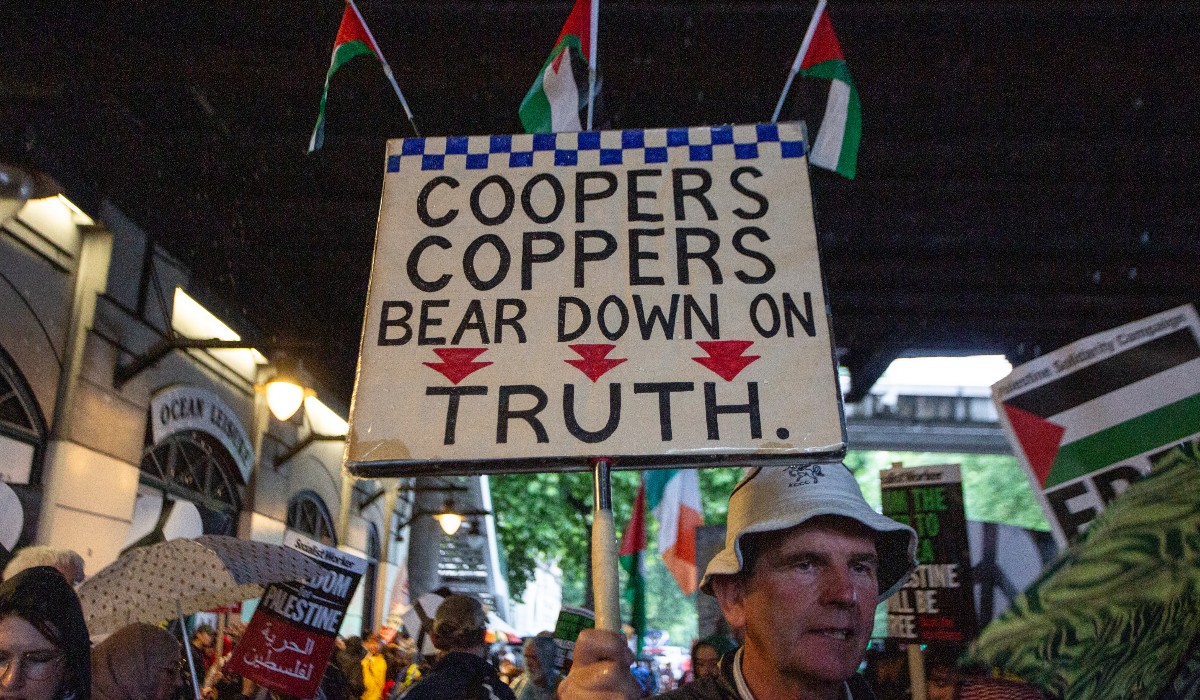
 Palestine national demonstration, 19 July 2025. Photo: Steve Eason / CC BY-NC 2.0
Lindsey German on the authoritarian clampdown and why Diane Abbott is right about racism
Every week now we see more evidence of harassment and criminalisation of protest, especially round the Palestine movement. A woman in Canterbury was threatened with arrest by armed police for waving a Palestine flag and having a placard condemning Israel’s genocide. Councillor Michael Lavalette in Preston has been called in for an interview under caution over a post about intifada on Facebook. Dozens have been arrested for displaying placards or T-shirts in support of Palestine Action. Saturday’s national demonstration in London was greeted with dystopian signs telling us that ‘Threatening or abusive chants may lead to arrest’ and ‘It’s an offence to support a proscribed organisation’. Those on remand for spray painting planes at Brize Norton are told that their trials will not be until 2027 – a breach of their civil liberties and human rights.
The repression is rising. Even in November 2023, Suella Braverman, then Tory Home Secretary, was unable to ban our marches which she described as ‘hate marches’. Under a Labour government we are seeing increased powers granted to the police, the proscription of a non-violent direct action group as terrorist, and creeping restrictions on what we can say or do. The attempt is to demonise or criminalise support for Palestine and to widen the scope of illegality so that actions which should be regarded as perfectly normal parts of solidarity protests suddenly become illegal.
We should be clear why this is happening. Our government and its allies are losing the argument over Palestine, so they want to stop us making it. Opinion worldwide has firmly turned against the Israeli genocide in Gaza. In Britain all the attempts to ban, demonise, and attack the solidarity movement have failed to halt the growing number of demonstrations, BDS actions, meetings, bike rides, bake sales, boating regattas, and much more. Only this week, Edinburgh University students organised mass protests at their graduation ceremonies demanding disinvestment. An impressive 22 union general secretaries have signed a letter opposing the criminalisation of leaders of the movement who are facing trial.
The response of the British government to the appalling daily murders in Gaza, to the deliberate targeting of starving children and to war crimes carried out on a daily basis is to occasionally murmur in feeble embarrassment but carry on supplying the weapons, wining and dining the Israeli ambassador, carrying out surveillance flights from RAF Akrotiri and giving full endorsement to Netanyahu and Trump.
The Palestine movement has very deep roots in Britain and internationally, and it is this that the government and the Zionists want to change. We cannot allow the criminalisation of a movement. It will not of course stop with Palestine. Already supporters of non-violent direct action groups are in prison over environmental issues. But this will spread to trade unionists and other campaigns. People who want to protest over government cuts, against wars, for equality, will find themselves subject to draconian laws.
It is an illusion to think that we can campaign over specific issues without taking up the question of civil liberties and protest. We said this back in 2001 when we founded Stop the War Coalition: if they bring us imperialist wars they will bring us racism against those they attack and try to prevent us protesting. Tony Blair did not dare criminalise the Iraq movement, despite attempts to stop us marching to Hyde Park in 2003. But Keir Starmer has no such compunction. Therefore part of the Palestine movement – and the left more generally – has to be campaigning against bans and proscriptions, for the right to protest. This isn’t a diversion from the struggle for solidarity, but an integral part of it, and needs to be seen as such. We need to defend our civil liberties and the best way of doing that is to keep organising, keep building mass protests which involve ever wider numbers, and keep showing solidarity for Palestine.
Diane is right about racism
The scapegoating of black MP Diane Abbott was another low point last week. As it happens, I listened to her interview with the BBC’s James Naughtie on Thursday morning before she was suspended. I was totally taken aback a few hours later when Labour decided she had been anti-Semitic in her comments. She was nothing of the sort. She did not repeat her claims of two years ago, which got her suspended for the first time. Instead, she clearly said that anti-Semitism and anti-Traveller racism were real but talked about the differences between those and anti-black racism. She did so in terms of visibility. There should be no doubt about this: stop and search for example is targeted at black and to a lesser extent Asian kids. Black and Asian people suffer abuse on public transport, on the streets and from the police because they are visibly black.
I would go further than this important point: you cannot understand anti-black and Asian racism in this country without looking at the racial division of labour at work and the history of slavery and imperialism to which Britain was central. This brings us on to wider definitions of racism where of course many people on the left differ. But we should understand racism as a material reality which is not simply about moral imperatives. Of course racism is morally wrong and should be opposed in all circumstances. But the arguments of Marxists go further: it is deliberately created and recreated in order to divide working-class people and to dehumanise its victims. It is therefore anathema to any idea of collective action or socialism – and why it tends to break down where people do take collective action to change the world, for example on the Palestine demos.
Our rulers are happy to place opposition to racism under the general rubric of diversity. That in itself doesn’t address the bigger questions: why racism is also connected to class, why some racism is much more pervasive and damaging. Any racism is terrible for those who experience it. But the institutional anti-black racism and Islamophobia in Britain go to the heart of education, policing, employment, and much else. Diane has been attacked for daring to imply there is a hierarchy of racism. But in reality the daily oppression of working-class black and Asian people is much more far-reaching, and deliberately so, throughout society than other racial oppressions.
Diane Abbott is right to point to that. As a working-class black woman who has experienced racism all her life she should be supported not sanctioned. And it’s about time we had a serious discussion about racism and how it works in society – not least within the Labour Party – rather than outbursts of moral outrage which end up attacking an MP who has received more racist abuse than any other.
This week: a lot of work on Palestine and civil liberties. Plus a trip to Manchester to join the very successful Stephen Kapos tour on Thursday.

Before you go
The ongoing genocide in Gaza, Starmer’s austerity and the danger of a resurgent far right demonstrate the urgent need for socialist organisation and ideas. Counterfire has been central to the Palestine revolt and we are committed to building mass, united movements of resistance. Become a member today and join the fightback.

Lindsey German
As national convenor of the Stop the War Coalition, Lindsey was a key organiser of the largest demonstration, and one of the largest mass movements, in British history.
Her books include ‘Material Girls: Women, Men and Work’, ‘Sex, Class and Socialism’, ‘A People’s History of London’ (with John Rees) and ‘How a Century of War Changed the Lives of Women’.