
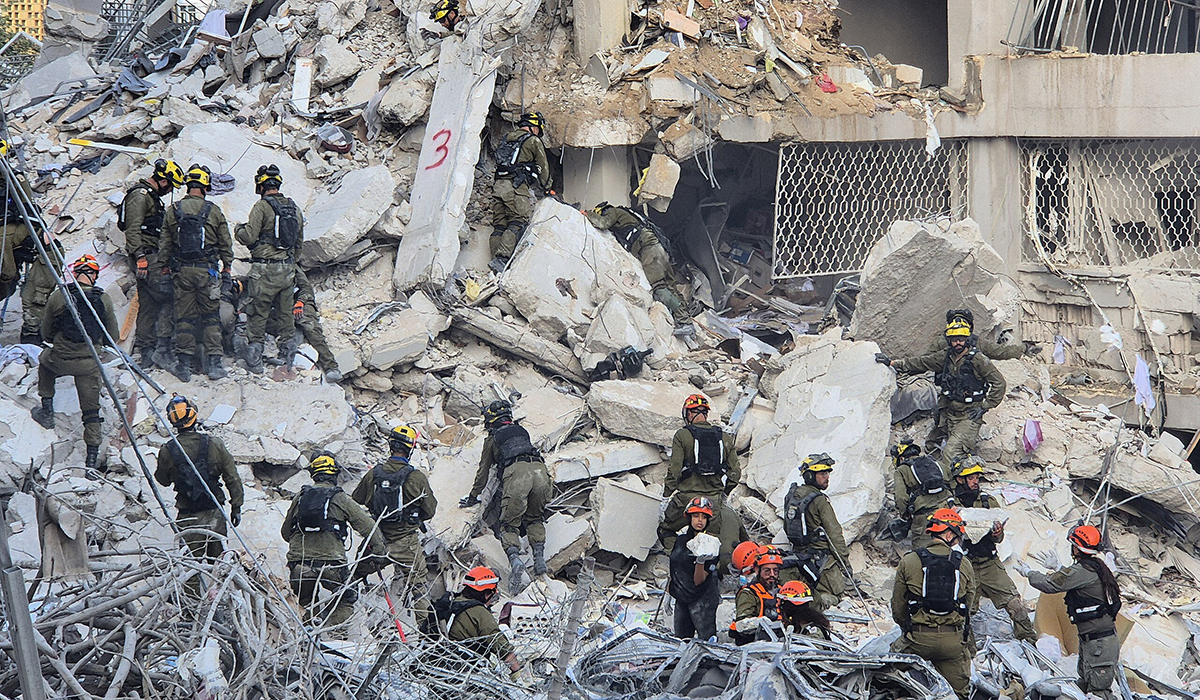
 Aftermath of Iranian air strike on Bat Yam. Photo: Yoav Keren / CC BY-SA 3.0
There is considerable evidence that Iran gave Israel a bloody nose in their short war, so further Israeli attacks on Iran will require US involvement, explains Chris Bambery
Reports say that the Israeli prime minister told President Donald Trump on his recent visit to Washington (over which, highly unusually, there was an effective press blackout) that Israel would strike Iran again if it believed it was building a nuclear bomb.
My first response is that Netanyahu and Trump know Iran is not building a nuclear bomb, despite a vigorous debate over the merits of doing just that, because Supreme Leader Ali Khamenei has not lifted his fatwa against it.
My second reaction is to wonder if Netanyahu is a glutton for punishment. After all, it was he who phoned Trump asking for a ceasefire after twelve days of war because Israel had received a bloody nose.
There is tight censorship over what damage Iranian ballistic missiles, fired in retaliation for Israeli strikes, did in Israel and over the inability of Israeli air and missile defences, joined by the Americans and Jordan, to stop them.
Larry C. Johnson is a former CIA officer and intelligence analyst, and former planner and advisor at the US State Department’s Office of Counter Terrorism. Today he is a strident critic of America’s ‘forever wars’. As a ceasefire came into effect, he produced this map of where Iranian missiles struck.
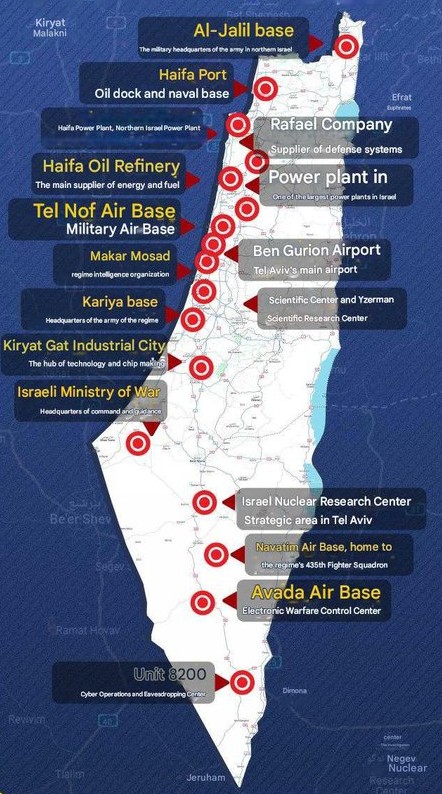
His conclusion is that:
‘According to various Israeli media reports, damage spanned residential buildings, scientific infrastructure (e.g., labs at the Weizmann Institute in Rehovot), the Israeli Defense Ministry complex, and commercial hubs like the Tel Aviv Stock Exchange. Iran also struck a military target near the Soroka Medical Center in Be’er Sheva. The medical center was hit by the blast wave, which caused extensive structural damage, a chemical leak, and dozens of injuries. The Israeli press claimed this was a direct strike on Soroka, but the fact that no one was killed undermines that claim.
‘Iran also struck the following residential areas, reportedly targeting Israeli military and intelligence officials:
- Bat Yam: nine killed, about 200 wounded, high-rise apartments destroyed.
- Ramat Gan: nine buildings destroyed, hundreds displaced.
- Haifa and Tel Aviv: strikes near military HQs (“Kirya”) and civilian neighbourhoods.
‘Iran also caused extensive damage to the Port of Haifa and the Port of Ashdod … as well as the refineries at Haifa and Ashdod. Israel has maintained a complete blackout on the damage to its military and intelligence facilities, but the sites identified on the map above indicate that Iran likely enjoyed similar success as that observed in Haifa and Tel Aviv.’
Costs and capabilities
The Israeli Defence Forces (IDF) laughably claims that Iran fired over 500 missiles and 1000 drones but only hit 36 targets. In an update on how successful Iran was, Larry C. Johnson writes:
‘Iran claims it attacked almost all scientific, research, and academic centers, factories and industries affiliated with Rafael and Elbit Systems, as well as other arms manufacturing and artificial intelligence factories. For example, Iran claims it destroyed Intel’s chip manufacturing plant, located in the occupied settlement of Kiryat Gat south of Tel Aviv. If true, this has inflicted as much as $5 billion in losses on the Zionist regime. Facilities and factories of other US companies in Israel, which include Intel, Microsoft, Tesla, Google, and Apple also were targeted by Iran.
‘Rafael and Elbit Systems are deeply integrated into Israel’s defense, academic, and industrial landscape. Rafael has strong ties with Ben-Gurion University and maintains multiple R&D and production sites across Israel, while Elbit Systems leads national research consortia and operates numerous factories, including those acquired from IMI Systems. Both companies maintain extensive collaboration with the Israeli Ministry of Defense and partner with a wide range of academic, governmental, and industrial entities.’
Middle East Eye, using Israeli press reports notes that:
‘Direct damage from Iranian missile strikes is assessed at three to five billion shekels ($900m to $1.5bn) with indirect losses projected to be of a similar scale, according to TheMarker.
‘Data published in Maariv indicated that more than 1,000 buildings were damaged or destroyed, primarily in central cities such as Ramat Gan, Tel Aviv, Ness Ziona, and Bat Yam.
‘Additional destruction was reported in Beersheba and Haifa, the largest cities in southern and northern Israel, respectively.
‘Israel faces a multi-billion shekel price tag from the Iran war
‘The Israel Tax Authority said over 46,000 compensation claims have been filed for damage to homes, vehicles, property, and equipment.
‘According to The Times of Israel, around 18,000 residents were forced to evacuate their homes, with most relocated to hotels at the government’s expense.
‘During much of the 12-day conflict, only essential workers were permitted to report to work, as Defence Minister Israel Katz imposed a nationwide state of emergency.
‘The economic toll was significant. The Manufacturers Association, quoted in Ynet, estimated that the shutdown cost the economy approximately 1.5 billion shekels per day ($450m).’
Israel has two oil refineries, two functioning ports and one international airport. Iran, a far larger country has many more of these. Israel’s main port, Haifa, was not just in danger of closure but shipping destined there faced having insurance withdrawn. The Telegraph, not an enemy of Israel, used radar data and reports Iranian missiles hit five IDF bases during the twelve days. It also reported that the United States launched around 36 THAAD missiles to support Israel’s air defence. Each missile is estimated to cost $12 million.
How could Iran penetrate Israel’s famed missile and air defence system? One report notes:
‘Iran has primarily challenged Israel’s aerial defences through saturation attacks, launching numerous missiles and drones in waves. Israel’s defence system consists of several tiers: the Iron Dome for short-range rockets, David’s Sling for medium-range missiles and cruise missiles, and the Arrow 2 and Arrow 3 systems for long-range ballistic missiles, intercepting them at higher altitudes or even in space.
‘While each system boasts high interception rates for their intended targets, the sheer number of projectiles can overwhelm even the most robust defense. By firing hundreds of projectiles simultaneously, Iran aims to deplete Israel’s interceptor missiles and create gaps in its defensive shield, allowing some projectiles to penetrate.’
Running out of road
As I have previously reported, the interceptions were 90% effective at the start of the twelve days but just 65% by its close. Israel was running short of Arrow interceptor missiles, with the Wall Street Journal reporting on 18 June that the US has known about the shortage of Arrow interceptors for months and has been working to bolster Israel’s air defences accordingly. However, those stocks are limited, too. Having dispatched many to Israel, ‘there is now concern about the US burning through interceptors as well,’ the newspaper said.
Israel’s nightly missile defence operations cost up to one billion shekels ($285 million), with each Arrow interceptor alone costing around $3 million. It also seems Iran held back its most sophisticated hypersonic missiles which are unstoppable.
In October 2024, when Iran first retaliated against the assassinations of Hamas leader Ismail Haniyeh in Tehran, Hezbollah leader Hassan Nasrallah, and IRGC general Abbas Nilforoushan, this report noted the difficulties Israel faced:
‘Ravi Gupta, a former spokesperson and scientist at DRDO [India’s Defence Research and Development Organisation], explained that while ballistic missiles can be detected and intercepted due to their prolonged presence in the air after launch, tracking and neutralising hypersonic missiles is much more complex. These missiles travel at speeds starting from 5 Mach, making them extremely difficult to intercept with current technology.’
Another report states:
‘As confidence in Iron Dome began to erode, Israel’s population experienced an unprecedented sense of fear, panic, and instability.
‘Viral videos showed Israelis rushing to Ben Gurion Airport, trying to leave the country amid sirens and explosions.’
Israel went into war with Iran believing the advantage lay with them. Amos Yadlin is a retired Major General in the Israeli Air Force and served as the chief of Israel’s Defense Intelligence from 2006 to 2010. He is gung-ho about the need to strike Iran once more, but he points out the Israeli assessment was that this summer was the perfect time to hit Iran:
‘Israel, through months of airstrikes and a ground campaign, had severely degraded the Islamic Republic’s most important ally, Hezbollah. The Assad regime, another loyal Iranian friend, had collapsed. And Iran’s air defenses had proven vulnerable during Israeli strikes in 2024. Israel also timed its June attacks on Iranian facilities to coincide with the end of the 60-day window U.S. President Donald Trump had set for nuclear discussions.
‘As a result, early June was the perfect time for Israel to go beyond the covert action and one-off strikes it had conducted before. The core objectives of Operation Rising Lion were to inflict significant and long-term damage on Iran’s nuclear and missile programs, to create the conditions for a better nuclear agreement, and to further degrade Iran’s network of regional proxies. Israel also hoped that the attack would destabilize the Iranian regime, potentially facilitating its collapse, and persuade Washington to act, thereby demonstrating the United States’ commitment to preventing Iranian nuclearization—although these were not formal goals.’
Strategic failure
Iran, on that first Friday, was caught napping. Believing Trump’s assurances, wrongly, that with talks due to start on Sunday in Oman on their nuclear programme, there would be no such attack.
Israeli special forces had prepared drones in Iranian deserts and mountains to carry out devastating assassinations of nuclear scientists and Revolutionary Guard commanders. They also had bases for similar attacks in Azerbaijan and in the Kurdish region of Iran. This gave them tactical success at the outset, but the war ended in strategic failure.
At the start of the short-lived war, Netanyahu declared two goals: ‘decapitating the nuclear programme’ and ‘regime change’. Israel and America failed to achieve the latter, despite Trump’s bombast. Regime change looks to be a pipedream as reports show many of those critical of the Islamic Republic taking to the streets against the Israeli/US attacks. Iranian nationalism runs deep.
Ori Goldberg wrote in Al Jazeera:
‘The assassinations rallied the people around the government. Israel assassinated the senior commanders of the Iranian Revolutionary Guard Corps (IRGC), perhaps the most powerful element in current Iranian politics, but also one of the most hated by the Iranian public. Regardless, many Iranians who consider themselves staunch opponents of the Islamic Republic and especially of the IRGC found themselves supporting it. Iranians saw Iran in its entirety under attack and not just “the regime”.’
What now exists is a ceasefire, in which both Israel and Iran will re-arm. The US will of course give Israel everything it can but as Trump is still arming Ukraine, there are now limits to how much material the Americans can provide. Things like the Arrow missiles are not just expensive but take weeks to build.
Iran will be looking to Russia and China to provide air-defence systems, and will wish for Chinese J-10 aircraft which, during the short Pakistan-Indian war in May, which shot down at least six Indian planes, including the newly-acquired French-made Rafale fighter jets, regarded as cutting edge until then.
So, if Netanyahu wants to go another round with Iran, it would seem that is only possible if he has the US alongside him. That’s a frightening thought.
Before you go
The ongoing genocide in Gaza, Starmer’s austerity and the danger of a resurgent far right demonstrate the urgent need for socialist organisation and ideas. Counterfire has been central to the Palestine revolt and we are committed to building mass, united movements of resistance. Become a member today and join the fightback.

Chris Bambery
Chris Bambery is an author, political activist and commentator, and a supporter of Rise, the radical left wing coalition in Scotland. His books include A People's History of Scotland and The Second World War: A Marxist Analysis.