
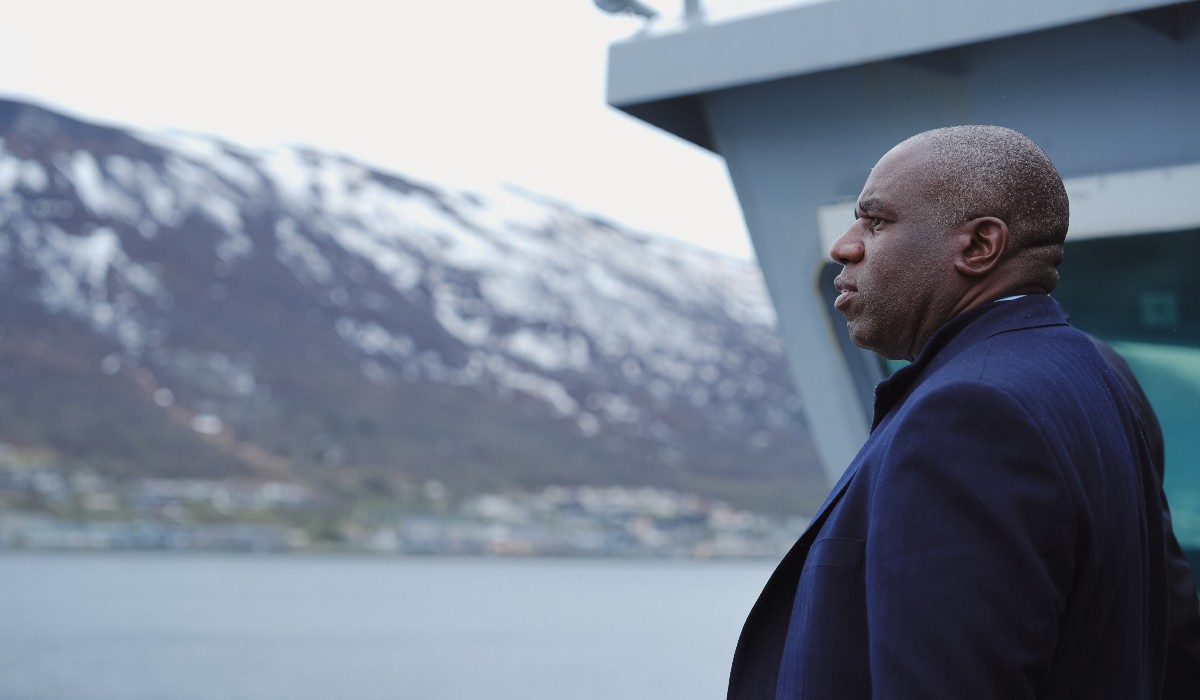
 David Lammy in the Arctic. Photo: Ben Dance / FCDO / CC BY-NC-ND 2.0
Imperialist rivalries have extended to one of the most environmentally fragile regions of the globe, explains Chris Bambery
In September 2023, Russia formally withdrew from the Barents Euro-Arctic Council (BEAC), a crucial body involved in environmental protection, rights of indigenous peoples, conservation, and the sustainable management of forest resources in the environmentally fragile Arctic.
‘Under the current conditions, we are forced to announce the withdrawal of the Russian Federation from Barents Euro-Arctic Cooperation (BEAC),’ the Russian Foreign Ministry said in a statement, and added:
‘Through the fault of the Western members (Denmark, Iceland, Norway, Finland, Sweden, the EU), the Council’s activities have been effectively paralysed since March 2022. The Finnish presidency failed to confirm the transfer of the BEAC presidency to Russia, scheduled for October 2023, in violation of the principle of rotation thus disrupting the necessary preparations’
The withdrawal came after Russia was informally excluded from the BEAC following its 2022 invasion of Ukraine. Russia is now proceeding with plans for a Brics research station in the Arctic island of Svalbard, formally Norwegian territory but both supposedly de-militarised and open to other Arctic powers such as Russia and China, who both have bases there, while Norway retains a satellite tracking station there.
The Arctic consists of land, internal waters, territorial seas, exclusive economic zones (EEZs) and international waters above the Arctic Circle (66 degrees 33 minutes North latitude). All land, internal waters, territorial seas and Exclusive Economic Zones (EEZs) in the Arctic are under the jurisdiction of one of the eight Arctic coastal states: Canada, Denmark, Finland, Iceland, Norway, Russia, Sweden and the United States. International law regulates this area. There are believed to be oil and gas fields under the sea. Canada, Russia, Denmark, and Norway have all announced extended continental shelf claims that cover almost the entire Arctic seabed.
In this context, the Debate US explains what’s at stake:
‘Arctic lands and seabeds also hold vast quantities of critical minerals and energy resources, and Arctic waters are becoming an increasingly important source of food as warming ocean temperatures compel fish to swim north seeking cooler waters. The main battle lines will thus be drawn along the Arctic seabed, in international waters, and en route to outer space. U.S. and Russian nuclear submarines already patrol zones where undersea cables connect Europe and the United States, and security is likely to get tighter as Russian and Chinese vessels target new cables. Countries will also be looking to lock in access to critical minerals.’
Three key powers – the USA, China and Russia – are involved in a military build-up in the Artic; a region where growing militarisation threatens peace and environmental damage.
Militarisation, global warming, and raising tensions
All of this explains what seemed at first absurd, President Trump’s statement that the US wishes to buy Greenland from its colonial owner, Denmark. Global warming means that, in summer at least, ships can sail from the Bering Sea (lying between Siberia and Alaska) to the Barents Sea, and thus either into the Atlantic or the North Sea. The Chinese see this as a new ‘Polar Silk Road’, faster and more secure because it passes the Russian coast, than the route via the Suez Canal.
A fifth of Russian territory is in the Arctic and it accounts for more than half of the coastline. The United Nations recognises its control of sea lanes and sea beds in that area. Russian Foreign Minister, Sergey Lavrov told the press in September 2024: ‘Russia is fully ready for a conflict with NATO in the Arctic. We see NATO stepping up drills related to possible crises in the Arctic.’
Russian defence minister Sergei Shoigu pointed out that the Russian Northern fleet’s strategic submarine base at Gadzhiyevo is 100 miles from the Finnish border: ‘Given NATO’s desire to build up military potential near Russia’s borders as well as to expand the Northern Atlantic Alliance at the expense of Sweden and Finland, retaliatory measures are required to create an appropriate grouping of troops in Northwest Russia.’
Growing ties between Russia and China saw them conduct their first-ever joint naval drills and bomber patrols in the Bering Sea. China increased funding for Russia’s liquefied natural gas projects in the Arctic and related infrastructure development along the Northern Sea Route, expanding its commercial presence in the region.
The US is very nervous about Chinese expansion into the region. There is a ‘choke point’ it wishes to control from Greenland, Iceland and Norway: the exit from the Barents Sea into the Atlantic. A US nuclear submarine has just docked for the first time in Iceland. Iceland only began allowing nuclear-powered submarines to enter its territorial waters in 2023. The US has had use of the Keflavik Air Base since 1954. British P8 submarine reconnaissance aircraft also operate out of there.
Dr Elizabeth Buchanan, a former Australian defence official and author of a forthcoming book on the Artic explains Washington’s interest: ‘Greenland is an enviable piece of real estate for Washington, it is basically physical insurance for the American homeland. It is no wonder it has always been viewed as a frontier for deterrence.’
‘Spying among friends’
In May, Denmark’s foreign minister summoned the US ambassador after the Wall Street Journal reported that Washington’s spy agencies have been told to focus on Greenland, centring efforts on the semi-autonomous country’s independence movement, and American potential to extract mineral resources there. The CIA and other agencies were told to look out for Russian or Chinese operatives there.
Lars Løkke Rasmussen said: ‘It worries me greatly because we do not spy on friends.’ He must be aware the US has always spied on its ‘friends’ as well as its enemies.
Greenland has long been of strategic interest for America. After the Third Reich occupied mainland Denmark during World War Two, the US took over Greenland, establishing military, radio and radar stations across the territory. After the war, US forces stayed in Greenland. Pituffik Space Base, formerly known as Thule Air Base, has been operated by the US ever since. In 1951, a defence agreement with Denmark granted the US the right to build and maintain military bases.
The other super-power with interests in the region is China, well placed because of its alliance with Russia. Moscow and Beijing have signed a memorandum for security cooperation in the Barents Sea and Arctic territories between Russian and Chinese coast guard units. Opening the door for China to establish itself as a ‘near-Arctic state’.
The Danish Institute for International Studies points out: ‘International law allows China to navigate, extract resources and conduct research in international waters of the Arctic, most extractable resources and infrastructure – such as ports, roads and research stations – lie within the national territories of, or in areas controlled by, the eight ‘Arctic states’, namely: Canada, Denmark (via Greenland), Finland, Iceland, Norway, Russia, Sweden and the United States.’
With Sweden and Finland joining Nato, Russia faces Nato states along its entire north-western border. In March last year, over 90,000 Nato soldiers from 32 Nato states, including Finland, Sweden, and the United States, participated in the Nordic Response 2024 exercise in Norway. Fifty frigates, submarines, and other vessels, as well as over 100 aircraft, were involved in the exercise.
UK to police the Arctic
Last week saw the US Department of Defense staged Anchorage Navy Week, held for the first time in Alaska’s largest city. One report stated: ‘The Arctic is no longer a distant frontier—it is a domain of increasing competition, demanding attention from military planners, policymakers, and operational commanders. As part of the DoD’s [Department of Defense] efforts to restore deterrence and reinforce homeland defense, leaders are prioritizing burden sharing with Allies and partners, enhancing multidomain awareness, and preparing for joint operational demands in the Arctic.’
Nearly all of the United States’ radar systems and ground-based missile interceptors are located in Alaska, where high latitude enables earlier detection of incoming threats.
What is the UK’s involvement in this new Cold War flash point? The BBC Reports: ‘The UK is not formally an Arctic power, but its involvement is growing, in part to counter Russia. One historic reason is something called the GIUK gap, an obscure but strategically important stretch.’
To reach the Atlantic easily, the Russian Northern Fleet need to go through the gap – a narrower body of water running between Greenland and the UK with Iceland in the middle. In World War Two, its importance was one of the reasons for the US establishing a military base in Greenland to deal with Nazi U-boats. In the Cold War and through to today, this chokepoint remains the place to look for submarines, and Nato deploys underwater sensors to hunt for them.
UK Foreign Secretary David Lammy visited the Arctic in late May and announced a new joint scheme with Iceland to use AI technology to monitor ‘hostile activity’ in the region. That means looking for Russian submarines and boats.’
The Starmer government has committed to build more submarines and to reinforce the hulls of warships so they can operate in the Arctic. More money for warfare rather than welfare.
Before you go
The ongoing genocide in Gaza, Starmer’s austerity and the danger of a resurgent far right demonstrate the urgent need for socialist organisation and ideas. Counterfire has been central to the Palestine revolt and we are committed to building mass, united movements of resistance. Become a member today and join the fightback.

Chris Bambery
Chris Bambery is an author, political activist and commentator, and a supporter of Rise, the radical left wing coalition in Scotland. His books include A People's History of Scotland and The Second World War: A Marxist Analysis.