
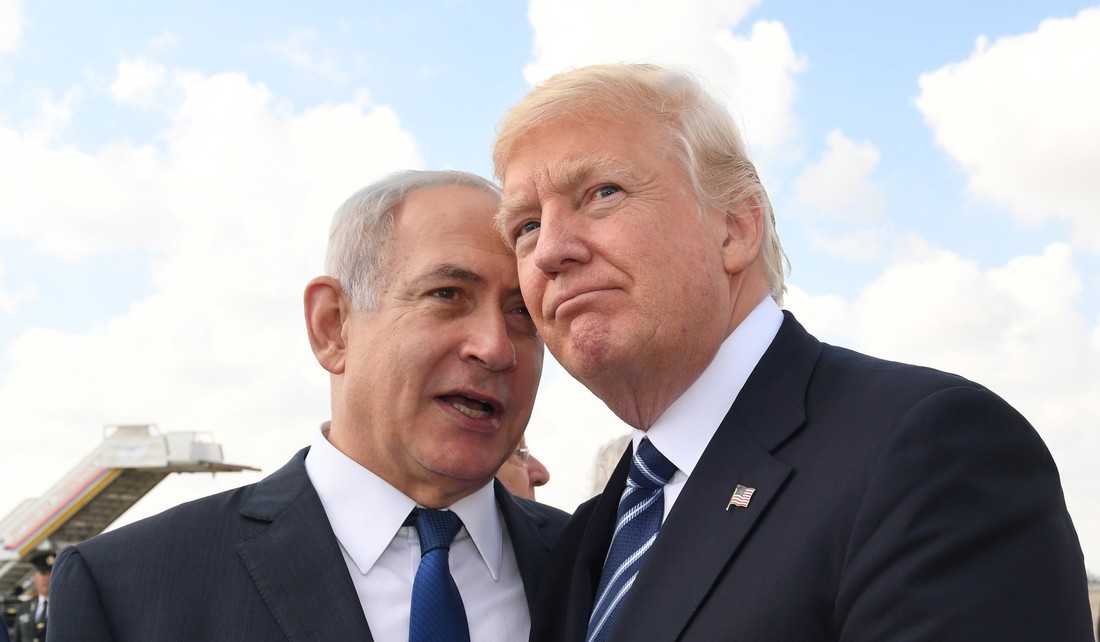
 Photo: Israel MFA / Flickr / CC-BY-2.0
Chris Bambery analyses Trump’s brokering between Iran and ‘wounded beast’ Israel
Once there was an Israeli dream. Its citizens could be sitting supping their morning coffee at a beach front café in Tel Aviv, while the Israeli Defence Force turned Iran into another Gaza. That turned into a nightmare as they found themselves sheltering underground and coming out to find apartment blocks blown away.
Israel is built on the notion of the Iron Wall; that not only has it greater military power than any potential foe, but it can inflict such damage on them they will never try that again.
Having promised Tehran’s destruction and regime change in Iran, Benjamin Netanyahu accepted Trump’s brokered ceasefire. The question is why?
Before the ceasefire came into effect Iran carried out one of its most intense missile attacks in Israel, with sirens heard across multiple cities, including Tel Aviv and Beersheba. In the latter, medical and security sources confirmed that at least eight Israelis were killed and dozens more wounded, with several in critical condition and others still trapped in rubble. Emergency teams reported that a seven-storey residential building in Beersheba was directly struck, and rescue operations are ongoing to recover those trapped under the rubble.
The Wall Street Journal, which strongly defends Israel reported on 18 June:
“Israel is running low on defensive Arrow interceptors, according to a U.S. official, raising concern about the country’s ability to counter long-range ballistic missiles from Iran if the conflict isn’t resolved soon.
The U.S. has been aware of the capacity problems for months, the official said, and Washington has been augmenting Israel’s defenses with systems on the ground, at sea and in the air. Since the conflict escalated in June, the Pentagon has sent more missile defense assets into the region, and now there is concern about the U.S. burning through interceptors as well.”
The day before, 17 June, a separate source briefed the Washington Paper on U.S. and Israeli intelligence. The paper concluded that “the system is already overwhelmed,”
Before their attack on Iran, Israel’s missile defences were already struggling to cope:
“Israeli missile defence systems have proven to have struggled to intercept attacks launched using even relatively basic ballistic missile classes, such as those launched by Ansurullah Coalition forces in Yemen. This has placed their ability to intercept medium or high end Iranian missiles into serious question. Israeli shortages of anti-ballistic missiles was already a serious issue by mid-2024, with continued ballistic missile attacks from Yemen, two large scale strikes from Iran in April and September, and to a lesser extent strikes by the Lebanese paramilitary group Hezbollah, having depleted the arsenal. Successful efforts by Hezbollah to specifically target Israeli missile defence assets reportedly worsened the situation.”
The key Israeli Arrow 2 interceptor is built by Israel Aerospace Industries (IAI) and Boeing:
“It requires specialized components and rigorous testing, slowing output. The process is susceptible to supply chain constraints.”
Each Arrow 2 interceptor costs approximately $1.5–3 million, making mass production expensive.
By the second week of its war with Iran, Israel was reliant on the US for intercepting Iranian missiles.
It is unclear how many missiles Iran has left. The Pentagon estimated in 2021 that Iran just under 3,000 missiles of different ranges. Since Israel attacked Iran on June 12 through June 16, Iran had fired around 400 missiles, meaning thousands could remain.
On 18 June, Iranian Revolutionary Guards launched its first ever strike using the new Fattah ballistic missile, which is expected to be effectively impossible to intercept due to its use of a hypersonic glide vehicle.
NBC News, citing a senior Israeli intelligence official, reported on 20 June that only about 65% of Iranian missiles had been intercepted in the past 24 hours, significantly lower than the nearly 90% interception rate the day before.
In October, the United States sent Israel a THAAD system – capable of intercepting missiles inside and outside of the atmosphere – with American personnel to operate it. According to news reports, the United States sent a second THAAD to Israel in April, although the Pentagon has not publicly confirmed the transfer.
The U.S. Army has just seven THAAD batteries in total – it will get an eighth later this summer.
Israel’s talk of controlling the skies above Iran was hyperbole. Only the most advanced F-35 stealth bombers, utilising so-called ‘beast mode,’ featuring heavier loads on underwing pylons, and Israel’s unique F-35I fleet — locally known as the “Adir” (Hebrew for mighty) were operating inside Iranian airspace.
Other planes fired missiles into Iran from across the border with Iraq and Syria, plus attacks by drones smuggled into the country – copying the recent Ukrainian attack on Russia nuclear bomber bases.
What of the wider economic and social damage Israel has suffered? Ben Gurion airport, its only international airport, has been closed since this war began. Although flights still depart from Israel, they are for tourists and fleeing foreign residents, while Israeli citizens are effectively trapped. That will have unnerved a significant section of the population; the more wealthy who might have had the resources to escape.
Over half a million Israelis had quit the country before Israel attacked Iran. Middle East Eye reports:
“Meanwhile, since the outbreak of the war on Gaza – and even earlier, during Israel’s judicial overhaul – many Israelis have opted to move money overseas, with a financial services firm reporting in March a 50 percent increase in the number of Israelis seeking to exchange and transfer money overseas.
Since October 2023, there has reportedly been a seven-fold rise in money transfers from Israel to other countries, with around $5.6bn moved out of the country that year alone.”
“Israel’s economy is going to be about 5pc smaller over the next few years than if the war hadn’t happened,” says Liam Peach, senior emerging markets economist at Capital Economics, told the Telegraph, citing the drop in labour from reservist call-ups and the lack of workers in Gaza.
“That is quite a big impact. Although Israel has been resilient, and some parts of the economy have bounced back, there has been this quite big supply-side impact that is taking a long-lasting toll on the economy.”
The paper reports:
“An economy that normally expands by at least 4pc a year, and clocked 6.5pc in the year before the October 2023 Hamas attack, grew less than 1pc last year.
Defence spending has also surged more than 60pc, sending the government’s budget deficit above 6pc of GDP, and its debt-to-GDP ratio to just shy of 70pc.”
For Israel this war became unsustainable. That is a dangerous development for a country based on the afore-mentioned Iron Wall.
The ceasefire will allow it time to rebuild its military capabilities and missile defence systems, but it remains a fact neither it nor the US could stop Iranian missiles getting through.
But that works both ways, so Iran will be looking to acquire more military equipment, including air defence systems, from Russia and China.
Neither of those states was going to enter into the war but, first, they saw it as the US laying down a marker for what might lay in wait for them, and secondly, they cannot be seen to allow the US and degrade a key ally.
When Trump came out of support of Israel’s initial strike on Iran there was euphoria in Israel. This was repeated when news of the US bombing of the three nuclear sites came through.
But, when Israel kept bombing Iran after it had declared a ceasefire, Trump exploded, saying he was “really unhappy” with Israel. He called on Israel to stop dropping bombs and to “bring your pilots home, now!”
Turning on both states Trump said “they don’t know what the f**k they’re doing”,
CBS reports that Trump was “exceptionally firm and direct with Israel’s Prime Minister Benjamin Netanyahu about what needed to happen to sustain the ceasefire,” during a call between the two leaders a little earlier.
“The prime minister understood the severity of the situation and the concerns President Trump expressed,” CBS reports.
Netanyahu’s office released a statement saying that Israel had “refrained from further attacks” after the PM spoke to Trump.
No US President since Ronald Reagan told Israel to stop bombing Beirut in 1982, has spoken to an Israeli leader in such a way. It will have left Netanyahu in shock.
Iran has taken the strongest stand in support of Palestinian in the region; but the bar is not very high. Its priority is to rebuild its economy and that will always come first.
Iran faces Western sanctions, high inflation, lack of investment, declining natural gas production and inefficient irrigation are all leading to power blackouts and water shortages.
But it looks to its allies, Russia and China, for future investment. Both states see Iran as strategically important, for China as part of its new Silk Road from east to west; for Russia as a north south trade route ending at the Persian Gulf.
Can there be a deal between Iran and Trump over the Iranian nuclear programme?
The US knows Iran does not have a nuclear bomb and is not working on one. US Secretary of State for National Intelligence, Tulsi Gabbard, said so on the record in March, saying that this was the assessment of all US intelligence services.
Rebuked by Trump, Gabbard recanted and claimed Iran could produce a nuclear bomb, but her original statement was under oath and represented the views of five US intelligence agencies.
Despite Trump’s claims that Iran’s stocks of enriched uranium have been destroyed with all else, this does not seem the case. I suspect for Supreme Leader, Ali Khamenei, the ban on building a bomb will hold as a negotiating tool. After all under international law Iran has the right to develop a civic nuclear programme.
I also believe Russia, China and many states in the Global South will be raising the issue of Israeli nuclear weapons and its refusal to sign up to international law including allowing inspectors into their sites.
Can there now be a deal between the US and Iran?
Firstly, Iran will not agree to simply scrapping its whole programme as Trump demands. That would destroy its sovereignty.
Iran struck the Joint Comprehensive Plan of Action (JCPOA) deal in 2015 with the US under President Obama, Russia, China, France, Germany, the United Kingdom and the European Union. They were told sanctions would be lifted. They weren’t.
If Iran was about to reach a deal with Trump, it would insist on those sanctions being lifted. But Trump could not get that past Congress.
So, most likely Iran will continue with its programme. The US MOP “bunker busters” did some damage but they did not destroy that programme. Israel has not got the capability to do that.
All of this suggests that this ceasefire is not a solution. Trump would pay a huge price for rolling back on his promise to end US “forever wars” by renewing the conflict, not least among his own voting base.
This leaves Israel in a dangerous place. Like a wounded beast it will continue to hit out, not least killing civilians in Gaza. But as the missile strikes fade it looks more like a wounded beast than at any time in its history.
Before you go
More war, escalating authoritarianism, a deepening cost of living crisis – the left faces big challenges.
But resistance is also growing.
Counterfire has been at the heart of the mass movements against war, in solidarity with Palestine, and against austerity. Given the scale of the crisis, we urgently need to ramp up our operations. We need your help to raise £30,000 to make that happen.

Chris Bambery
Chris Bambery is an author, political activist and commentator, and a supporter of Rise, the radical left wing coalition in Scotland. His books include A People's History of Scotland and The Second World War: A Marxist Analysis.