
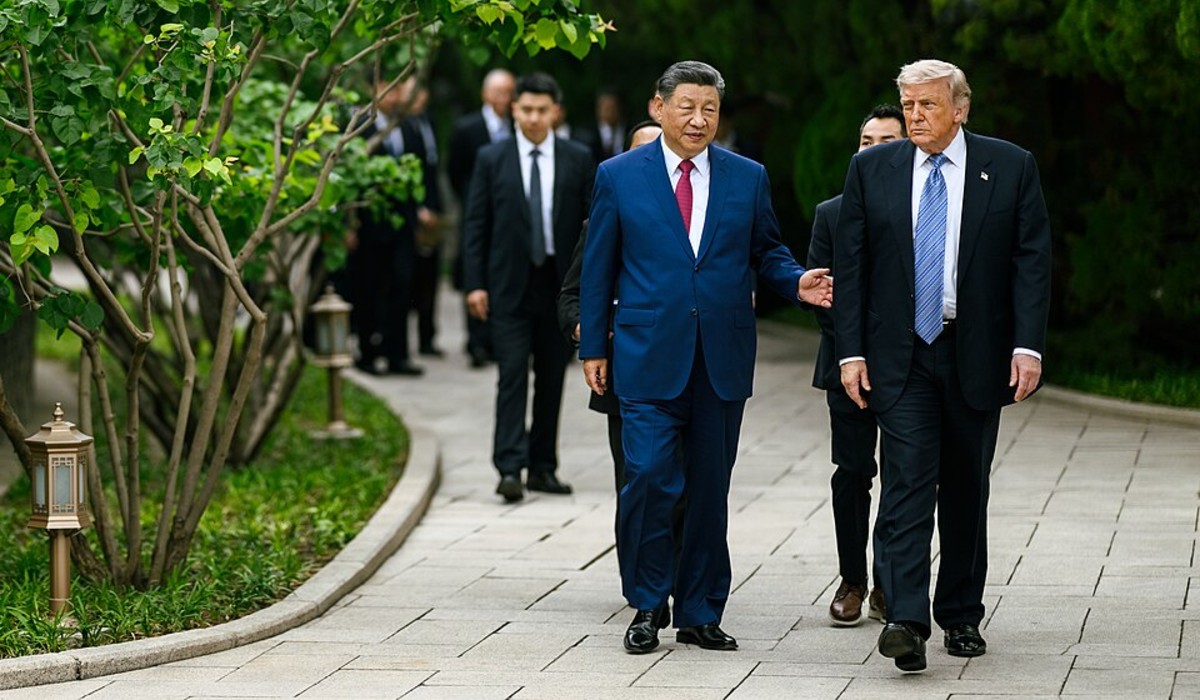
 US President Donald Trump and CCP General Secretary Xi Jinping at Zhongnanhai on 15 May 2026. Photo: White House / Public Domain
The summit between the US and Chinese presidents in Beijing marked a real change in relations which further highlights the decline of US imperialism, writes Chris Bambery
Trump trumpeted his visit to China as a triumph but that was not how the US media and many right-wing commentators viewed it.
The Washington Post headline on Friday was:
‘Beijing summit yields Chinese goal — equal footing with US’
The New York Times headline was:
‘China Increasingly Views Trump’s America as an Empire in Decline’
Both papers are very close to the US state, particularly its defence and intelligence services. What comes across is a shock that China could dare to address the US on equal terms and a sense that this signals another strong indicator of its decline.
USA Today stated:
‘Beijing no longer behaves like a rising power seeking acceptance into an American-led order. It behaves like a co-owner of the international system. And increasingly, Washington treats China that way…Trump arrived in Beijing not as the triumphant leader of an unchallenged superpower, but as the head of a country increasingly constrained abroad, economically vulnerable at home, and struggling to impose its will even on far weaker adversaries.’
Others in America referred to the Beijing summit as a ‘Suez moment’ – a reference to the Anglo-French invasion of Egypt in 1956 which ended in humiliation when Washington pulled financial support from both Sterling and the French Franc, ending those countries’ imperial ambitions.
I don’t think this is the end for US imperialism, nowhere near it, but the very fact the comparison is being made gives a sense of shock in US ruling circles.
The Times of India commented:
‘For allies across Asia – especially India, Japan, South Kores and Taiwan – the summit offered a complicated picture: a US President eager for transactional deals and personal rapport with Xi, but increasingly reluctant to define clear red lines in the Indo-Pacific’s central strategic contest. The result was a summit that may ultimately be remembered less for what it revealed: a China confident enough to treat America as merely another great power, and America struggling to decide how much of its old dominance it is still willing – or able – to defend.’
In his opening speech at last week’s summit meeting with Donald Trump in Beijing, President Xi of China referenced the Thucydides trap. The Thucydides trap refers to the idea that when a rising power threatens to displace an established one, the result is often war.
‘It was the rise of Athens and the fear that this instilled in Sparta that made war inevitable,’ Thucydides wrote in his book, The History of the Peloponnesian War. The implication was that China’s rise provokes anxiety and potential conflict with the US.
The Chinese leader later warned Trump that any missteps on Taiwan, which China claims sovereignty over, could push their two countries into ‘conflict’. ‘The Taiwan question is the most important issue in China-US relations,’ Xi said, of the self governing island that China claims as its own. ‘If mishandled, the two nations could collide or even come into conflict, pushing the entire China-US relationship into a highly perilous situation,’ he added. It is hard to imagine Xi saying this if it were not for the US debacle in Iran.
Until recently the US treated China as an authoritarian state and would lecture it regarding human rights abuses, the mistreatment of the Uighurs or its occupation of Tibet for instance. In this visit to Beijing, Trump treated China as a peer superpower.
Previously Trump has tried to shift Chinese policy tariffs, sanctions and technological pressure. His most recent attempt to impose tariffs ended their withdrawal when China retaliated by threatening to block exports of rare earth and other necessities to the US. In other words, it used its control of industrial choke points to force Trump into a U turn.
China no longer seeks full access to the US dominated ‘international rules-based order’. It requires Washington to recognise it as an equal, superpower. In these talks tariffs were not discussed, signifying a major retreat by Washington.
On Taiwan, which until now the US stressed would defend its independence at all costs, there has been another shift:
‘Would a grand bargain mean the U.S. is abandoning Taiwan? Not necessarily in explicit terms. The framework being discussed involves tacit acknowledgment of Chinese primacy rather than formal abandonment. A negotiated peaceful resolution may actually better preserve U.S. access to Taiwan’s semiconductor manufacturing base than military confrontation, which would likely destroy the industrial assets making Taiwan strategically valuable.’
Xi warned Trump that the Taiwan issue is crucial to Sino-American relations. Trump told reporters on Air Force One en route back to Washington that he did not ‘want to say’ whether he would defend Taiwan if the island nation were to face military threats from Beijing, adding that he was the only one who could make that determination. That too is a major retreat from the previous position of unconditional support for Taiwan. It will cause anxiety in Japan, South Korea and Australia as well as Taiwan.
It’s important to stress the US still has enormous financial and military power, greater than China. One reason for Trump’s war with Iran was to re-affirm US control over oil coming out of the Persian Gulf, on which it depends. That has backfired badly. An emboldened China makes no secret of the fact it provided Iran with satellite tracking of US assets there, making their drone and missile attacks far more accurate.
The consequences of the Iran war represent a conjuncture, a moment of decisive shift.
A doyen of the neo-cons, Rober Kagan, wrote in The Atlantic regarding the Iran war that:
‘Washington can’t reverse or control the consequences of losing this war.’
When someone like Kagan states this it has a real impact inside the US ruling class.
China is an imperialist power pursuing its own self interests. But in its decline the US, like Britain post-1870, is the much more aggressive power as it tries to buttress its position. The fact it has been forced into retreats regarding China and Iran is a positive thing in this context.
Before you go
The ongoing genocide in Gaza, Starmer’s austerity and the danger of a resurgent far right demonstrate the urgent need for socialist organisation and ideas. Counterfire has been central to the Palestine revolt and we are committed to building mass, united movements of resistance. Become a member today and join the fightback.

Chris Bambery
Chris Bambery is an author, political activist and commentator, and a supporter of Rise, the radical left wing coalition in Scotland. His books include A People's History of Scotland and The Second World War: A Marxist Analysis.