
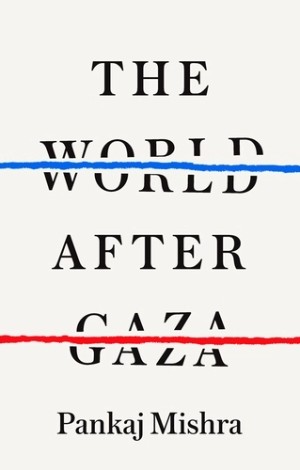
 Pankaj Mishra, The World After Gaza (Fern Press 2025), 304pp.
Pankaj Mishra explores, through the Holocaust to the context of colonialism and imperialism, how Israel’s impunity came to be, finds Lindsey German
The conflict in Gaza over the past eighteen months has spawned large numbers of books and articles. The hideous sight of the horror and brutality suffered by the Palestinians faced with a genocidal Israeli state has challenged all of us to try to understand and explain what the roots of this are, why it is happening and what we can do about it.
Pankaj Mishra’s work is a welcome addition to books which help that understanding. While its title is The World After Gaza,quite a lot of its focus is on the past. In particular, it tries to grapple with the legacy of the Holocaust which saw the death of six million Jews in Europe during the Second World War. This crime of extermination – the camps were called Vernichtungslager in German – remains one of the most shocking in modern history, not least because the most sophisticated industrial techniques were used to destroy the lives of so many.
The Italian Jew Primo Levi, a survivor of Auschwitz, is quoted in Mishra’s book as being aware of its impact on fellow Jews where he could sense ‘the incurable nature of the offense, which spreads like an infection’ and which was ‘an inexhaustible source of evil’ which ‘is perpetuated as hatred in the survivors’ which occurs ‘as a thirst for revenge, as moral breakdown, as negation, as weariness, as resignation’ (p.91).
Mishra tries to make sense of the history of Israel since the Second World War. Growing up in India, he speaks of an admiration for Israeli Jews during his childhood, connected to the Hindu nationalism which could see this young independent state as an ally. Those of us growing up in Britain also often saw it as an important refuge for persecuted Jews, and in some way progressive. But this has faded over the past fifty years to be replaced with understanding of the oppression of the Palestinians. He examines the attitudes to Israel and the Holocaust in the postwar years.
The Jewish state and the Holocaust
As he points out, the idea of a Jewish state as a homeland and refuge for Europe’s Jews was contested. Before the war, the majority of Europe’s Jews did not favour the Zionist idea of such a state, but saw their political contribution and future as being in the states where they then lived. Many were socialists, communists or otherwise on the left, and the Bund was their main representative organisation. The Holocaust changed all that, with the Zionist argument that Jews needed their own safe haven, their homeland, carrying overwhelming weight. In addition, the postwar climate in both the US and Europe was not particularly favourable to Jews: astonishing but true.
There were those like Hannah Arendt, for example, who did not want a Jewish state which would be militarised and in conflict with its Arab neighbours (p.92). There were others who understood what it would become. Tony Cliff, who was a huge influence on me politically, was born Ygael Gluckstein in Palestine in 1917 to a Jewish settler family. He and his wife Chanie Rosenberg decided to leave after the war and before the establishment of the state of Israel because they understood it would be impossible to operate politically there as socialists, in a state based on racial division.
Mishra details these very mixed views among Jews and the changing attitudes to the Holocaust which developed after the war. In the years following, the history of the concentration camps was one part of the war’s history, a great atrocity among many horrors. Mishra catalogues various books and films which cover it but only as a sometimes relatively small part of the whole. The word ‘Holocaust’ was not used in English in this context until the early 1960s (pp.118-19).
That changed with the trial of Nazi war criminal Adolf Eichmann in Israel in 1961. It was filmed and shown around the world as an example of the utmost brutality and genocidal intent. This altered the public view of the Holocaust and became increasingly important in justifying the existence of the state of Israel, using the fact of the Holocaust in order to do so. Following the capture of Eichmann, a Hebrew newspaper editorialised: ‘Only the Jewish state can now defend Jewish blood’ (p.100). Arendt again commented that the trial was ‘an effort to show Israeli youth and (worse yet) the whole world certain things. Among others, that Jews who aren’t Israelis will wind up in situations where they will let themselves be slaughtered like sheep. Also: that the Arabs were hand in glove with the Nazis’ (p.101).
As Mishra comments, this ‘history shows that the collective memory of the Shoah in Europe as well as Israel did not merely spring organically from what transpired between 1939 and 1945, it was belatedly constructed, often very deliberately, and with specific political ends’ (p.119).
Weaponising atrocites
Another extremely controversial area in recent years has been the notion that criticism of Israel has increasingly been connected with charges of anti-Semitism, and therefore regarded as illegitimate. They were used as a means of attacking Jeremy Corbyn’s leadership of the Labour Party and are continuously thrown at the Palestine movement in a series of completely unjustified slurs. Perhaps the country where this has been most politically damaging is Germany, which uses the charge of anti-Semitism to attack those protesting in support of the Palestinians, and which tries to link it to the Muslim community.
In a very powerful chapter, Mishra talks about the politics behind this, documenting the collusion with West Germany, which rehabilitated many former Nazis who lived comfortable and often prestigious lives after the war. He describes the flip side of that as a form of philosemitism. ‘This philosemitism, parasitic on old antisemitic stereotypes, and combined with sentimental images of Jews, still shapes Germany’s relationship to Israel, and is now even more obtrusive’ (p.134). The link between this with the racism towards Arabs and Muslims prevalent in Germany is put like this:
‘Cheap discharge of guilt was one motivation. Back in the early 1960s, however, it greatly suited Germany as well as Israel to portray Arab adversaries of Israel, including Nasser (dubbed “Hitler on the Nile” by the Daily Mail) as the true embodiments of Nazism. The Eichmann trial underplayed the persistence of Nazi support in Germany while exaggerating the Nazi presence in Arab countries’ (p.140).
Fast forward to today and Germany’s Muslim population are denounced as anti-Semitic, even though most anti-Semitic crimes are carried out by far-right white Germans. Yet it is those with ‘Arab roots’ who have to disavow any prejudice against Jews and denounce Hamas (p.141). This also serves to cover up Germany’s own role as a colonial power before 1918, including the genocide against the Herero people in Namibia (p.144). It also leads to the most repressive treatment of Palestine protestors anywhere in Europe and the suppression of free speech on the issue as support for Gaza is so openly construed as anti-Semitism.
Mishra writes from the viewpoint of someone born in India who, growing up, had admiration for the Israeli state, because he saw it from the point of view of racism and colonialism. ‘I grew up in India imbibing the reverential Zionism of my family of Brahmin Hindu nationalists’ (p.17). Later understanding of the suffering of the Palestinians and a visit to the West Bank in 2008 led him to different conclusions, themselves reinforced by the growing attacks on the Palestinians and the onslaught on Gaza since October 2023.
This background allowed him to understand more deeply the existence of colonialism and racism and the role of the Western powers in their continuation in the Middle East. This leads to some interesting insights into the period after the Second World War where his own country gained independence followed by many African and Asian states. He also takes up the question of colonial atrocities, of which there are many and which are often ignored by Western politicians and media in a way that the Holocaust is not.
The book looks at the Palestine question through the lens of racism and colonialism and talks about the ‘atrocity hucksterism’ where authoritarian regimes such as Turkey and India try to build support for their rule by reference to past horrors. ‘One testament to the power and prestige of victimhood is that even the powerful demagogues of political and intellectual life in the West scramble to present themselves as besieged by the exponents of critical race theory and decolonisation. The politics of several authoritarian states also show more clearly how memories of sufferings are being weaponised in struggles for material power and intellectual privilege’ (p.243).
The scope of this book goes well beyond the present conflict in Gaza and is all the better for it. It is thought provoking and tries to tie up racism, colonialism and the current state of the Palestinians. I would have liked more on the role of imperialism today in that conflict, but overall I would recommend it especially to those wanting a background to the role of the West in why this horror continues.
Before you go
The ongoing genocide in Gaza, Starmer’s austerity and the danger of a resurgent far right demonstrate the urgent need for socialist organisation and ideas. Counterfire has been central to the Palestine revolt and we are committed to building mass, united movements of resistance. Become a member today and join the fightback.

Lindsey German
As national convenor of the Stop the War Coalition, Lindsey was a key organiser of the largest demonstration, and one of the largest mass movements, in British history.
Her books include ‘Material Girls: Women, Men and Work’, ‘Sex, Class and Socialism’, ‘A People’s History of London’ (with John Rees) and ‘How a Century of War Changed the Lives of Women’.