
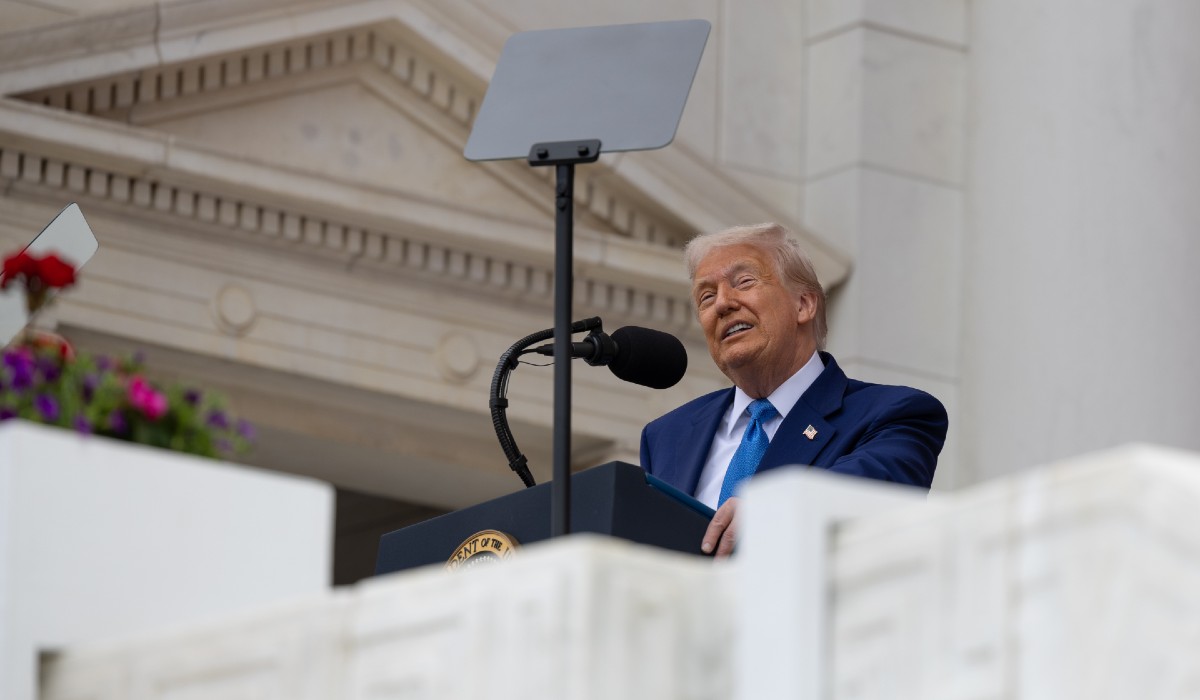
 National Memorial Day Observance in Arlington National Cemetery, Virginia on May 26, 2025 / Wikimedia Commons / CC BY 2.0
The vague statements emerging from the G7 pre-summit meeting suggest that few concrete answers to Trump’s upending of the international order will be forthcoming, argues John Clarke
Last week, the leading finance officials of the G7 countries met in Banff, Canada as a prelude to a full summit that will be held next month. Their final communique presented the usual upbeat formulations that we have come to expect from such gatherings.
‘After 50 years of working together, transcending national differences and promoting global prosperity, the value of the G7 is clear. We held a productive and frank exchange of views on the current global economic and financial situation, the risks and opportunities common to our countries, and ways to address them,’ the communique read.
Despite such language, however, there was a distinct lack of clarity, when it comes to ‘the role of the G7’ and much else besides as the international order struggles to come to terms with the America First turn of the Trump administration. The conditions of global trade war, the splintering of international alliances and the redefining of the US role in the world have all created a great deal of instability and uncertainty.
Damage control
Canada’s Finance Minister François-Philippe Champagne gamely declared that the ‘best proof of unity is that we have a joint communique.’ According to the CBC, Champagne also informed the media that the assembled officials ‘found common ground on issues including combating financial crime and support for Ukraine in its war against Russia.’
The final statement that was issued by this high-powered gathering, however, ‘made no mention of the sweeping tariffs initiated by the United States, which continue to send shock waves through the global economy.’ This vital issue might perhaps have taken priority over ‘combating financial crime,’ yet this was clearly not the case.
It seems that tariffs ‘were widely viewed as the elephant in the room heading into the meeting.’ Champagne said they were discussed but offered limited details on the ‘constructive dialogue’ that he claimed took place. While the finance minister insisted that he ‘got along well’ with US Treasury Secretary Scott Bessent, he remained tight lipped on whether any change in the US turn to protectionism and the increased use of tariffs was being considered.
Bank of Canada governor Tiff Macklem, who co-chaired the summit with Champagne, was slightly more candid. He acknowledged that ‘the discussion very much did include a focus on improving the dialogue around tariffs.’ He also told reporters that ‘many businesses have paused investments due to tariff uncertainty, and the Canadian economy is showing signs of weakness through the first two quarters of the year.’ He continued, ‘Where we go from there, I think, really depends on what happens to tariffs … if we can get that clarity, we can get back to growth. If things go in the other direction, yes, things will be worse.’
European Central Bank President Christine Lagarde bluntly acknowledged that ‘international trade will never be the same again’ after the turn to trade-war tactics by the US. She suggested that a ‘complete review of relationships, of trust, of diversification of sources and destination of both products and services’ was now underway.
Taking aim at the Trump administration, Lagarde also expressed the view that ‘our collective objective should be, first and foremost, remove the uncertainty. Second drive to negotiate and agree on rules of the game that will be favourable for all parties, not just for one party.’
It was precisely the question of whether it will be possible to set mutually acceptable ‘rules of the game’ that hung over the meeting in Banff like a sword and that continues to aggravate international dealings. When the full G7 summit takes place from 15-17 June, it is very unlikely that the volatile presence of Donald Trump will increase the prospects for resolving this impasse and restoring a level of stability to world trade.
The G7 has been, of course, an alliance between the US and its leading junior partners. The six other member countries have long accepted the leadership role of the US, while functioning as global exploiters in their own right. The particular impacts of the America First approach the G7, however, are occurring within a broader context of international destabilisation.
At the time of Trump’s return to power in January, there was widespread consternation in diplomatic circles over the implications of his presidency for the UN. In an article for Counterfire, I noted at the time that like ‘all other US presidents, he will be ready to act unilaterally, but without the usual desire to keep up diplomatic norms or the appearance of multilateralism.’ Trump’s dictates and deal making on the world stage are being pursued with very little regard for the trappings of international consensus.
Even Nato finds itself dealing with a vastly altered landscape, as Beyond the Horizon has pointed out. It notes that ‘President Donald Trump’s return to the White House in January 2025 has brought a series of abrupt policy shifts that are reverberating across the NATO alliance.’
It adds that perhaps ‘the most jarring change has been President Trump’s open equivocation on NATO’s Article 5 mutual defense guarantee. In a break from over 70 years of U.S. policy, Trump has explicitly cast doubt on whether the United States will honor the pledge to defend any and all NATO allies if they are attacked. “If they don’t pay, I’m not going to defend them,” he told reporters bluntly in March, referring to allies he views as spending too little on defense.’
For decades, it would have been inconceivable for a US president to call into question the inviolability of Article 5 but Trump has done this and very much more. The key allies and partners-in-crime of the US are suddenly having to deal with a change they didn’t see coming. Trump’s administration is undertaking the most fundamental US strategic shift since the end of the Second World War and the complete refashioning of a world order that has held sway for an entire human lifetime.
Pragmatic shift
Under Trump, the decisions that the US takes will be based on pragmatic considerations of immediate gain, with the longstanding concept of US ‘world leadership’ put aside. Unquestionably, this approach reflects the fact that the dominant position of the US, while still formidable, is weakening considerably in the face of global rivalry, especially from China.
To the Trumpians, it seems that an unfair burden of responsibility is being unloaded to the advantage of the US but the America First turn creates enormous difficulties and vast uncertainties for global capitalism. The trade-war methods that flow from this new ‘transactional’ way of operating have been an especially sharp shock. The G7 may meet and issue positive communiques that prattle on about common goals and unified approaches but the alliance is still rudderless for all that.
As the country that will be hosting the next G7 Summit, Canada, with its massive trading relationship with the US, is in a particularly vulnerable position. Prime minister Mark Carney, having just won a federal election, chose to open the session of the new parliament by taking the unusual step of bringing King Charles across the Atlantic to deliver the Throne Speech. The text of the speech reflected the period we have entered.
Charles spoke of ‘a new economic and security relationship between Canada and the U.S., rooted in mutual respect and founded on common interests, to deliver transformational benefits for both sovereign nations.’ At the same time, however, he stressed that the Canadian government is ‘working to strengthen its relationships with reliable trading partners and allies around the world, recognizing that Canada has what the world needs and the values the world respects.’
The speech even included an assertion that ‘Canada is ready to build a coalition of like-minded countries that share its values, that believe in international co-operation and the free and open exchange of goods, services, and ideas. In this new, fast-evolving world, Canada is ready to lead. This will be demonstrated in June, when Canada convenes the G7 Summit.’
Like the other G7 allies of the US, Canada’s ruling establishment is struggling to respond to the America First turn. The hope is that terms can be secured with the Trump administration but, at the same time, new trading relationships are being sought out and a vague notion of some ‘coalition of like-minded countries’ that can create a viable alternative to US global leadership is emerging.
The upcoming G7 summit may involve a level of confrontation with Trump or it may simply be a bland exercise that leaves the real questions unanswered. We may be certain, however, that it won’t solve the crisis in international trading relations. The America First turn and the contradictions that underlie it have generated highly dangerous and unstable conditions for global capitalism for which no immediate remedy is at hand.
Before you go
The ongoing genocide in Gaza, Starmer’s austerity and the danger of a resurgent far right demonstrate the urgent need for socialist organisation and ideas. Counterfire has been central to the Palestine revolt and we are committed to building mass, united movements of resistance. Become a member today and join the fightback.

John Clarke
John Clarke became an organiser with the Ontario Coalition Against Poverty when it was formed in 1990 and has been involved in mobilising poor communities under attack ever since.