
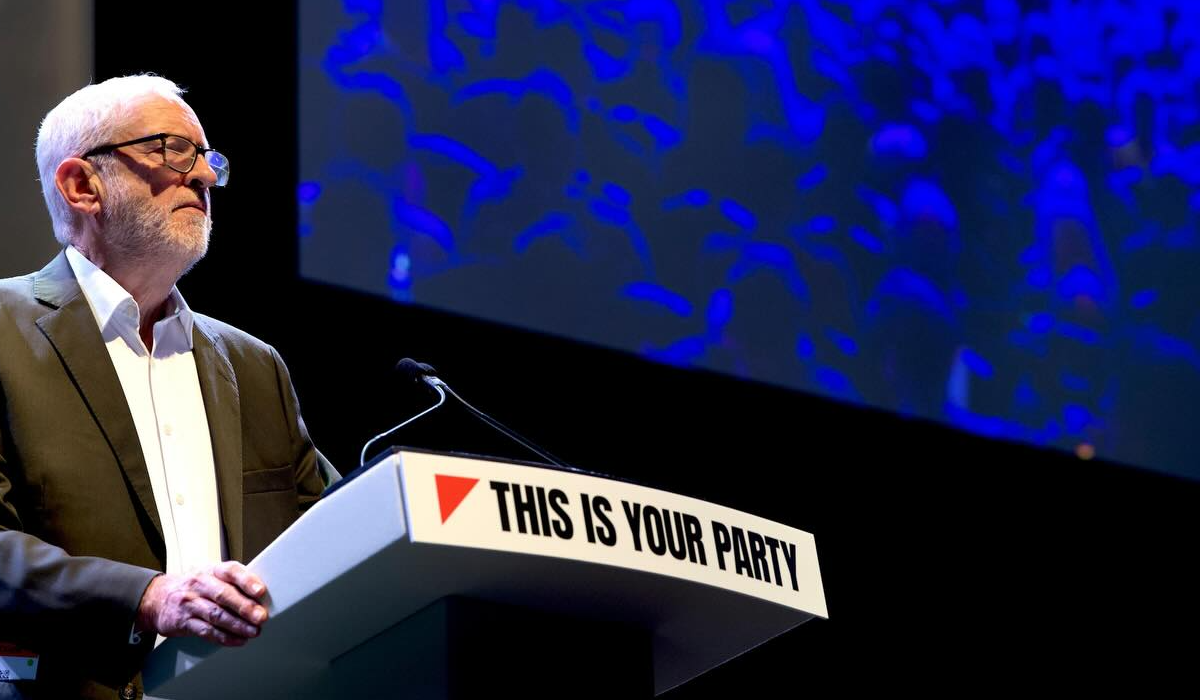
 Jeremy Corbyn at Your Party’s founding conference in Liverpool, November 2025. Photo: Facebook/Jeremy Corbyn
Lindsey German on the new initiative’s fledgling steps
The Your Party conference was double edged: there were many impressive socialists and campaigners there, wanting to build a real alternative to the disastrous policies of the Starmer government and provide a focus for discontent which can otherwise go to Reform. In the week following a budget which will make working-class people worse off, and a retreat on day-one rights for workers over unfair dismissal, there isn’t a better and more urgent time to meet.
The downside however was that the conference was beset with problems, many of them caused by the very limited levels of debate on important political issues, and a tendency to compress political differences into constitutional and other amendments which narrowed debates. It was a conference where those attending could only debate on specific amendments which were selected for us to discuss. There was also a lot of discontent with the process of sortition which selected those who could attend the conference supposedly randomly, and with the lack of democracy in many of the local assemblies which marked what there was of pre-conference discussion.
But some of the problems were caused completely unnecessarily by sections of the leadership. The decision to expel a number of SWP members, refuse entry to several Counterfire members and to an adviser of Zarah Sultana the day before the conference was a spectacular own goal which rebounded on those responsible. It was politically and personally indefensible (those accused found out as they were travelling to Liverpool for the conference). It also ensured that the vote which allowed parties and groups that were not electoral rivals to be members of YP was almost certainly bigger than it otherwise would have been.
The attempt to bar and witch-hunt left-wing organisations is in the worst tradition of Labour’s right and should not be used in YP. It is an attempt to use administrative methods to silence debate. It is also a denial of the role of the far left in British politics. This left has been at the centre of – and very often created – some of the most important campaigns in our history: the Anti-Nazi League, the poll tax campaign, the Stop the War Coalition, the Palestine campaign, anti-racism and anti-fascism more generally from Cable Street on. Eleanor Marx and Edward Aveling were involved in the founding of the Independent Labour Party, encouraged by Frederick Engels, and the Marxist SDF was in at the formation of the Labour Party.
The activities and organisation of the left have often been in the teeth of opposition from the Labour leadership. These left-wing organisations have always been in a minority but have often won their political ideas, because they are able to prove in practice that they are right.
The ban – effectively reversed by the vote on dual membership – contributed to the signs of deep division in the party and meant that it was not able to draw the line under months of conflict between Jeremy Corbyn and Zarah Sultana. This was clear from the decision – mistaken I think – by Sultana to boycott the first day of the conference in protest at the ban. It was also clear from the body language of both.
There are political differences for sure, but not ones that can’t be accommodated in a potentially mass party like YP. However, there was clearly great frustration and some anger at the lack of involvement of the members, the avoidance of debate and the refusal by much of those organising the conference to accept any challenge to them.
So the left won decisively on most issues, and narrowly on the question of a collective rather than individual leadership. This should be a time when everyone agrees to move forward on the basis of democratic decisions. I’m not confident that is going to happen on either side – Sultana’s speech was powerful and well-received but while she apologised for mistakes she had made, she also made clear how angry she was about things that had been happening. Fair enough, but it didn’t sound as if a line was being drawn under those debates after conference had decided a number of issues in her favour.
The vote for collective leadership is often framed as a victory for Sultana, and obviously she supported the proposal in advance. But in reality it is a victory for the politics of the majority of members who are fed up with the infighting, manoeuvring and press briefings (still much in evidence at conference) and who want a democratic structure that doesn’t just place its trust in any one leader. It is also a sign that much of the membership wants a clearly left, working-class organisation with principled politics, not a Labour Party mark 2.
What now? The divisions are clearly there, epitomised by the failed attempt of some around Jeremy Corbyn to lobby to reject the constitution because it had been amended to provide for a collective, not individual, leadership. Had it succeeded, it would have blown up the whole project. It is likely that there will be attempts to row back from or not implement certain decisions. That is unacceptable and members will have to fight to ensure their voices are heard.
The urgent task is for the local branches to be properly formed and to decide their priorities, to elect a new leadership and to start campaigning around issues, including the May elections. The factionalism at the top has to end and should not be imported into local organising. My sense is that most members want to positively engage and work together. There is a widespread and correct feeling that we have only this chance, given the scale of attacks we are facing.
At the same time, the far left has a responsibility. I think it is still possible to build a mass Your Party, which reaches out to working-class people to win them towards left-wing ideas. That means we have to patiently explain, as Lenin once said, our politics, rather than denouncing anyone who disagrees with even 10% of them. I’m particularly concerned here with the attitude of some towards the Muslim community, now dubbed as ‘socially conservative’ and written off. The rift needs to be healed quickly if we are not to squander the very good work between the left and the Muslim community which has been a mark of the anti-war and Palestine movements.
So the jury’s still out. But the left is in there fighting, and we need to continue.
This week: I have a lecture on imperialism, lunch with my old school friends, a Stop the War groups meeting, and a visit to Othello with David Harewood and Toby Jones.
Before you go
The ongoing genocide in Gaza, Starmer’s austerity and the danger of a resurgent far right demonstrate the urgent need for socialist organisation and ideas. Counterfire has been central to the Palestine revolt and we are committed to building mass, united movements of resistance. Become a member today and join the fightback.

Lindsey German
As national convenor of the Stop the War Coalition, Lindsey was a key organiser of the largest demonstration, and one of the largest mass movements, in British history.
Her books include ‘Material Girls: Women, Men and Work’, ‘Sex, Class and Socialism’, ‘A People’s History of London’ (with John Rees) and ‘How a Century of War Changed the Lives of Women’.