
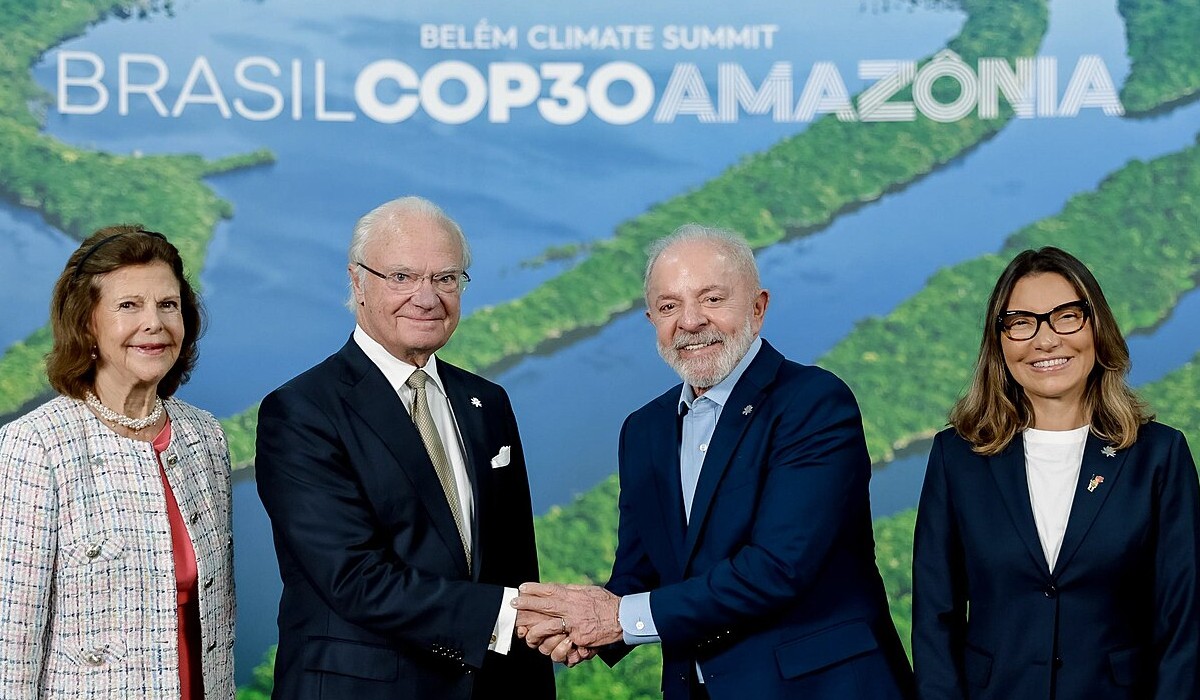
 President of Brazil Luiz Inácio Lula da Silva with Silvia and Carl XVI Gustaf of Sweden at COP30. Photo: Lula Oficial / Wikimedia Commons / CC BY-SA 4.0
The Cop summits have long been dominated by fossil-fuel interests, and expecting them to achieve meaningful change is a dangerous illusion, argues John Clarke
The Cop30 UN climate summit is underway this week in the Brazilian city of Belém. Given its purpose, it is bitterly ironic that, as the BBC explained, a ‘new four-lane highway cutting through tens of thousands of acres of protected Amazon rainforest’ was constructed, in order to deal with the ‘more than 50,000 people – including world leaders’ who will attend the prestigious gathering.
Organisers hope that this year’s summit can restore some of the credibility that the Cop process has lost in recent years. There is no doubt that these international forums face major challenges when it comes to demonstrating that they are anything more than futile talking shops with very big carbon footprints.
Not fit for purpose
Last year’s Cop gathering took place in Azerbaijan and the country’s president created a major embarrassment when he told the assembled delegates that ‘natural gas was a “gift from God” and he shouldn’t be blamed for bringing it to market.’ This note of scandal was compounded by revelations that ‘a senior Azerbaijani official appeared to have used his role at COP to arrange a meeting to discuss potential fossil fuel deals.’
To make matters worse, a group of prominent people who had long been associated with the Cop initiative issued an open letter calling for major reforms in the planning and organising of the summits. They went so far as to argue that the point had been reached where the climate talks were ‘no longer fit for purpose.’
When it comes to the effort to set a new tone at Cop30, two important issues must be addressed. Firstly, we must consider just how meaningful the changes being put into effect at Cop30 really are. At the same time, the relevance and likely impact of the meeting and the decisions that arise from it must be evaluated.
While Brazil’s president, Luiz Inácio Lula da Silva, may be ready to tell the world leaders attending Cop30 that, ‘Earth can no longer sustain the development model based on the intensive use of fossil fuels,’ the host government faces its own contradictions when it comes to the threat of global heating.
Brazil is already the eighth largest oil producer in the world and, as a CBC report informs us, the country ‘is on the cusp of another oil boom, if deposits are confirmed in the Foz do Amazonas basin, part of it 500 kilometres from the mouth of the Amazon River.’ As the summit gets underway, ‘Brazil’s state-owned oil company Petrobras has just begun exploratory drilling 170 kilometres off the Amazonian coast.’ Lula’s government is facing considerable criticism from Brazilian climate activists because of this.
A different approach to the summit proceedings has been developed. The Guardian explains that ‘the host is resisting calls to end the Cop by gavelling through the usual “cover decision”, a document agreed by all parties that brings together numbered resolutions on many of the disparate strands of the climate crisis.’
In place of this, an Indigenous-based concept of the mutirao will be utilised, which involves ‘a community coming together to work on a shared task, whether harvesting, building, or supporting one another.’ As valid as such an approach might be in a different context, the ‘community’ that will be jetting into Cop30 is, to say the least, highly unlikely to enter into the ‘shared task’ of environmental protection with any level of sincerity or good faith.
An article in the Guardian, on 7 November, noted that: ‘Last year, 1,773 registered fossil fuel lobbyists attended the summit in Azerbaijan – 70% more than the total number of delegates from the 10 most climate-vulnerable nations combined (1,033).’ It is as if a conference on combatting crime was dominated by representatives of the Mafia.
While, no doubt, there will be delegates to the Cop30 summit who genuinely want the climate crisis to be addressed, we may be sure that the delegates from the oil and gas companies and the political leaders who serve their interests will control the process decisively and ensure that nothing is adopted that they find too threatening.
Fundamentally, the entire Cop initiative is based on the concept of a collaborative effort towards self-reform on the part of fossil-fuel capitalism and the very fact that dozens of these gatherings have failed to alter the course the world is on to climate catastrophe is evidence enough that this hope is entirely misplaced. The promises of a greener capitalism that oil and gas executives and some politicians put forward have consistently failed to materialise and the planet is heading for an environmental reckoning.
The yearly Cop summits should be decisively rejected as any kind of meaningful solution to the climate crisis. In practice, they have provided camouflage for the fossil-fuel interests and their political agents, enabling them to pretend that they are interested in climate solutions, even as they drill for oil and gas and continue to profit from environmental degradation. However, we have now entered a period where even this function may no longer be viable.
Return of Trump
The return of Trump to the White House was a green light for jettisoning pretences on climate change and global heating. Trump himself, rather predictably, won’t attend the summit and CNBC reports that the ‘White House has confirmed it does not intend to send any high-level representatives to the summit, marking an unprecedented absence of U.S. officials at the conference.’
Trump recently used an address to the General Assembly of the UN to proclaim that: ‘This “climate change”, it’s the greatest con job ever perpetrated on the world, in my opinion. All of these predictions made by the United Nations and many others, often for bad reasons, were wrong. They were made by stupid people that have cost their countries fortunes and given those same countries no chance for success. If you don’t get away from this green scam, your country is going to fail.’
Taking full advantage of this change of course by the White House, the major oil and gas companies have moved to ditch climate-related commitments. In March, the Grist reported that British Petroleum had slashed $5 billion (£3.9bn) in green energy investments, with other major companies taking similar decisions.
However, the article stressed that the really harmful element of this changed approach was a series of decisions to increase fossil-fuel production massively. In the case of BP, the ‘company is now aiming to produce 2.4 million barrels per day of fossil fuels by 2030, which is a 60 percent jump from its 2020 target.’
In this harsh light, the effort to restore some credibility for the Cop summits takes on the dimensions of a forlorn hope. The endless round of useless meetings has disappointed and frustrated those who seek genuine climate solutions, while the dominant sections of the power structure have lost interest in even pretending that they working for this objective.
In such a situation, the focus shifts away from jet-fuelled international conferences. We see all around us the results of the present 1.1C of global heating and the world is on track to reach 2.8C by the end of the century, with unimaginable impacts taking effect as the process intensifies.
Those responsible for this situation have no intention of averting climate disaster and the capitalist system they represent is totally at odds with responsible environment stewardship. Summits like Cop30 can’t overcome that harsh reality and illusions in their effectiveness are highly dangerous.
News has just broken of an action at the gathering in Belém in which Indigenous people tried to enter the UN compound where the international delegates are meeting. As reported in the Guardian, they carried signs that read: ‘Our land is not for sale.’ Nato, an Indigenous leader from the Tupinamba community, stated that, ‘We want our lands free from agribusiness, oil exploration, illegal miners and illegal loggers.’
Though the protesters were ultimately driven back by security personnel, their bold action points to an important conclusion. The destructive path that fossil-fuel capitalism is following can only be effectively challenged by mass working-class action and the mobilisation of those whose lives and communities are impacted by global heating. The Cop summits will change nothing.
Before you go
The ongoing genocide in Gaza, Starmer’s austerity and the danger of a resurgent far right demonstrate the urgent need for socialist organisation and ideas. Counterfire has been central to the Palestine revolt and we are committed to building mass, united movements of resistance. Become a member today and join the fightback.

John Clarke
John Clarke became an organiser with the Ontario Coalition Against Poverty when it was formed in 1990 and has been involved in mobilising poor communities under attack ever since.